 Skip to content


Social Listening vs CX Intelligence: What’s the Real Difference?
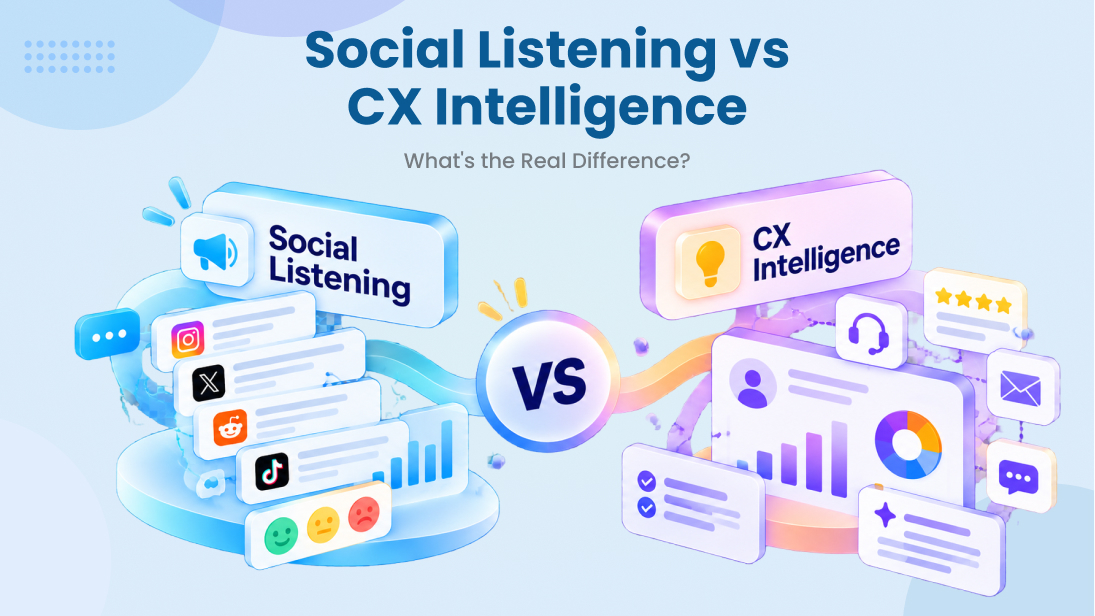
Social listening monitors what is said about you in public and reports on volume, sentiment and share of voice. CX Intelligence answers business questions using every customer conversation you hold, public and private, joined to the systems that give them commercial meaning. One watches a channel and tells you what is happening there. The other reasons across all of them and tells you what to do.
- Social listening is a data source. CX Intelligence is a reasoning layer that uses it.
- Public conversation is a fraction of what customers tell you; the rest is in tickets, calls and chats.
- The output differs: listening produces a report to interpret, intelligence produces a conclusion with evidence.
- Most brands already own both halves of the evidence and have never joined them.
- Social listening remains essential. The mistake is treating it as the whole picture.
Where the Confusion Comes From
Social listening let brands hear customers without asking them, and for years it was the most accessible place to read unprompted customer opinion at scale. So it inherited the job of representing the voice of the customer inside most organisations.
That inheritance is the source of the confusion. Social listening represents the public fraction of the voice of the customer. It is a real fraction and often the loudest one, but it is not the whole, and the part it misses is usually the part with commercial consequences attached.
Think about who ends up in a listening tool. People who were angry enough, or delighted enough, to post publicly. Now think about who ends up in your ticketing system, your call recordings, your chat logs. Everyone who tried to do something and needed help. That second group is larger, more representative, and attached to an account record.
“Nobody wakes up wanting more data. They wake up with questions.”
A listening dashboard answers “what is being said about us.” A CX Intelligence layer answers “why are customers leaving,” “what should we build,” “which competitor gap is open.” Those need the private half too.
The Four Differences That Matter
Coverage. Listening reads public channels. CX Intelligence reads public channels plus tickets, calls, chats, emails, reviews and survey verbatims, against one customer record. The same person complaining on Instagram and calling your helpline is one story, not two data points.
Commercial context. A listening tool knows a handle. An intelligence layer connected to your CRM knows that handle belongs to an account worth a known amount with a renewal in nine weeks. That turns a sentiment score into a prioritised action.
The output. Listening returns a visualisation and leaves interpretation to you, which is why two teams read the same sentiment dip and reach opposite conclusions. Intelligence returns a conclusion, states its reasoning and cites the conversations underneath it.
The question. Listening answers questions you configured in advance: these keywords, these competitors, these topics. Intelligence takes questions nobody set up, including the follow-up question, which is usually where the value sits.
What Each Is Genuinely Good For
This is not an argument for replacing listening. It is an argument for being precise about jobs.
Use social listening for brand health tracking over time, campaign amplification measurement, influencer and advocate identification, competitor share of voice, and crisis detection in public channels. These are real jobs it does well, and an intelligence layer without good listening underneath it is reasoning with a blind spot.
Use CX Intelligence for churn causes, product and roadmap demand, competitive gaps described by your competitors’ own customers, account risk, and the board-level questions that cross functions. These need both halves of the evidence and systems beyond CX.
The practical relationship. Listening is one of the inputs to intelligence, along with your ticketing, your calls and your CRM. A company with listening but no intelligence layer has one eye open. A company with an intelligence layer and no listening has the other eye open and misses everything happening where it does not operate.
What This Looks Like in Practice
A sentiment dip with no explanation. Listening shows negative sentiment up six percent week on week. Intelligence identifies which narrative is driving it, whether it is spreading or contained, which audience is amplifying it, and that it correlates with a policy change shipped nine days earlier.
A complaint theme that looks small. Public volume on one issue is modest. Joined to ticket data, the same theme is the second largest driver of contacts, and joined to CRM data it concentrates among the accounts with the highest renewal value.
A competitor insight listening cannot complete. Listening shows competitor customers complaining about a capability. Intelligence sets that against your own service conversations and tells you whether your customers describe the same gap, which decides whether it is a positioning opportunity or a category-wide weakness.
A quiet churn cohort. The customers who left without ever posting publicly are invisible to listening entirely. They are visible in engagement decline and support history.
How Konnect Insights Approaches It
Konnect Insights builds both layers, which is why the distinction matters here rather than being a marketing device.
Social listening across 30+ channels sits inside the platform alongside omnichannel ticketing, social CRM, publishing and quality assessment, unified on one customer record across 500+ enterprise brands in 35+ countries. That unification is the part most organisations lack: listening in one tool, service in another, no join between them.
KRC is the reasoning layer on top. It reads the public and private conversation as one body of evidence, extends through MCP into CRM, contact centre and marketing systems for commercial context, and answers questions in plain language with the underlying conversations attached.
The honest summary: if you only have listening, you are seeing the public fraction and guessing at the rest. If you have both and nothing reads across them, you have the evidence and no answer.
Frequently Asked Questions
Author


