

What Should Land on a CMO’s Desk Every Monday?
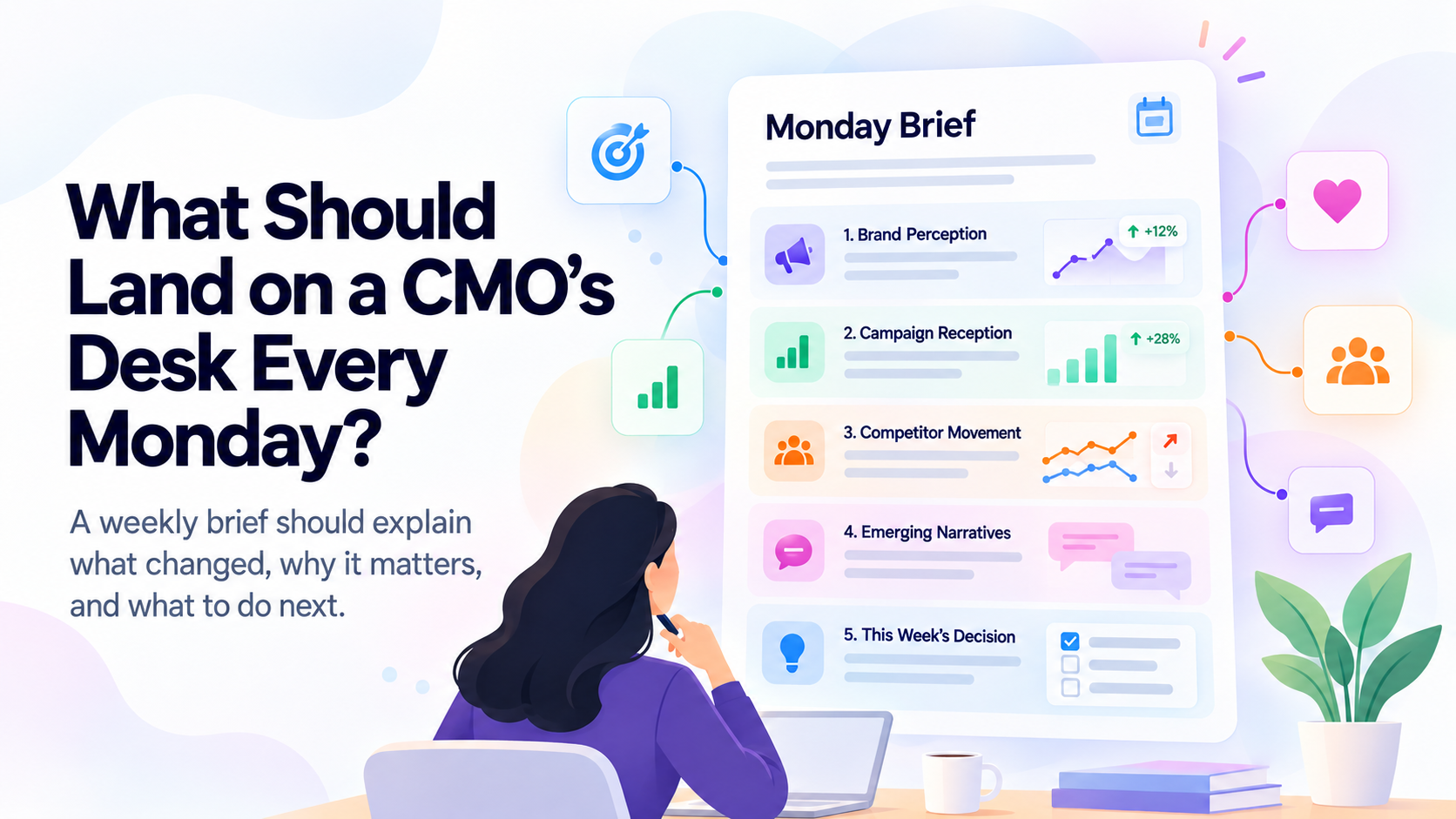
A CMO’s Monday brief should carry five things: what moved in brand perception and why, how last week’s campaigns landed in customer conversation, what competitors did and how the market responded, which narrative is forming before it becomes a story, and the one decision needing attention this week. Numbers without reasons do not qualify.
- Most marketing reporting answers what happened. A CMO needs to know what it means and what to do about it.
- Brand perception without a reason attached is an anxiety generator, not intelligence.
- Campaign performance measured only in delivery metrics misses how the campaign was received.
- Competitive intelligence belongs in the weekly brief, not in a quarterly deck.
- The brief should be readable in under five minutes and should end with a decision, not a dashboard link.
The Monday Test
Here is a test worth running on your current marketing report. Open it on a Monday morning with eleven minutes before your first meeting. Can you tell, from the top of the document, what changed last week and what you should do differently this week?
Most fail. Not because the data is wrong, but because it was assembled to demonstrate activity rather than to inform a decision. Impressions, reach, engagement rate, sentiment score, share of voice. All real. None of them answers the only question a CMO actually arrives with on Monday: what should I change.
“Not a dashboard. Not a report. You just ask. In plain language. The way a CEO would ask a trusted advisor.”
A trusted advisor does not hand you forty numbers. They tell you the three things that matter, why they happened, and what they would do.
The Five Things
One: what moved in brand perception, and why. Not the sentiment score. The reason behind it. If perception softened among a specific audience, the brief should say which audience, what they are saying, when it started and what preceded it. A number that moves without an explanation produces a meeting where everyone guesses.
Two: how last week’s campaigns landed in customer conversation. Delivery metrics tell you the campaign went out. They say nothing about reception. The brief should connect campaign timing to what customers then said and did: complaint themes that appeared after a send, questions a message created, the gap between what the creative promised and what service could deliver. The most expensive marketing failures are campaigns that performed well on delivery and badly in the inbox of the contact centre.
Three: what competitors did and how the market responded. Weekly, not quarterly. A competitor launch, price move or public stumble has a response window measured in days. More useful than what they did is how their customers reacted, because a competitor’s unhappy customers describe your positioning opportunity more precisely than any research project will.
Four: which narrative is forming. Every brand crisis was a small conversation first. The brief should surface themes gaining velocity while they are still small, with the audience quality assessed rather than just the volume. Forty mentions from influential accounts in a core market deserve more attention than four thousand from outside it.
Five: the one decision that needs you this week. A brief that ends in information is incomplete. It should name the single thing that requires a CMO call, state the options and say what the recommendation is. If there is genuinely nothing, say so, which is itself useful.
What to Cut
Vanity volume. Total mentions and total reach belong in a quarterly review, not a weekly decision document.
Unexplained scores. Any metric that cannot be accompanied by a reason should move to an appendix. A sentiment score with no cause attached generates speculation, and speculation fills meetings.
Last week restated. If a number has not meaningfully changed, it does not need a paragraph. The brief is about change.
Channel-by-channel breakdowns. Customers do not experience channels. A theme that appears across four channels is one finding, not four.
Why It Rarely Exists Today
The brief described above is not hard to specify. It is hard to produce, for a structural reason.
Each of the five items needs evidence from a different place. Perception sits in listening data. Campaign reception sits in the marketing platform and in the ticketing system. Competitive response sits in public conversation. Narrative formation sits in social data read over time. The decision needs all four joined.
In most organisations those live in separate tools owned by separate teams, so producing the brief means a human spending two days assembling it. Which is exactly why, in practice, it gets produced before a board meeting and not on a Monday.
How Konnect Insights Approaches It
This is the problem Pulse was built for inside KRC. It ships a CMO template that runs against the omni-channel record, the social listening data across 30+ channels and whatever systems are connected through MCP, and surfaces what changed for that reader without anyone assembling it manually.
The structure above is close to what the template produces, because it came from asking marketing leaders what they actually open. Teams adjust it, which matters, since the priorities that belong in a telecom CMO’s brief are not the ones that belong in a bank’s.
The reason this is possible at all is the breadth underneath it. Campaign reception cannot be assessed from marketing data alone; it needs the service conversations that followed. Competitive response needs listening data with real depth, including contractual access to X. A brief is only as good as the evidence available to the system writing it.
Frequently Asked Questions
Author