 Skip to content



One Platform, Five Different Readers
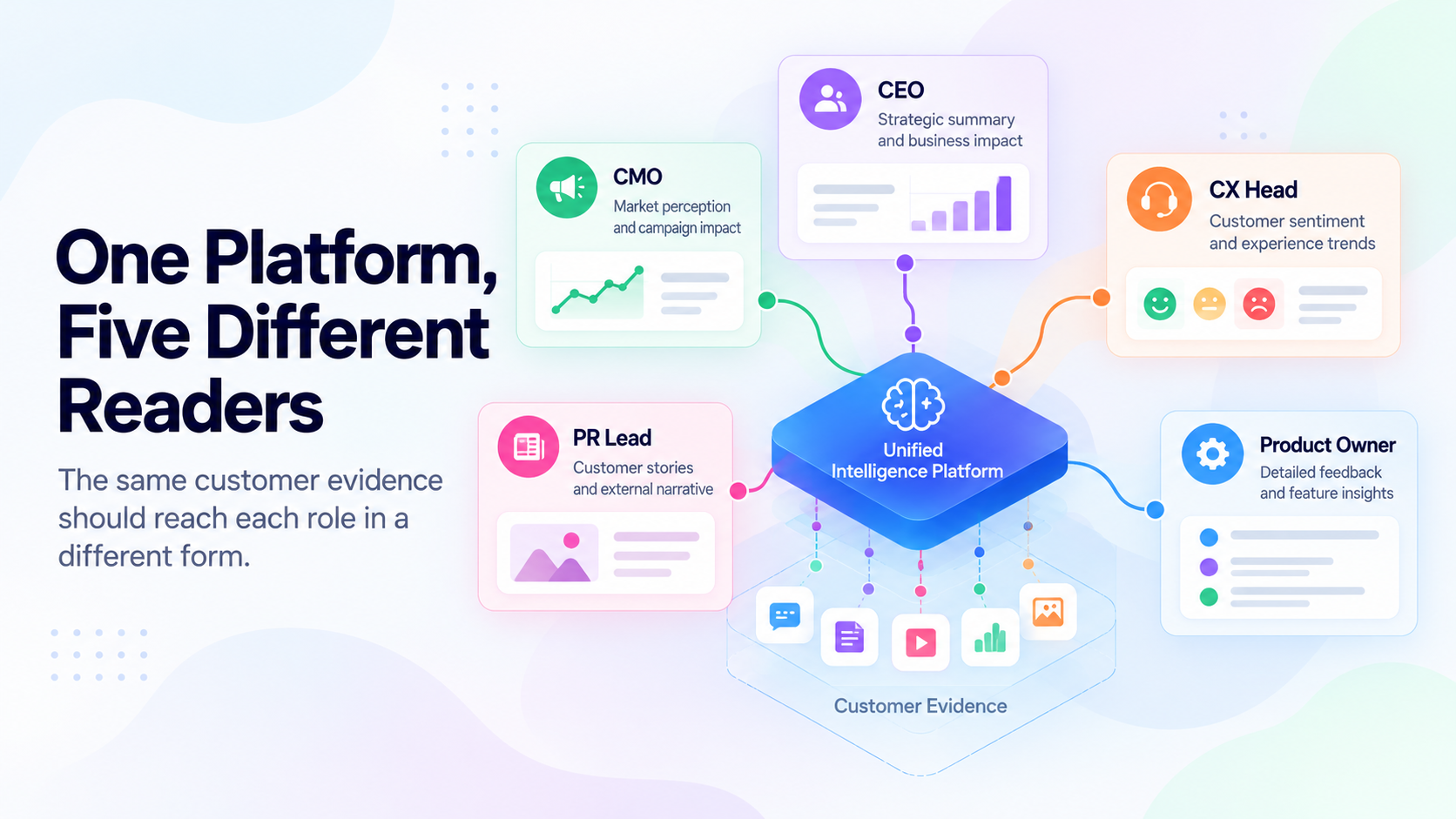
The same customer data should reach a CEO, CMO, CX head, PR lead and product owner in five different forms. Each has a different decision to make, a different time horizon and a different threshold for acting. One shared report forces four of them to translate. Role-specific intelligence removes that translation step.
- A single CX report is usually written for one reader and tolerated by the rest.
- The difference between readers is not detail level. It is which question they are trying to answer.
- Time horizon varies from minutes for PR to quarters for product, from the same underlying data.
- The cost of a shared report is silent: people stop reading rather than complain.
- Role-specific views work only when they are driven from one body of evidence, not five separate tools.
The Shared Report Problem
Most organisations produce one monthly CX report. It is circulated widely. It is read properly by about one person.
That is not laziness. The report was written for a particular reader, usually whoever commissioned it, and everyone else is doing translation work to find their part. The product owner scrolls past brand sentiment looking for feature signals. The PR lead scrolls past SLA attainment looking for narrative risk. The CEO reads the first page and asks a question the report cannot answer.
Nobody complains, because the report is not wrong. It is simply not addressed to them, so they quietly stop reading and ask a person instead.
“One interface. Every platform. All the intelligence.”
One interface is the right goal. One output is not. The platform should be shared. What it produces should not be.
Five Readers, Five Jobs
The CEO. Wants to know what is happening before someone else tells them, and whether anything threatens the plan. Horizon: this quarter. Tolerance for detail: low. Threshold for acting: only what is material. What they need is three things that matter and what each implies, with the ability to ask a follow-up immediately. A CEO given a twelve-page report reads two pages and forms a view from an incomplete picture, which is worse than no report.
The CMO. Wants to know how the brand is perceived, how campaigns landed in real conversation and what competitors are doing. Horizon: this week. The detail needed is narrative and cause rather than metric movement.
The CX head. Wants operational intelligence: what is broken, what is at risk, which complaint themes are growing, where resolution quality is slipping. Horizon: today and this week. This reader does want detail, and is the one person for whom a dashboard genuinely works, because they are monitoring a known process continuously.
The PR lead. Wants to know what is forming before it is a story. Horizon: minutes to hours. Volume matters less than velocity and audience. This reader needs very few things, delivered fast, with the underlying posts attached so they can judge for themselves.
The product owner. Wants demand signals: what customers keep asking for, which workarounds keep appearing, which competitor gaps their own customers describe. Horizon: this quarter and the next. This reader needs patterns aggregated over months, which is the opposite of the PR lead’s requirement from the same data.
Why This Is Not a Permissions Problem
A common response is to build role-based dashboards. Same data, different default views, access controlled by role.
That helps a little and misses the point. The difference between these readers is not which fields they can see. It is which question they are trying to answer and over what period. The PR lead and the product owner may be looking at exactly the same customer conversations, one asking whether this is accelerating right now, the other asking whether this has been consistent for two quarters. A filtered view of the same chart serves neither.
What each needs is a different piece of reasoning performed on the same evidence. That is an analysis task, not a display configuration.
What Makes Role-Specific Intelligence Work
One body of evidence underneath. The moment the CMO’s view comes from a listening tool and the CX head’s view comes from a ticketing tool, the two readers are working from different realities, and the first meeting where their numbers disagree destroys trust in both. Role-specific outputs must be different reasoning over the same data, not different data.
Explicit priorities per role. A role template needs to know what matters to that reader, which is a conversation with the reader, not a default. Most of the value of this approach is created in that conversation.
Different cadences. Minutes for PR. Weekly for the CMO. Daily for the CX head. Quarterly depth for product. Forcing one cadence on all five is the second most common way this fails.
A shared place to go deeper. When any reader wants to follow up, they should land in the same system with the same evidence, so the conversation between them stays grounded.
How Konnect Insights Approaches It
Pulse inside KRC ships stakeholder templates for the CMO, CX head, PR, content and the CEO, and teams define their own, which most do within the first month because the priorities that matter are company-specific.
What makes this work is that all five read the same underlying evidence: the omni-channel customer record, listening across 30+ channels, and whatever CRM, contact centre and marketing systems are connected through MCP. The outputs differ. The source does not. That is the property that keeps a CMO and a CX head from arriving at a meeting with contradictory versions of the same week, which is one of the five questions leaders most often bring to KRC in the first place.
The practical advice from deployments: start with two roles, not five. The templates that work are the ones shaped with the person who will read them, and that attention does not scale to five at once.
Frequently Asked Questions
The one with a decision cycle fast enough to notice the difference quickly. In most companies that is the CX head or the PR lead.
Author


