

Intelligence That Arrives Before You Ask
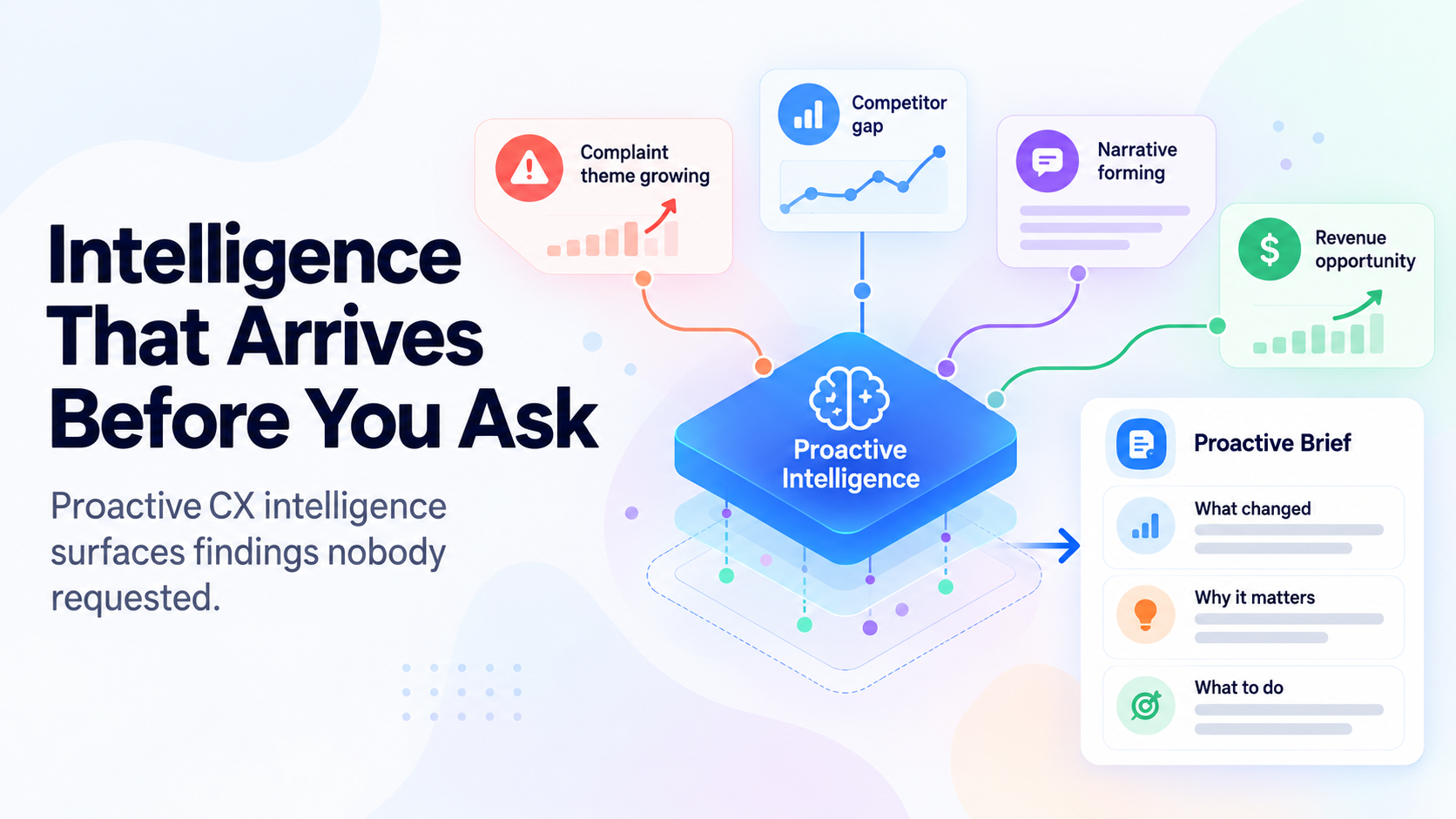
Proactive intelligence surfaces findings without a question being asked. Instead of waiting for a leader to know what to query, the system runs standing analysis against a stakeholder’s priorities and delivers what changed, why it matters and what to do. The shift matters because the most valuable insight is usually the one nobody thought to request.
- Every query-based system shares one blind spot: it can only return answers to questions somebody knew to ask.
- Senior leaders are the least likely people in the organisation to know what to ask, because they are furthest from the raw conversation.
- Proactive intelligence inverts the default. The system carries the burden of noticing.
- This is not alerting. Alerts fire on thresholds you defined. Proactive intelligence finds what you did not define.
- The measure of success is simple: how often does it tell you something you would not have asked for.
The Blind Spot in Every Query System
Natural language querying was a genuine breakthrough for CX. A CEO who could never have written a filter can now ask why customers are leaving and get a real answer, in plain words, with the conversations attached.
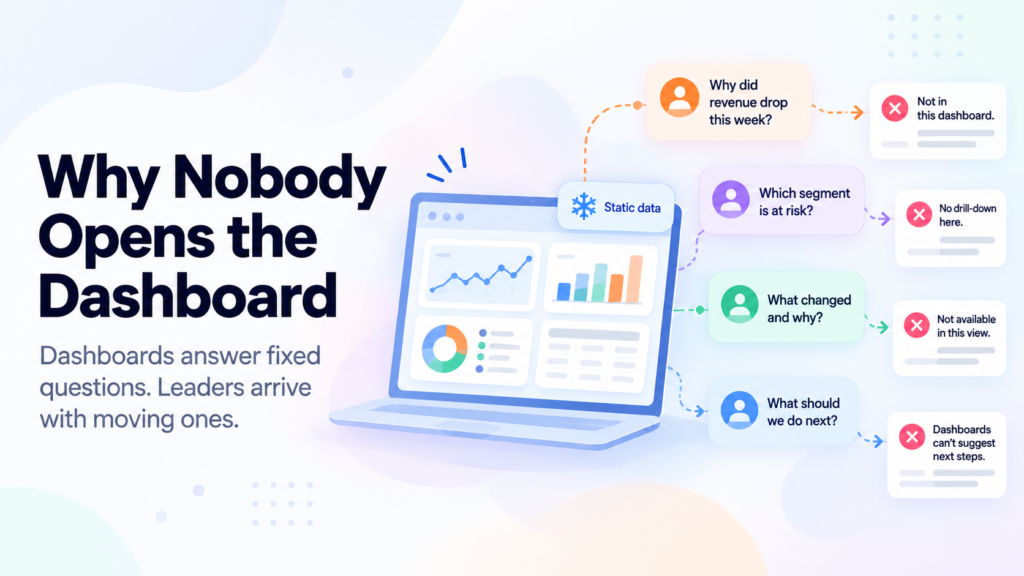
But every question-and-answer system carries the same structural limit. It answers what you ask. It is silent about everything else.
“Nobody wakes up wanting more data. They wake up with questions.”
That line is true, and it is only half the problem. Leaders wake up with questions, yes. The trouble is which questions. The ones that arrive in the morning are the ones already on the agenda: the escalation from Friday, the number the board flagged, the campaign that underperformed. Those are the known concerns.
The things that damage a business are rarely on the agenda yet. A narrative forming in a market you are not watching. A complaint theme growing nine percent a week from a small base. A competitor’s customers describing a gap you could fill, in a forum nobody on your team reads.
None of those generate a question, because nobody knows they are happening. A query system will wait, perfectly capable, while the window closes.
What Proactive Intelligence Actually Does
The mechanism is less exotic than it sounds. Four parts.
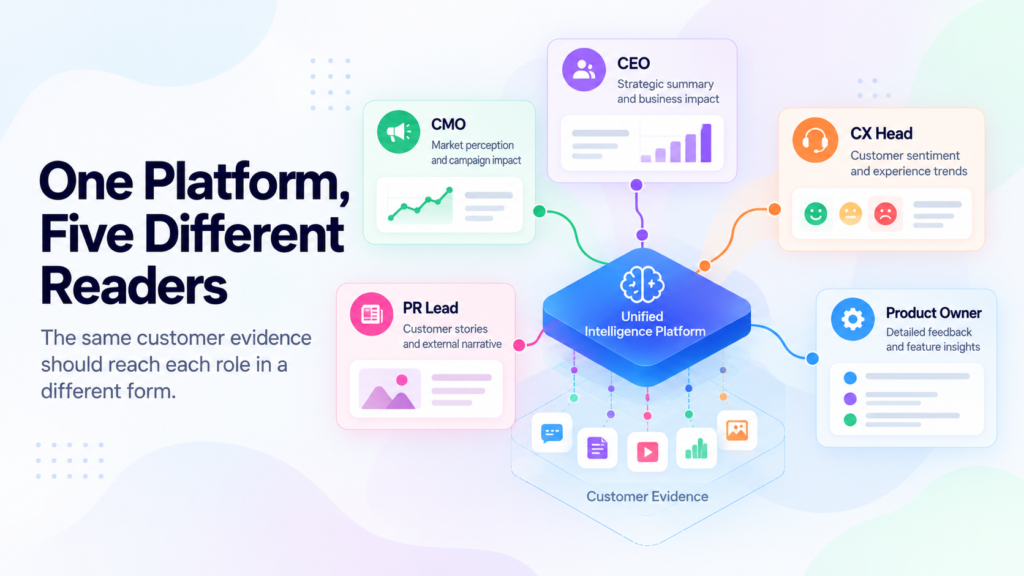
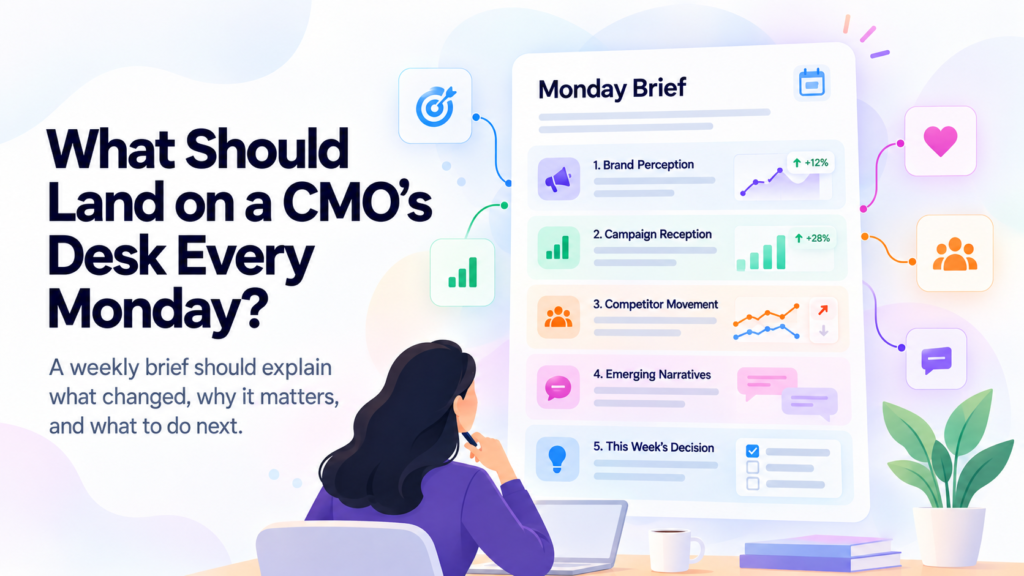
It knows who it is working for. A CMO cares about perception, campaign reception and competitive movement. A CX head cares about resolution quality, emerging complaint themes and operational risk. A PR lead cares about narrative velocity. Without a defined priority set, a proactive system produces noise. With one, it produces a brief.
It runs continuously, not on request. Standing analysis sweeps the full conversation body across public and private channels on a schedule, looking for change rather than state. State is what a dashboard reports. Change is what matters.
It reasons about significance, not just magnitude. This is the hard part and the part most tools get wrong. A spike in volume is not automatically important. Forty mentions of a new issue from customers in your highest-value segment may matter more than four thousand mentions of a known one. Significance is a judgment about consequence.
It explains and recommends. A finding without reasoning is an anxiety generator. The output should say what changed, what is driving it, what is likely to happen next and what the recipient should do, with the underlying customer sentences available to check.
Where It Changes the Outcome
The narrative you caught at day four. A complaint theme about a policy change begins among a small, articulate group. Volume is low, so no threshold fires. A proactive layer flags acceleration and audience quality rather than volume, and PR has a response ready before the first journalist calls.
The product signal nobody owned. Customers keep describing a workaround for something your product does not do. Support closes each ticket correctly. No single conversation looks important. Read together across a quarter, it is the clearest roadmap input you have, and nobody would have queried for it because nobody knew the pattern existed.
The competitor opening. Your competitor’s customers are complaining about something specific. Your own customers are not. That asymmetry is a positioning opportunity with a shelf life, and it never appears in a report about your own brand.
The quiet dissatisfaction. Customers who are unhappy and have not complained are invisible to every reactive system by definition. They show up only as engagement decline, shortened conversations and falling response rates, which is a pattern, not an event.
How Konnect Insights Approaches It
KRC began as the layer you ask. Pulse is the part that does not wait to be asked.
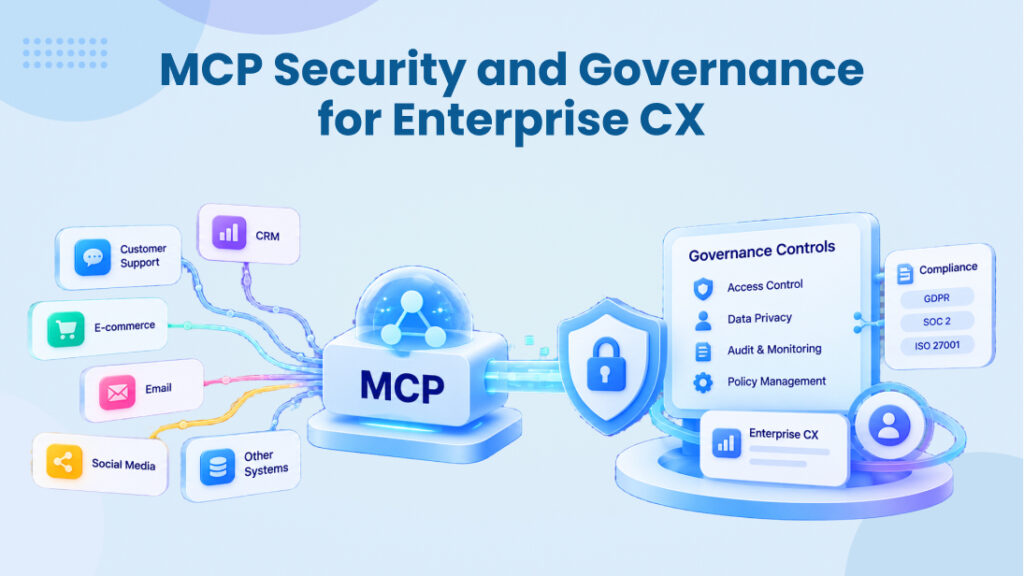
Pulse runs stakeholder templates inside KRC. There are predefined ones for the CMO, the CX head, PR, content and the CEO, and teams build their own, because the priorities that matter are often specific to a company rather than a role. Each template runs against the omni-channel record, the listening data and whatever systems are connected through MCP, and surfaces what has changed for that reader.
The useful discipline it enforces is editorial rather than technical. The question stops being how much can we show and becomes what deserves this person’s attention this week. Most CX tooling has never been asked to make that judgment.
Two honest caveats. A proactive layer is only as good as the priority definition behind it, so the setup conversation matters more than the configuration. And it works on the breadth of evidence available to it, which is why it sits on an omni-channel platform rather than a single channel feed.
Frequently Asked Questions
Author