 Skip to content



What Changes When Insights Arrive Unrequested
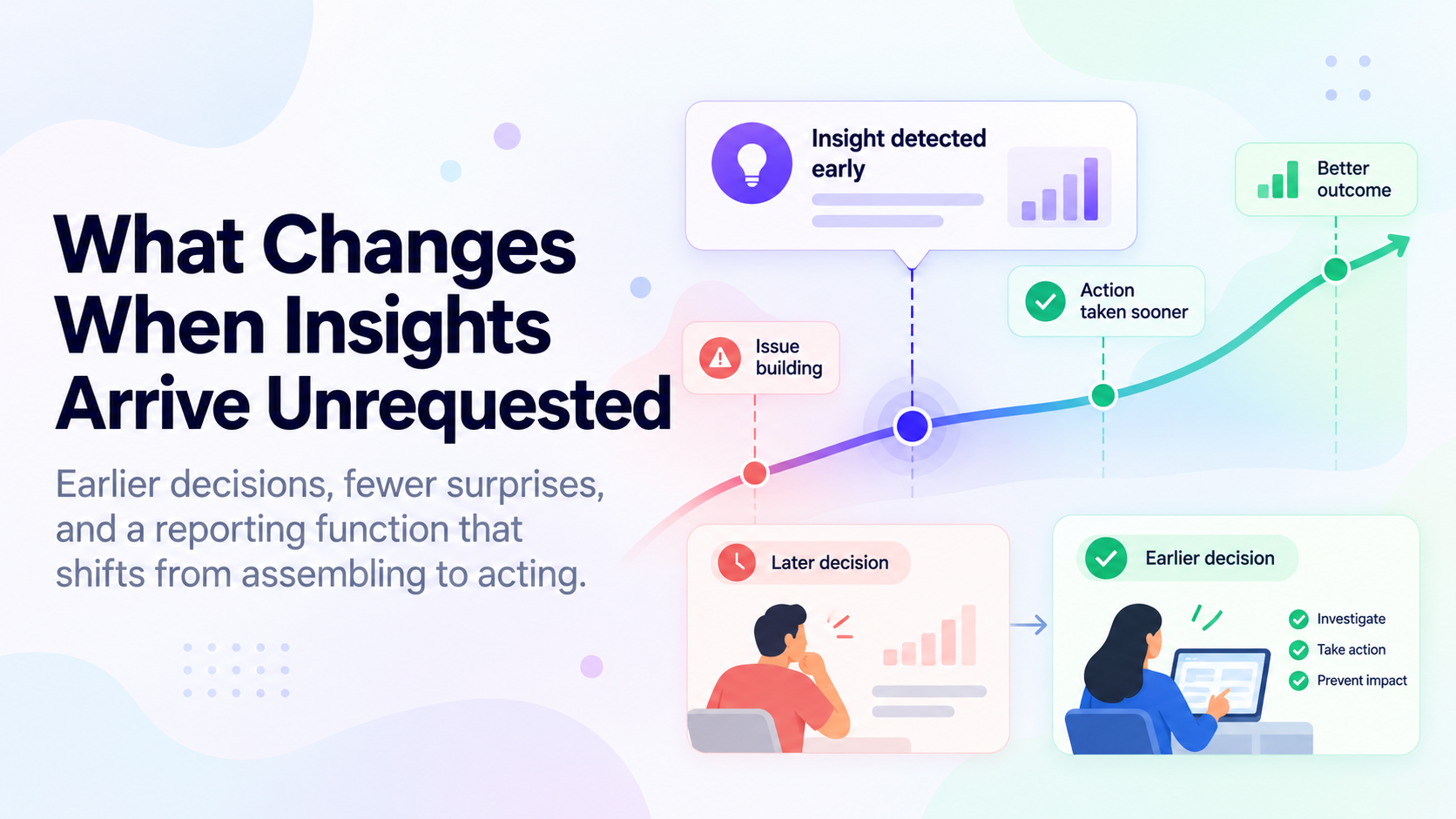
Three things change. Decisions move earlier because problems surface before they are escalated. The reporting function shifts from producing briefs to acting on them. And the organisation stops being limited by whoever happens to ask the best question, which is the quiet constraint most leadership teams never name.
- The biggest change is timing. Most CX decisions today are made at the latest possible moment because that is when the information arrives.
- Reporting teams gain back the majority of their week, and the role has to be redefined or it decays.
- Curiosity stops being a bottleneck, which quietly changes who has influence.
- The failure mode is volume. A proactive channel that is not pruned becomes a channel nobody reads.
- Expect twelve weeks before the behaviour change is visible, not twelve days.
The Constraint Nobody Names
Ask a leadership team what limits their customer intelligence and you will hear about data quality, tooling, integration and headcount. All real.
The constraint nobody names is curiosity. In a pull-based organisation, you find out what somebody thought to ask about. The quality of your intelligence is capped by the quality of the questions being asked, and the people best placed to ask good questions are usually the furthest from the raw conversation.
“CX was operations. That era is ending.”
That shift is not only about CX becoming strategic. It is about removing the dependency on somebody being curious at the right moment about the right thing. When insights arrive unrequested, the organisation stops missing what nobody suspected.
Change One: Decisions Move Earlier
Most CX decisions are made late, and not because leaders are slow. They are made at the moment the information finally arrives, which is usually when something has escalated far enough for somebody to raise it.
A complaint theme typically surfaces to leadership at the point it generates a volume spike, a regulatory question or a journalist’s call. By then the response options are narrow and expensive.
The same theme is visible in customer conversation weeks earlier, as a small pattern with an identifiable cause. Surfacing it then changes the option set entirely. Fixing something quietly is a different, cheaper exercise than responding publicly.
Across deployments, this is the change people describe first, and they describe it in a specific way: fewer surprises. Not better analysis. Fewer surprises.
Change Two: The Reporting Function Changes Job
In most enterprises there is a team whose week is consumed by assembling. Pulling data from four systems, reconciling definitions, building slides, circulating the deck. Smart people spending the majority of their time on preparation and a small fraction on interpretation.
When briefs are produced by the system, that ratio inverts, and this is where organisations either gain a great deal or waste the opportunity.
The teams that gain redefine the role toward interpretation, challenge and investigation. Someone needs to decide whether the system’s finding is right, pursue the follow-ups, understand the commercial context the system lacks and make the recommendation defensible. That is a more valuable job than assembly and a more demanding one.
The teams that waste it leave the role undefined, and within two quarters the team is producing supplementary reports alongside the automated ones, which is the same work with an extra step.
This deserves to be planned before deployment, not discovered after.
Change Three: Who Gets to Notice
This is the subtle one and it shows up in meetings.
In a pull organisation, influence attaches to whoever can get answers. Analysts and whoever controls the reporting queue have unofficial standing, because access to evidence runs through them.
When intelligence arrives to each stakeholder directly, that structure flattens. The PR lead no longer waits for a report to know a narrative is forming. The product owner does not need to commission a study to see a demand pattern. Arguments shift from whose numbers are right to what should be done, which is the better argument to be having.
It also changes expectations. A leadership team that receives intelligence weekly starts asking sharper follow-ups, because they are no longer spending their attention on establishing the basic picture. The standard of discussion rises, which some teams find uncomfortable for a quarter.
What Does Not Change
Worth stating plainly, because proactive intelligence gets oversold.
Judgment. The system surfaces what changed and why. Whether it matters enough to act, given commercial context it cannot see, is a human call.
Accountability. Somebody still owns the response. A finding delivered to five people and owned by none is a finding nobody acts on.
The need to ask. Pulse-style briefs do not remove questions. They change what the questions are spent on, from establishing the picture to pursuing the interesting part of it.
The quality ceiling set by evidence. A proactive layer reading one channel produces confident conclusions from a fraction of the signal. Breadth underneath it is not optional.
How Konnect Insights Approaches It
Pulse inside KRC is the proactive half: stakeholder templates that run standing analysis and surface what changed, for the CMO, CX head, PR, content and the CEO, plus whatever a team defines for itself. KRC remains the place to follow up, in plain language, with the customer conversations attached.
Three things we tell customers before they start, from watching this land.
Start with two stakeholders, not the whole leadership team. The templates that work are shaped with the person who will read them.
Decide what the reporting team does next, before the briefs start arriving. That decision determines most of the value.
Give it twelve weeks. The first fortnight produces interest. The behaviour change, leaders arriving at meetings already informed, takes a quarter to become normal.
Frequently Asked Questions
Author


