 Skip to content



From Omnichannel to CX Intelligence: The Third Era of Customer Experience
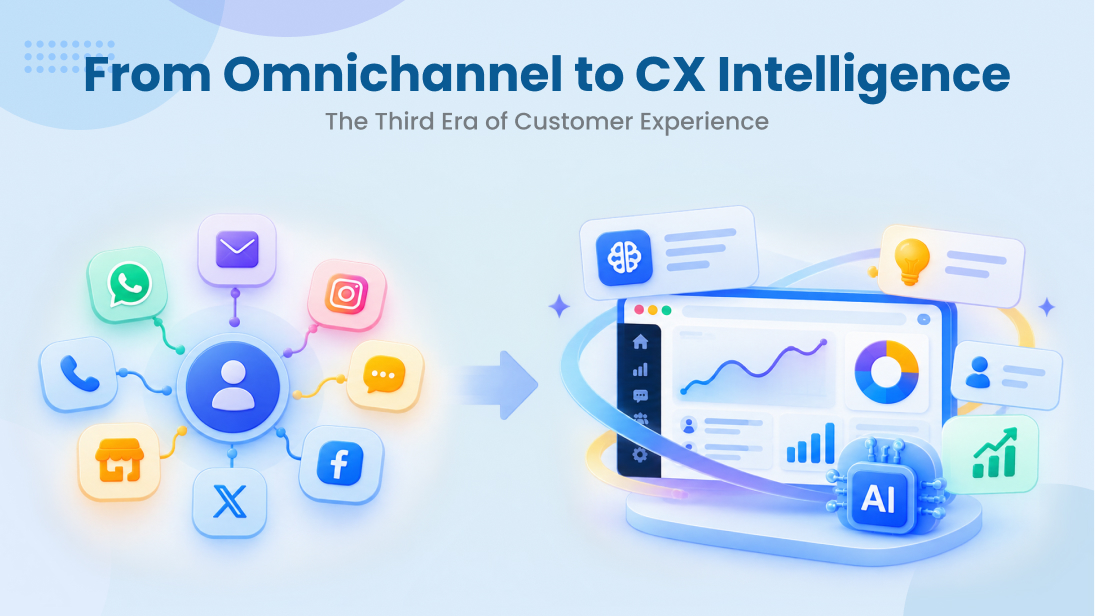
Customer experience has moved through three eras. The first organised around the channel, and the contact centre was the function. The second organised around the customer, and omni-channel unified the conversation. The third organises around the question, and the customer record becomes a source of business intelligence rather than a service history. Each era changed what CX was for, not just what it ran on.
- Each era was triggered by a constraint being removed, not by a vendor announcement.
- The first era organised around the channel, the second around the customer, the third around the question.
- Omni-channel solved the plumbing and left the purpose unchanged.
- The third era changes who CX reports to and what budget it draws from.
- Organisations do not move eras by buying software. They move by changing the questions they ask.
Era One: The Channel (1990s to 2008)
The telephone was the customer’s route into a company, so the company organised around the telephone. The contact centre was born as an operational unit with operational measures: call volume, average handle time, abandonment rate, service level, first call resolution.
Those measures were correct for the problem. The constraint was capacity, the cost was labour, and the discipline that emerged was industrial. Workforce management, forecasting, queue design and agent productivity are era-one inventions and they remain genuinely useful.
What the era could not do was read. Two million conversations existed every year and nothing could understand them at scale, so the only available management information was about the queue rather than about the customer. CX was defined as operations because, at the time, that was the only thing it could be.
Era Two: The Customer (2008 to 2022)
Digital channels arrived and multiplied. Email, then social, then chat, then messaging apps, then bots. Each arrived with its own tool and its own team, and the customer experienced the result as being passed between strangers who did not know what had just been said.
Omni-channel was the correction. One customer, one conversation, one platform, regardless of how many doors they used. It was a genuine advance and it solved a real problem: the unit of management moved from the channel to the customer.
“CX was operations. That era is ending.”
But notice what did not change. The unified record was still being asked for a service level. Companies built a single view of the customer and then used it to report CSAT. The plumbing was rebuilt; the purpose was inherited.
That is why era two feels unfinished to anyone who lived through it. The investment was large, the capability was real, and the questions stayed small.
Era Three: The Question (2023 onward)
The constraint that defined era one has gone. Reading two million conversations and understanding what they collectively mean is now a solved problem, which removes the reason CX was ever filed under operations.
What becomes possible is a different kind of question. Not what is my CSAT, but why are customers leaving. Not what is my SLA, but what should we build next. Not what is my NPS, but which competitor gap is open and how long will it stay open. These are business questions, and the evidence to answer them has been accumulating inside CX systems for fifteen years.
Three changes mark the transition, and all three are organisational rather than technical.
The unit of management moves again. From the channel, to the customer, to the question. The system is organised around what someone needs to know rather than around where the conversation happened.
The audience changes. Era one reported to operations. Era two reported to the CX function. Era three reports to the CEO, the CMO and the board, because the answers concern growth, competition and risk.
The budget changes. An operational cost line and a strategic intelligence line are different conversations with different thresholds. This is usually the clearest signal that an organisation has actually moved, rather than bought software and stayed put.
Where the Third Era Is Being Named
A category without a name is hard to buy, hard to budget for and hard to govern. This one is being named now: CX Intelligence for the discipline, Front Office OS for the architecture it implies.
The naming matters because the alternatives mislead. Call it analytics and it gets evaluated against BI tools. Call it listening and it gets evaluated against monitoring tools. Call it a CX feature and it gets bought by the function least able to use it.
It is also worth being honest that naming a category is a claim, not a description, and the market decides whether it holds. The test is whether organisations behave differently: whether the questions change, whether the audience changes, whether the budget moves. Where those three happen, the era has arrived regardless of the label.
How Konnect Insights Approaches It
Konnect Insights was built in era two and has been building for era three since before the category had a name.
The omni-channel cx platform is the era-two foundation and remains essential: 30+ listening channels with ticketing, social CRM, publishing and quality assessment on one customer record, across 500+ enterprise brands in 35+ countries. Without that unification there is nothing coherent for an intelligence layer to reason from.
KRC is the era-three layer. It reads across that record, extends through MCP into CRM, contact centre, marketing automation and productivity systems, and answers business questions in plain language with the evidence attached. The questions it is designed around are the era-three ones: where the next revenue is, which competitor gap is open, what risk is forming, what to build next.
Era two is not being replaced. It is becoming the foundation for something that was never possible on top of it before.
Frequently Asked Questions
Author


