 Skip to content
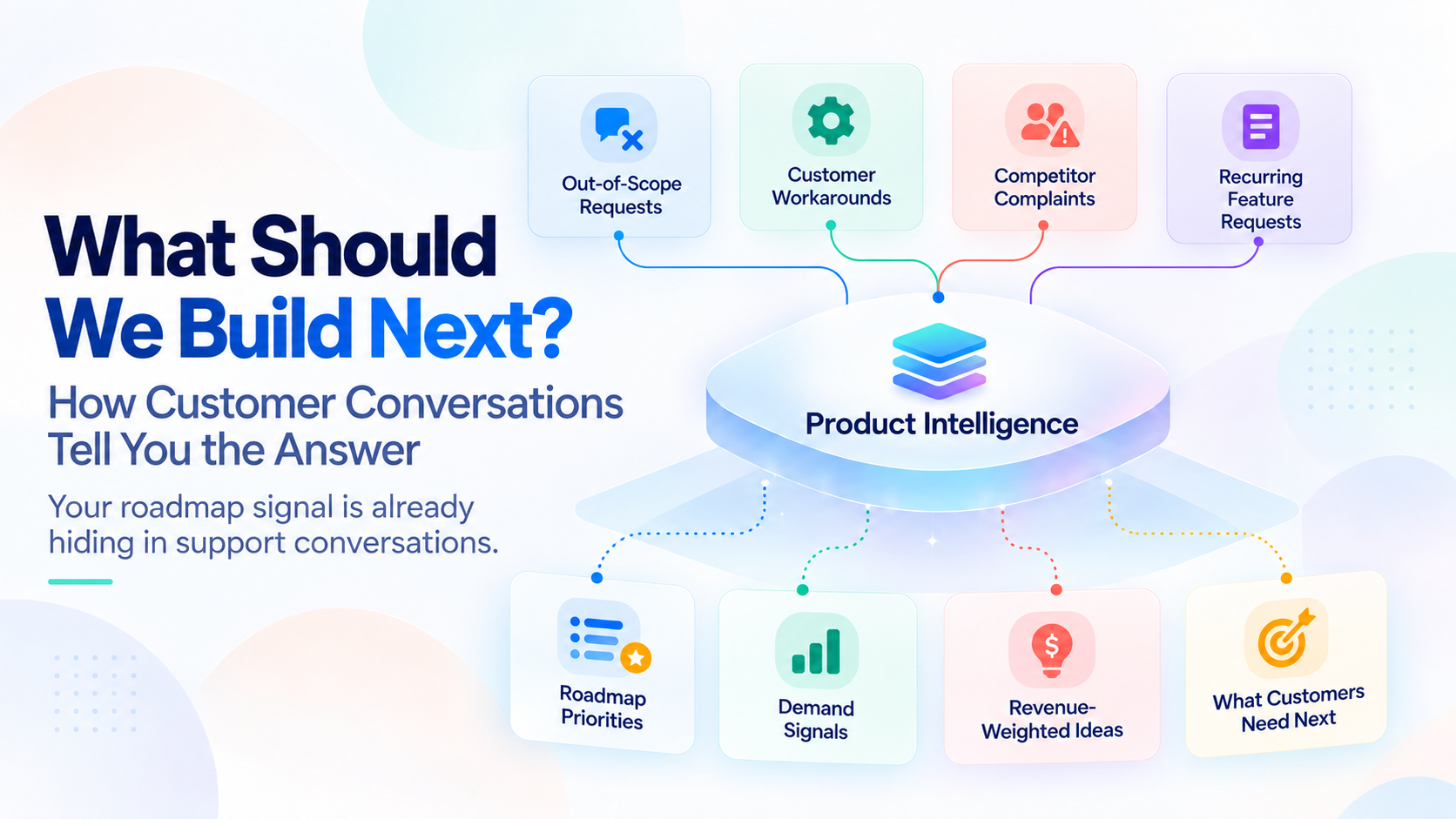


What Should We Build Next? How Customer Conversations Tell You the Answer
Your customers are already telling you what to build. They do it in service conversations, in requests your team logs as out of scope, in comparisons with competitors, and in workarounds they have invented. Almost none of it reaches your product team, because it is filed as support volume rather than demand signal. Reading it properly produces a roadmap input that is unprompted, continuous, and attached to real revenue.
- Out-of-scope requests are the most under-used demand signal in most companies.
- The loudest request is rarely the most valuable one. Rank by revenue, not by volume.
- Workarounds customers invent are stronger evidence than features they ask for.
- Public complaints about competitors are free product research on an adjacent market.
- This does not replace product discovery. It tells discovery where to point.
The Signal That Gets Thrown Away Daily
Every contact centre receives requests the company cannot fulfil. A customer asks whether you do something you do not do. The agent says no, categorises the ticket as out of scope or general enquiry, and closes it.
That exchange is a market research response. The customer volunteered what they wanted, at the moment they wanted it, without being prompted, and you paid an agent to record it. Then it was deleted from your commercial thinking by a dropdown.
Aggregate a year of those and you have a demand list with volumes attached, segmented by who asked, weighted by what those customers are worth. Most organisations have never counted them.
“It always could. But nobody ever asked it. Because somewhere along the way, we decided that CX was operations.”
The reason is the classification, not the data. Requests arriving through a service channel are treated as service events. The same request arriving through a survey would reach a product manager within a week.
The Four Signals, Ranked by Strength
Not all conversational demand signal is equal. In rough order of how much weight to give it:
One: invented workarounds. The strongest signal available. A customer describing the manual process they built to get around your product’s limits has told you three things at once: the job they are trying to do, the cost they are willing to absorb, and exactly where you stop being useful. Nobody builds a workaround for a problem they do not care about.
Two: out-of-scope requests. Unprompted, specific and countable. Weakened slightly by being a stated want rather than a demonstrated one, which is why workarounds rank above them.
Three: unprompted competitor comparisons. A customer saying another product does something yours does not is describing a gap they are actively aware of. These often arrive just before churn, which makes them both a product signal and a retention signal.
Four: friction complaints. Where people struggle most is where improvement compounds. Weaker as a direction for new building, stronger as a guide to what to fix before building anything else.
A fifth category is worth watching separately: what your competitors’ customers complain about publicly. That is research on a market you do not yet serve, available at no cost, and it describes a gap somebody is already failing to fill.
How to Rank What You Find
Volume is the trap. The most frequently requested thing is often requested by customers who would not pay for it.
Weight by revenue. The same request from fifty small accounts and from five of your largest is not the same request. Attaching commercial value to each requester is the single step that changes most roadmap conversations.
Weight by churn correlation. Requests that appear disproportionately among customers who later left are retention features in disguise. This is the most valuable cut and it requires conversation history joined to churn outcomes.
Weight by expansion correlation. The mirror image. Requests concentrated among accounts that later expanded point at what unlocks growth in the base you already have.
Separate stated wants from demonstrated needs. A request is a want. A workaround is a need. When they disagree, follow the workaround.
Check whether it is a product gap or a knowledge gap. A meaningful share of feature requests are for capabilities that already exist and nobody could find. That is a very different fix with a much shorter timeline.
What This Looks Like in Practice
A consumer electronics brand choosing a category. Feature requests and unprompted comparisons in service conversations pointed at a category months before it appeared in market research. The signal was free and already in the building.
An automobile brand reading intent early. Purchase intent signals for electric vehicles surfaced in social conversation well ahead of dealer data, which changed how a launch was timed.
A software company reclassifying its backlog. The most requested feature turned out to be concentrated in its smallest accounts. The fourth most requested was concentrated among accounts that had churned. The backlog got reordered.
A real estate brand finding expansion in its own base. Looking for unresolved complaints surfaced a pattern of unmet requests among existing buyers that read as an upsell path rather than a service problem.
How Konnect Insights Approaches It
Two things have to be true for this to work, and most organisations have neither.
The first is unified conversation data. A request made on WhatsApp, a complaint posted publicly and a call transcript have to be one body of evidence. Konnect Insights runs 30+ listening channels alongside ticketing, social CRM and quality assessment on one customer record, across 500+ enterprise brands in 35+ countries, which includes what customers say in places you do not operate.
The second is commercial context. Konnect Insights connects through MCP to the CRM, so a request can be weighted by the value of who asked, and joined to churn and expansion outcomes.
KRC runs the question itself. Asked what to build next, it clusters requests into themes, ranks them by revenue exposure rather than volume, flags which themes concentrate among churned or expanded accounts, and separates genuine product gaps from capabilities customers could not find. The output is a ranked brief with the underlying conversations attached, so a product leader can read the actual customer sentences behind any line.
Frequently Asked Questions
Author


