

Recommendations For Social Listening Tools With Real-Time Alerts
A beauty brand’s social listening tool sends alerts every four hours in a digest email. On a Tuesday afternoon, a micro-influencer with 85,000 followers posts a video about a product reaction. By the time the alert arrives at 6 PM, the video has 140,000 views, 2,300 comments, and has been reposted by three larger accounts. The brand’s PR team discovers the situation at 9 AM the next morning when a journalist emails for comment.
The tool did not fail to detect the mention. It detected it perfectly, and then held it in a queue for four hours.
Real-time is not the same as soon.
Every major social listening software platform markets real-time alerts as a core feature. The reality is more complicated. Real-time in the social listening market means anything from sub-minute notification to a four-hour digest, depending on the platform, the plan tier, the channel being monitored, and how the alert threshold is configured.
Choosing a tool for genuine real-time alert capability requires evaluating three distinct layers: detection latency, alert logic, and delivery mechanism. Most buyers evaluate only the third. This guide evaluates the major platforms against all three, honestly.
- Real-time alerts are the most heavily marketed and most inconsistently delivered feature in social listening. Detection latency ranges from under 1 minute to over 4 hours depending on tier, channel, and configuration.
- Brands with mature social listening respond to issues 4.3x faster than peers using traditional monitoring. The alert speed is the primary determinant of whether a detected issue can be contained or requires full crisis response.
- Three layers to evaluate: detection latency, alert logic, and delivery mechanism. Most buyers evaluate only the delivery mechanism.
- The most common alert failure mode is not slow detection, it is alert fatigue from misconfigured thresholds. 200 alerts per day effectively disables the alert system.
- Not all monitoring needs are genuinely real-time. Reputation crisis detection and influencer mention tracking require sub-30-minute delivery. Campaign performance and share of voice work on daily digest cadence.
- Konnect Insights provides real-time monitoring with engagement-weighted alert logic, rate-of-change detection, and direct integration into omnichannel ticketing, so every high-priority alert becomes a routed, trackable response interaction.
What real-time actually means in social listening, and why the gap matters
“Real-time” is one of the most common promises in social listening, but the term can hide major differences in how quickly information actually reaches your team. To evaluate whether a tool is truly fast enough for reputation monitoring, you need to look beyond the label and examine detection latency, alert delivery, and response time.
Detection latency, the metric no vendor advertises but every buyer needs
Detection latency is the time between when a mention is posted on a social platform and when the listening tool indexes it and makes it available for alerting. This is the foundational metric of real-time monitoring capability, and it is almost never disclosed clearly in vendor marketing.
Detection latency varies by:
- Platform tier, enterprise plans typically have faster indexing than entry-level plans on the same tool
- Channel, Twitter/X API access allows near-real-time indexing; Reddit, forum, and review platform indexing can lag significantly depending on the tool’s crawling architecture
- Content type, top-level posts are indexed faster than comments and replies on most platforms
- Geographic and language scope, regional language content and platforms outside the tool’s primary market often have higher latency than English-language mainstream social
When a vendor claims “real-time monitoring,” ask specifically: what is the detection latency for Twitter mentions, Reddit comments, and Trustpilot reviews on your standard business plan? The answers to all three questions will be different, and the Reddit and Trustpilot answers will tell you more about the tool’s actual capability than the Twitter answer.
The four-hour digest problem, how most “real-time” tools actually deliver alerts
Many tools that describe themselves as real-time monitoring platforms deliver alerts via scheduled digests, email summaries sent every 1, 4, or 24 hours aggregating the mentions detected in that window. The detection may be genuinely fast. The alert delivery is not.
The distinction matters enormously for reputation use cases. A product complaint video detected at 2:14 PM and included in a 6 PM digest has had 3 hours and 46 minutes to accumulate views, comments, and reposts before anyone on the team knows it exists. For campaign monitoring, a 4-hour digest is entirely adequate. For reputation crisis detection, it is structurally too slow.
Why alert speed determines whether a detected issue becomes a contained one
Real-time AI alerts enable reactions up to 5x faster than conventional monitoring approaches. In brand reputation terms, speed is not a user experience improvement, it is the difference between intervention categories.
A complaint at 50 engagements, responded to promptly, is a community interaction. The same complaint at 5,000 engagements, discovered through a digest four hours later, is a crisis management exercise. The alert speed is the variable that determines which situation the brand is responding to.
The three-layer alert architecture every tool must be evaluated against
Fast alerts depend on more than how quickly a notification appears in Slack or an inbox. A reliable real-time monitoring system has three connected layers, detection, alert logic, and delivery and weakness at any one of them can delay or dilute the response.
Layer 1: Detection latency: how quickly does the platform index new mentions?
Detection latency is the infrastructure layer. It is determined by the platform’s data access agreements with social networks, its crawling architecture for forums and review sites, and the processing pipeline that converts raw content into indexed, searchable mentions.
For Twitter/X, most enterprise-tier tools have detection latency under 5 minutes due to direct API access. For Reddit, forum communities, and review platforms, detection latency ranges from minutes to hours depending on the tool’s crawling frequency for those specific surfaces.
Test this in any vendor demo: post a test mention on the platform you most need to monitor and time how long it takes to appear in the tool’s interface.
Layer 2: Alert logic – what triggers a notification and how is threshold sensitivity configured?
Alert logic is the intelligence layer. It determines whether the tool is useful signal or chronic noise. The most important distinctions:
Volume-based logic
Fires when mention count crosses a threshold (e.g., “alert me when brand mentions exceed 50 in one hour”). This logic is adequate for detecting volume spikes but will fire too late, a volume spike means the issue is already significant, and will generate false positives during expected high-activity periods like product launches.
Rate-of-change logic
Fires when mention velocity accelerates beyond baseline, regardless of absolute volume. This is the early warning capability that catches crisis signals before they become volume events. A brand generating 10 mentions per hour that suddenly generates 80 in 15 minutes has a rate-of-change alert firing at the 10th above-baseline mention.
Engagement-weighted logic
Fires based on the influence score of the accounts involved and the engagement rate of the mention, so that a journalist with 80,000 followers posting a critical thread triggers an immediate alert while a 200-follower account posting the same content enters a daily digest. This is the distinction that makes alerts actionable rather than exhausting.
Sentiment-shift logic
Fires when the ratio of negative to positive mentions shifts materially from baseline, detecting reputation deterioration before it manifests as a volume spike.
The best real-time monitoring tools combine all four logic types. Most use only one or two.
Layer 3: Delivery mechanism – how and where does the alert reach the team?
The delivery mechanism is the channel layer. The most well-configured alert system in the world fails if the alert arrives in a channel the team does not monitor at the moment it matters.
Delivery channels across major platforms:
- Email, universal but asynchronous; not appropriate for sub-30-minute response requirements
- In-app notification, requires someone to be actively using the platform; not reliable for after-hours coverage
- Slack/Teams integration, the most commonly requested enterprise delivery mechanism; effective when the response team is Slack-native
- SMS, highest urgency delivery for red-tier alerts; appropriate for on-call rotation coverage
- Mobile push notification, effective for mobile-primary team members; not universally supported
Why most buyers evaluate only layer 3, and what they miss
Most platform demos focus on delivery mechanism, showing the alert notification arriving in a Slack channel, the email format, the mobile push. This is the most visually demonstrable layer and the one vendors can most easily control in a demo environment.
Detection latency and alert logic require specific testing against real brand data on the target channels, which is why vendor demos rarely address them. They are also the layers that determine whether the tool performs in production, not just in a controlled demo.
The alert failure modes that kill real-time monitoring programmes
Even a technically fast monitoring platform can fail once it meets real-world workflows. Poor thresholds, incomplete channel coverage, missed untagged mentions, and the wrong delivery channels can turn a supposedly real-time system into one that consistently surfaces critical issues too late.
Alert fatigue, when 200 alerts per day means zero alerts get acted on
Alert fatigue is the primary operational failure mode in social listening programmes, and it is produced by alert logic that is too sensitive, not by detection that is too fast. When every negative mention triggers an immediate alert, the team begins to ignore alerts as a matter of survival. The alert that matters, the journalist engaging with the critical thread, the influencer video accelerating to viral velocity, arrives in a stream of 200 daily notifications that no one is reading anymore.
The correct configuration is not maximum sensitivity. It is a threshold calibrated to produce fewer than 10 actionable alerts per day on the red tier, with everything below that threshold entering a structured daily or weekly digest.
The untagged mention gap, why volume-based monitoring misses the most dangerous signals
The most dangerous brand mentions are often the ones that do not include a direct tag. A Reddit thread titled “[Brand] quality control disaster” with 400 upvotes does not mention the brand in a way that volume-based keyword monitoring will catch if the keyword is only the exact brand name. It requires contextual search, entity recognition, and forum-specific monitoring to surface.
Untagged mention detection capability must be tested separately from tagged mention detection capability. Ask vendors to demonstrate untagged mention detection on Reddit and forum communities specifically.
Channel blindness, platforms that alert on Twitter but lag on Reddit and forums
Most social listening tools real-time alerts capability is concentrated on Twitter/X, because Twitter API access is the most reliable and most mature integration available. Reddit, forum communities, and review platforms often have significantly higher detection latency on the same plan.
The channel blindness failure: a team that sets their alert threshold based on Twitter performance discovers that Reddit alerts consistently arrive 2-4 hours after posting. By the time the Reddit alert fires, the thread has already developed community consensus, linked to external sources, and possibly been indexed by news aggregators.
Test detection latency on all channels the brand needs to monitor, not just on Twitter.
The delivery channel mismatch, alerts that arrive in email when the team is in Slack
The delivery mismatch is simpler to solve than the others but is still responsible for significant alert response failures. A 5 AM red-tier alert about a viral complaint delivered to a work email account that no one checks before 9 AM has failed to deliver the response window the tool’s detection speed earned.
Map the team’s actual communication behaviour before configuring alert delivery: when do team members receive email versus Slack versus SMS? Does the on-call rotation have mobile push notifications enabled? Is the alert delivery channel different for weekday business hours versus weekend off-hours?
Matching alert cadence to use case, what actually needs real-time
Use cases that require sub-30-minute alert delivery
- Reputation crisis detection, complaints gaining rapid engagement velocity, influencer posts about the brand, journalist engagement with negative content
- Product safety or defect mentions, complaints about physical harm, contamination, malfunction
- Executive or leadership mentions, CEO or founder mentions in negative context
- Regulatory vocabulary emergence, “recall,” “lawsuit,” “investigation,” “fraud”
- Competitor attack posts, competitor-initiated comparison content or claims
- Viral threshold approach, any brand mention crossing 1,000 engagements
Use cases where daily digest monitoring is sufficient
- Share of voice measurement, category conversation volume tracking
- Campaign performance monitoring, branded hashtag and campaign mention aggregation
- Competitor mention volume tracking, trend data, not real-time response
- Influencer relationship management, scheduled outreach, not crisis response
- Industry trend identification, emerging category conversation themes
Building a tiered alert architecture, different thresholds for different signal types
Red tier (immediate notification via SMS and Slack): any mention from an account with 50,000+ followers, any mention with engagement velocity exceeding 100 per hour, any mention containing crisis vocabulary, any cross-platform clustering of the same complaint.
Yellow tier (30-minute review via Slack): any mention from accounts with 10,000-50,000 followers, sentiment shift above 15% from baseline in any monitored surface, rate-of-change trigger on any monitored surface.
Green tier (daily digest via email): standard mention volume aggregation, share of voice data, campaign performance metrics.
Major social listening platforms, real-time alert capability assessment
Not every social listening platform defines or delivers “real-time” monitoring in the same way. The differences become clearer when each tool is assessed across detection latency, alert logic, delivery options, channel coverage, and how efficiently an alert moves from detection to action.
Konnect Insights, real-time monitoring integrated with omnichannel response
- Detection latency: Real-time to sub-5-minute on mainstream social; comprehensive forum, Reddit, review platform, and regional Indian platform coverage.
- Alert logic: Engagement-weighted alerting with rate-of-change detection, sentiment-shift alerts, cross-platform clustering detection, and Konnect AI+ classification. The alert logic fires on signal quality, not just mention volume.
- Delivery: In-app, email, Slack, SMS, mobile push, with direct routing to omnichannel ticketing queue.
- Best fit: Brands that need real-time detection integrated directly with response workflow, so every high-priority alert becomes a routed, trackable support interaction rather than a notification requiring manual handoff.
- Distinguishing capability: Every alert above a defined threshold automatically creates a ticket in the unified inbox with full mention context, sentiment score, originating account reach, and routing assignment. Detection and response are the same workflow.
Brand24, real-time monitoring for mid-market teams
- Detection latency: Sub-5-minute for Twitter and Instagram; 15-60 minutes for other sources.
- Alert logic: Volume and sentiment shift triggers; limited rate-of-change capability.
- Delivery: Email, in-app, Slack integration available on higher tiers.
- Best fit: Mid-market brands needing accessible, fast setup with primary monitoring on mainstream social.
- Limitations: Forum and review platform coverage is narrower; advanced threshold configuration requires manual workarounds.
Mention, accessible alerting with emotion analysis
- Detection latency: Near-real-time on major social platforms; variable on forums.
- Alert logic: Volume triggers with emotion analysis layer (anger, joy, fear, sadness). The emotion analysis adds a useful reputation signal beyond positive/negative.
- Delivery: Email, in-app, Slack.
- Best fit: Small to mid-market teams who want emotion-level sentiment in accessible pricing.
- Limitations: Enterprise alert configuration depth is limited.
Brandwatch, enterprise coverage with configurable alert logic
- Detection latency: Sub-minute on Twitter via direct API access; minutes to low hours on forums and review sites.
- Alert logic: Highly configurable, volume, sentiment, rate-of-change, influencer tier, and custom Boolean logic. This is one of the most sophisticated alert architectures available.
- Delivery: In-app, email, Slack, Teams, SMS.
- Best fit: Enterprise brands with dedicated analyst capacity who need the deepest configuration capability.
- Limitations: Pricing is enterprise; the configuration sophistication requires analyst time to calibrate effectively.
Talkwalker, visual listening and crisis alerting at scale
- Detection latency: Competitive on mainstream social; strong on news and media indexing.
- Alert logic: Crisis alerting with configurable thresholds; sentiment-shift detection; image and video recognition for visual complaint content.
- Delivery: In-app, email, Slack, Teams.
- Best fit: Brands where visual content (unboxing videos, product photos) is the primary complaint medium; PR and communications teams with large media monitoring needs.
- Limitations: Pricing is enterprise; Reddit and forum coverage requires verification.
Sprinklr, enterprise unified platform with real-time CX integration
- Detection latency: Competitive across mainstream social and news; variable on forums.
- Alert logic: Sophisticated AI-driven alert classification with CX integration, alerts can trigger customer care workflows, not just notification delivery.
- Delivery: In-app, email, Slack, Teams, mobile push.
- Best fit: Large enterprises that need social listening and customer care on the same platform.
- Limitations: Pricing and implementation complexity are significant; not appropriate for mid-market teams.
Keyhole, real-time hashtag and campaign alerting
- Detection latency: Sub-5-minute on Twitter and Instagram for hashtag monitoring.
- Alert logic: Primarily volume-based; good for campaign tracking.
- Delivery: Email, in-app.
- Best fit: Teams with primary use case of campaign and hashtag performance monitoring.
- Limitations: Not reputation-first; limited forum and review platform coverage.
Awario, budget-friendly monitoring with rate-of-change detection
- Detection latency: Near-real-time on major platforms; forum coverage variable.
- Alert logic: Includes rate-of-change detection, which is unusual at this price tier. Delivery: Email, in-app; Slack integration via webhook.
- Best fit: Budget-conscious brands who need rate-of-change alerting without enterprise pricing.
- Limitations: Coverage breadth is narrower than enterprise alternatives; analyst-level configuration not as deep.
Alert configuration best practices, making any tool’s alert system work
The effectiveness of an alert system depends as much on configuration as it does on the platform itself. Well-designed keywords, thresholds, priority-account rules, and testing protocols can reduce noise while ensuring that genuinely important signals reach the right people quickly.
Keyword and entity framework that reduces noise without missing signal
Configure monitoring for: brand name in all variants (including common misspellings), product line names, executive names, complaint vocabulary specific to the brand’s category, and regulatory terms. Do not monitor generic category keywords without filtering for brand adjacency, this inflates mention volume without adding signal.
Review and update the keyword framework quarterly. The complaint vocabulary that was relevant after a product launch may be less relevant three months later.
Engagement-weighted threshold design, alerting on influence, not just mention volume
Set separate thresholds for different account reach tiers. A mention from an account with 100,000 followers should trigger a higher-urgency alert than 50 mentions from accounts with 200 followers each, even if the latter represents more total potential reach.
Configure engagement velocity as an alert trigger: any mention accumulating 500 engagements within 1 hour triggers immediate alert regardless of originating account size.
Rate-of-change configuration, the alert logic that catches crises early
Establish a 7-day rolling baseline of hourly mention volume for each monitored surface. Configure rate-of-change alerts to fire when current hourly volume exceeds the 7-day average by 300% or more. This baseline approach adjusts for day-of-week and time-of-day variation, reducing false positives from predictable volume patterns (Monday product launch spikes, Friday afternoon social activity drops).
Influencer and journalist account flagging, the priority layer most teams do not set up
Most best social listening tool configurations do not include explicit flagging of priority accounts. Create a list of 20-50 accounts whose engagement with the brand warrants immediate notification: key journalists in the brand’s category, influential industry voices, known brand critics, competitor accounts, and any verified accounts with 100,000+ followers in the brand’s category.
Configure any mention from these accounts to trigger an immediate red-tier alert regardless of engagement level.
Testing alert coverage before you commit
Before purchasing any social listening tool, run a 2-week parallel test: subscribe to the trial, configure monitoring, and compare the tool’s alert history against a manual daily search for brand mentions across target platforms. The gap between what the tool detected and what the manual search found is the coverage gap. If the coverage gap is above 30%, the tool is missing too much signal to be the primary monitoring layer.
How real-time alerts connect to response infrastructure?
Real-time detection creates value only when it leads to an equally fast and coordinated response. That requires connecting alerts to the wider response infrastructure, where prioritisation, routing, ownership, and resolution can happen without unnecessary handoffs or delays.
The gap between alert received and response sent, the handoff problem
The alert received is not the response sent. Between detecting a brand mention and publishing a response, there is a workflow: the alert reaches a team member, the team member assesses urgency, finds the relevant context, decides on the appropriate response, drafts the response, gets approval, and publishes.
Each step adds time. The 5-minute detection latency that made the monitoring feel fast becomes irrelevant when the internal workflow takes 2 hours before the first response goes out.
Integrating real-time alerts with omnichannel ticketing for closed-loop resolution
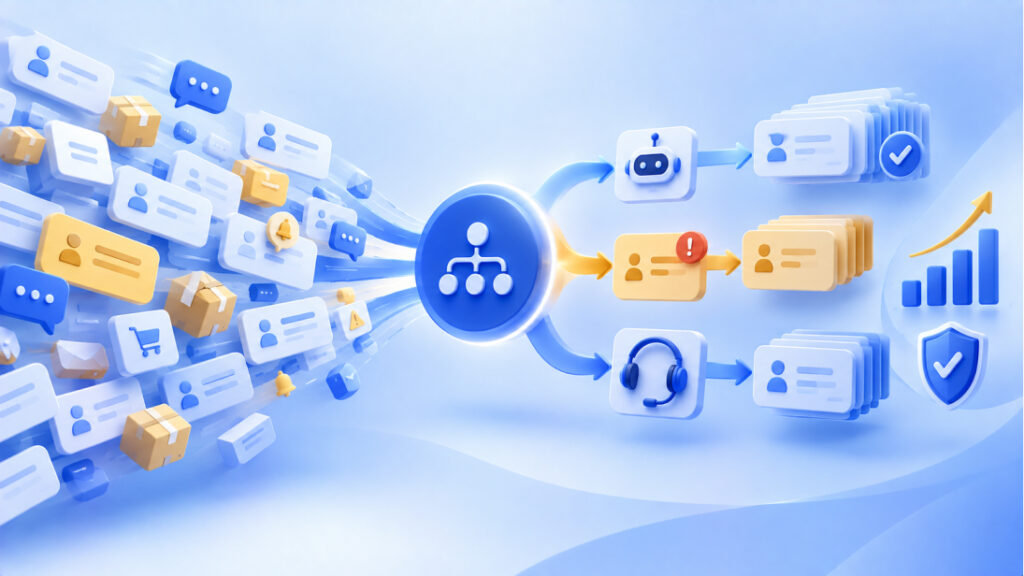
The architecture that closes the handoff gap: when a high-priority alert fires, it automatically creates a ticket in the omnichannel ticketing system with the full mention context, the sentiment classification, the originating account’s reach data, and a routing assignment to the appropriate team member. The response team member does not need to check a monitoring dashboard, the alert and the ticket arrive simultaneously, with everything needed to respond.
This is the architectural difference between a monitoring tool and a reputation management tool. The monitoring tool detects. The reputation management tool detects and routes.
The response speed standard that makes real-time alerts operationally valuable
Real-time detection is only as valuable as the response it enables. Define response time standards by alert tier before configuring the alert system:
- Red tier: first response within 30 minutes on the platform where the mention occurred
- Yellow tier: first response within 2 hours
- Green tier: included in next business day community management
Configure alert delivery to match the response time standard, SMS for red-tier alerts, Slack for yellow, email digest for green. The delivery channel is the mechanism that makes the response standard achievable.
Evaluation questions to ask vendors before you commit
Detection latency questions
“What is your detection latency for Twitter mentions, Reddit comments, and Trustpilot reviews on my plan tier? Can you demonstrate this with a live test posting during the demo?” If the vendor cannot demonstrate detection latency on Reddit and review platforms specifically, the latency is likely significantly higher than on Twitter and is not adequately tested.
Alert logic questions
“Does your platform support rate-of-change alerting? Engagement-weighted alerting by account reach? Sentiment-shift detection? How are alert thresholds configured, can I set different thresholds for different surface types and different account tiers?” A platform with only volume-based alert logic is a blunt instrument for reputation monitoring.
Delivery mechanism questions
“Which delivery channels are supported at my plan tier, email, SMS, Slack, Teams, mobile push? Can I configure different delivery channels for different alert tiers?” A platform that delivers all alerts via email is inadequate for sub-30-minute response requirements.
Coverage questions
“Show me the channel list you monitor natively, specifically Reddit at comment level, the App Store, Trustpilot, and [specific platforms relevant to the brand’s category]. For each, what is the typical detection latency?” Native monitoring is indexing directly; third-party or partnership monitoring may have significantly higher latency.
Plan tier questions
“At which pricing tier does genuine real-time alert delivery become available? Are there any features in your real-time alert capability that are only available on higher-cost plans?” Many platforms restrict their fastest detection and most sophisticated alert logic to enterprise or premium tiers that are not described clearly in public pricing.
How Konnect Insights powers real-time alert monitoring with omnichannel response
Konnect Insights provides the real-time social listening and alert infrastructure that closes the gap between detecting a brand mention and resolving it, combining monitoring speed, intelligent alert logic, and direct omnichannel response integration in one platform.
Real-time monitoring across 20+ channels including forums and regional platforms
Twitter, Instagram, Facebook, YouTube (including comments), Reddit at community and comment level, Trustpilot, Google Reviews, app stores, ShareChat, and niche industry forums, monitored continuously with sub-5-minute detection on mainstream social and competitive latency on forum and review surfaces.
Engagement-weighted alert logic with rate-of-change detection
Alert thresholds based on the originating account’s reach and engagement rate, not just mention count. Rate-of-change alerts that fire when mention velocity accelerates beyond baseline. Sentiment-shift alerts that detect reputation deterioration before it manifests as a volume spike. Cross-platform clustering alerts that fire when the same complaint appears on multiple surfaces within a defined time window.
Konnect AI+ sentiment classification with emotion detection
Every monitored mention is classified for emotion type (anger, disgust, anxiety, satisfaction) rather than binary positive/negative, providing the context that determines whether an alert requires immediate response or enters a daily digest. Sarcasm detection and entity-level sentiment classification ensure that the alert logic fires on genuine negative signals, not on surface-level positive language with negative intent.
Tiered alert delivery with omnichannel response integration
Red-tier alerts delivered via SMS and Slack simultaneously. Every red-tier alert automatically creates a ticket in the unified omnichannel inbox with the full mention content, sentiment classification, originating account reach data, platform source, and routing assignment, before any human has to manually create a ticket. The response team receives the detection and the ticket together, not sequentially.
Influencer and journalist account priority flagging
Priority account lists that trigger immediate red-tier alerts when any monitored account engages with brand-adjacent content, regardless of engagement level at the moment of detection.
Real-time alerts are only as valuable as the response they enable
The beauty brand whose influencer complaint video accumulated 140,000 views before anyone knew it existed did not have a detection problem. They had an alert architecture problem. The tool detected the mention in minutes. The digest delivery held it for four hours. The four-hour delay converted a 2-hour response window into a 19-hour discovery, and a manageable influencer response into a full PR situation.
Real-time alerts earn their cost by providing the response window that makes early intervention possible. A tool with sub-minute detection latency, volume-only alert logic, and email delivery has effectively solved only one-third of the problem. The alert logic determines what gets surfaced. The delivery mechanism determines when the team finds out. And the response infrastructure determines how quickly they can act on what they have found.
The evaluation framework in this guide, detection latency, alert logic, delivery mechanism, is the framework that connects the tool’s marketing claims to its operational reality. Every vendor in the market claims real-time. The question is what they mean by it, how it performs on the channels that matter for the brand, and whether it routes to a response workflow or deposits into a dashboard.
The best social listening tool for real-time alert capability is the one that provides the detection speed, the signal quality, and the response integration that makes early detection operationally valuable, not just technically impressive in a demo.
Frequently Asked Questions
The best social listening tools for real-time alerts depend on use case and budget. For enterprise brands with large budgets and dedicated analyst capacity: Brandwatch and Talkwalker offer the most sophisticated alert configuration. For mid-market brands needing fast setup: Brand24 and Mention provide accessible real-time monitoring on mainstream social. For brands that need real-time detection integrated with omnichannel response: Konnect Insights provides the alert-to-ticket workflow that eliminates the manual handoff between monitoring and response.
Real-time social listening means different things across platforms. Detection latency, the time between a mention being posted and the tool indexing it, ranges from under 1 minute for Twitter on enterprise plans to over 4 hours for forums and review platforms on some tools. Alert delivery adds additional latency. Brands evaluating real-time capability should test detection latency specifically on the channels they need to monitor, not just on Twitter.
Configure brand monitoring alerts using engagement-weighted thresholds rather than mention volume. Set red-tier alerts for mentions from accounts with 50,000+ followers or mentions crossing 100 engagements per hour. Set yellow-tier alerts for rate-of-change triggers. Route everything else to a daily or weekly digest. Target fewer than 10 actionable red-tier alerts per day, a team receiving 200 alerts per day will stop checking them, defeating the entire monitoring investment.
Evaluate for four logic types: volume-based (mention count thresholds), rate-of-change (velocity acceleration beyond baseline), engagement-weighted (thresholds adjusted for originating account reach), and sentiment-shift (negative sentiment ratio increasing from baseline). The best real-time social listening tools combine all four. Volume-only alert logic will consistently fire too late for reputation crisis detection.
Author