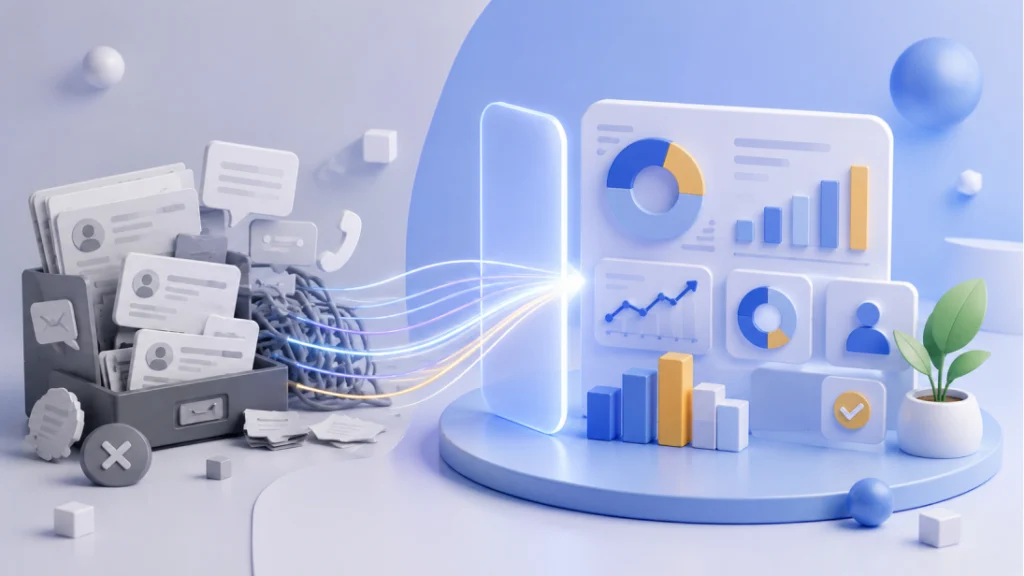


A mid-sized Indian D2C fashion brand runs its customer support on Zoho CRM. The sales team loves it. The support team hates it. Every time a customer calls about a delayed order, the agent spends three minutes searching across email threads, WhatsApp messages, and manual notes. There is no SLA clock.
There is no priority routing. There is no way to see that this customer has contacted the brand four times in the past month across three different channels.
The CRM knows everything about the customer’s purchase history. It knows nothing about their support history. Because of that gap, agents are starting every conversation from zero, even with customers who are one bad interaction away from churning permanently.
This is not a configuration problem. It is a tool mismatch problem.
91% of companies with more than 10 employees use a CRM system, but using a CRM is not the same as having the right infrastructure for customer support India operations. The two tools were built for fundamentally different jobs, and conflating them creates operational gaps that no workaround can fully close.
Understanding the structural difference between a CRM and a ticketing system, what each was designed to do, where each breaks down, and how they need to work together, is the foundation of every intelligent support technology decision an Indian brand makes.
- A CRM is built to manage relationships across the customer lifecycle. A ticketing system is built to manage support interactions at scale. They answer different questions.
- Most Indian brands are using one where they need the other, or using both in silos. The cost is context loss and SLA blindness.
- India’s support technology landscape has specific requirements global comparisons miss: WhatsApp API integration, regional language support, COD-driven post-purchase complexity, and the Zoho/Freshdesk SMB reality.
- The distinction collapses when both are part of a unified platform, where every ticket has full CRM context and every CRM record has full support history.
- Konnect Insights provides omnichannel ticketing across WhatsApp, Instagram, email, and 20+ channels, with CRM context surfaced at the agent level before every interaction.
What a CRM is actually built for, and what it is not?
A CRM, Customer Relationship Management system, was designed to track and manage the customer relationship from the moment they become a prospect to the moment they become a loyal account. Its core architecture reflects this: a customer record that accumulates purchase history, communication history, deal stages, renewal dates, and account value. The question the CRM is designed to answer is: who is this customer and what is our full history with them?
For sales teams, this is the central question. For support teams handling a specific problem that needs to be resolved by a specific deadline, it is necessary context, but it is not the operating question. The operating question in support is: what is this customer’s problem, who owns it, and when does it need to be resolved?
What CRM does well for support teams, and the ceiling it hits
CRM does several things that support teams genuinely need. It stores customer purchase history and account context that should inform every support interaction. It tracks communication history across email and some channels. It provides the relationship intelligence, account tier, lifetime value, renewal date, that determines whether a complaint should be escalated or treated as standard priority.
The ceiling: CRM was not designed for queue management. It does not have native SLA tracking that alerts when a case is approaching its resolution deadline. It does not have intelligent routing logic that assigns incoming contacts to the right agent based on skill and availability. It was not built to handle WhatsApp messages, Instagram DMs, and live chat conversations in a unified view. And it has no concept of a ticket, a discrete, trackable unit of customer issue with an owner, a status, and a clock.
The support failure modes of a CRM, what breaks when you use it for ticketing
When a CRM for customer support India operations is used as the primary support tool, three specific failures emerge:
SLA invisibility
Without a native SLA clock, agents have no real-time visibility into which customer issues are approaching the response deadline. Managers cannot see breach risk until it has already occurred. Support commitments become aspirational rather than operational.
Routing by assignment, not by logic
CRM case assignment is typically manual, a manager assigns cases or agents pick them from a shared view. There is no routing logic that directs an Instagram complaint to a social team agent or a billing query to a specialist. Every case is handled by whoever notices it first.
Channel fragmentation
A CRM can log email and phone interactions. It cannot natively ingest WhatsApp messages, Instagram DMs, Twitter complaints, and marketplace reviews into a unified queue. In India, where WhatsApp is the primary support channel for millions of customers, this is a critical gap.
What a ticketing system is actually built for, and where it falls short alone
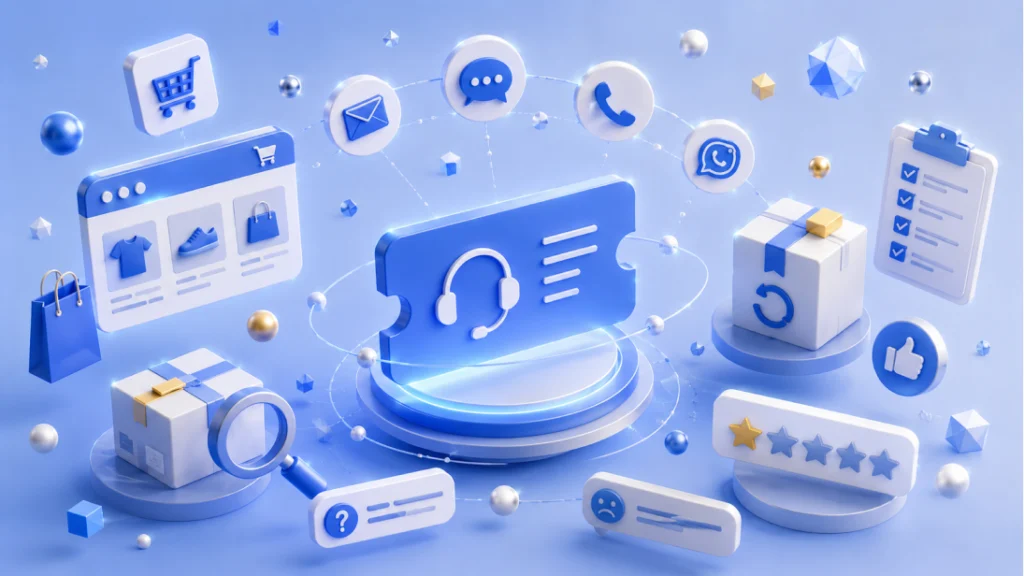
A ticketing system was designed to manage support interactions, complaints, queries, and service requests, as structured, trackable units. Each contact creates a ticket: a unique ID, a channel source, a customer identifier, a status, an assigned owner, and an SLA clock. The question the ticketing system is designed to answer is: what is this customer’s problem, who owns resolving it, and when does it need to be done?
This design produces the operational capabilities that CRMs lack: automatic routing by query type and channel, SLA tracking with breach alerts, queue management that balances agent load, and reporting that tells managers where the operation is performing and where it is not.
What ticketing does well that CRM cannot, SLA, routing, and queue management
- SLA tracking with real-time alerts when a ticket is approaching its response or resolution deadline, before the breach occurs, not after
- Intelligent routing that assigns tickets based on channel, query type, agent skill, and priority, not manual selection from a shared inbox
- Queue visibility that shows supervisors the current state of all open tickets, their urgency, and their owner at any moment
- Omnichannel ingestion that creates a ticket from any channel, WhatsApp, email, Instagram DM, live chat, marketplace message, in a single unified queue
The context failure of a ticketing system without CRM integration
A ticketing system without CRM integration knows the ticket. It does not know the customer. The agent handling a complaint sees: the message content, the channel, the ticket status. They do not see: the customer’s purchase history, their account tier, whether this is their first complaint or their seventh, whether their account is up for renewal next month, or whether they are a VIP customer whose churn would cost the business significantly.
The context failure produces generic handling, every complaint treated with equal priority regardless of the relationship context that should differentiate them. A VIP customer’s first complaint and a new customer’s fourth complaint receive the same routing, the same response time, and the same tone, because the ticketing system does not know the difference.
The 10 key operational differences, side by side
| Dimension | CRM | Ticketing system |
| Primary question | Who is this customer and what is our history? | What is this problem and when will it be resolved? |
| Primary user | Sales, account management | Customer support, CX operations |
| Customer history storage | Purchase, deal, communication history | Issue, resolution, SLA history |
| SLA management | None natively | Core capability |
| Channel coverage | Email, phone (limited) | Email, WhatsApp, social, chat, and more |
| Automation type | Lead scoring, deal stage automation | Routing, classification, escalation |
| Reporting focus | Pipeline, revenue, retention | Resolution time, FCR, agent performance |
| Integration requirements | Marketing, billing, product | CRM (for context), social listening, analytics |
| Failure under volume | SLA collapse, manual overload | Context loss, relationship blindness |
| India-specific fit | Good for sales, poor for WhatsApp-first support | Good for resolution, poor standalone for relationship context |
The Indian support context, why the global comparison misses what matters
In India, WhatsApp is the primary support channel for most consumer-facing brands outside metros, and increasingly inside them too. 500 million Indian WhatsApp users expect brands to be available there, to respond at messaging speed, and to maintain the conversation thread across multiple contacts.
A standard CRM has no native WhatsApp integration. The WhatsApp conversation exists in a separate interface, either WhatsApp Business app or a third-party tool, and is manually copied to the CRM as a note or email thread. This manual process is inconsistent, time-consuming, and loses context every time.
A ticketing system with WhatsApp Business API integration receives every WhatsApp message as a ticket in the unified queue, with the conversation thread, the customer’s phone number (used to look up their CRM record), and the SLA clock all active from the moment the message arrives. This is the difference between WhatsApp as a channel the support team checks separately and WhatsApp as a fully integrated support surface.
The SMB stack reality, Zoho, Freshdesk, and where each fits
Indian SMBs and growth-stage startups overwhelmingly use Zoho, Freshdesk, or Zendesk, and each spans both categories with different trade-offs that global comparisons rarely articulate for the Indian context.
Zoho CRM is designed as a relationship management and sales tool. Zoho Desk is the ticketing product, and the two are separate. Many Indian brands using Zoho CRM for support have never evaluated Zoho Desk, they are using a sales tool for support operations and living with its limitations.
Freshdesk is a ticketing-first product with CRM features added. It handles support queues, SLAs, and routing well. Its CRM depth is limited, account management, deal tracking, and renewal management are not its design centre.
Zendesk spans both but prices each module separately, making the full integrated stack expensive for Indian SMBs who often end up with ticketing only.
Understanding which product within each vendor’s suite to use, and what it requires for integration, is the practical decision most Indian support technology evaluations miss.
Regional language support, neither basic CRM nor basic ticketing handles it natively
Over 60% of Indian digital consumers are non-English primary, they communicate in Hindi, Tamil, Telugu, Marathi, and other regional languages. A customer complaint submitted in Hindi should be classified accurately, routed to an agent who can respond in Hindi, and resolved with communication in Hindi. This is not a marginal requirement, it is a CX and retention necessity for any Indian brand serving Tier II and III markets.
Neither basic CRM nor basic ticketing systems handle this natively. Regional language support requires: NLP models trained on Indian languages for classification and sentiment detection, routing logic that considers agent language capability, and response tools that support Devanagari and other Indian scripts.
COD and post-purchase complexity, the India-specific support volume driver
40-50% of Indian e-commerce orders outside metros are COD, and COD orders generate significantly higher support contact rates than prepaid orders. Return-to-Origin (RTO) disputes, delivery confirmation queries, refund delays for COD orders, and re-delivery requests are high-volume, India-specific support interactions that neither standard CRM support modules nor basic ticketing systems are configured to handle efficiently.
The omnichannel ticketing stack for an Indian D2C or e-commerce brand must include: direct integration with Indian logistics partners (Shiprocket, Delhivery, DTDC) for WISMO resolution, COD order confirmation workflow capability, and refund status communication at scale, in the customer’s preferred language, on WhatsApp.
When Indian brands need a CRM, a ticketing system, or both
A CRM alone is sufficient for support when: the support volume is low enough for manual management (under 30-50 contacts per day), the primary support channel is email or phone, and the customer relationships are complex enough that account context drives every interaction, typically B2B SaaS or enterprise services with small customer bases and high-touch relationships.
For these brands, the CRM’s relationship intelligence is more valuable than the operational efficiency gains of a dedicated ticketing system.
When a ticketing system alone is the right call
A ticketing system alone works when: the support volume is high and queue management is the primary operational challenge, the interactions are relatively transactional (WISMO, returns, billing inquiries), and the customer relationship context is less important than resolution speed. High-volume D2C brands in the early growth phase, where the primary support challenge is handling volume without hiring proportionally, often benefit from ticketing without CRM integration as a first step.
When you need both, and what integration must deliver
Most Indian brands above 500 customers need both, and what the integration must deliver is specific: CRM data surfaced in the ticket view before the agent responds (account tier, purchase history, prior contact history, renewal date), and ticket outcomes written back to the CRM record after resolution (so the customer success and sales team can see the complete support history).
This bidirectional integration is what closes the context gap. Without it, the tools coexist without communicating, and agents are still starting every conversation from zero despite the brand having both tools.
When a unified platform replaces both, and what to look for
A unified platform that handles ticketing, CRM context, and omnichannel ingestion natively, without requiring a separate integration between two third-party systems, is the configuration that eliminates the integration debt entirely. What to look for: native WhatsApp Business API integration (not through a middleware), regional language support in the classification and routing layer, CRM context surfaced automatically in the agent view, and SLA management built into the same interface as the customer profile.
The operational failure modes, what goes wrong when Indian brands use the wrong tool
The brand using Zoho CRM for support ticketing has no SLA clock on any case. Agents pick cases from a shared view based on what they notice first. A VIP customer’s complaint sits unassigned for four hours because no routing logic escalated it. A manager runs a weekly report and discovers that 23% of cases exceeded their informal response targets, but there is no automated alerting, no proactive escalation, and no agent accountability because none of these are native to the CRM design.
The customer experience: inconsistent response times, repeated explanations of the same issue to different agents, and no sense that the brand has a structured process for handling their problem.
Using ticketing without CRM context, the relationship blindness failure
The brand using a basic ticketing system without CRM integration handles every complaint generically. The agent who receives a complaint from a customer who has been with the brand for three years, has purchased 14 times, has a renewal due in 30 days, and has already contacted support twice this month, does not know any of this. They respond with the same urgency, the same tone, and the same resolution path as a first-time customer’s first inquiry.
The customer experience: feeling like a number, not a relationship. For the high-LTV customer who expected differentiated treatment, this is the churn trigger.
Running both in silos, the duplication and context loss failure
The brand running Zoho CRM and Freshdesk in parallel without integration has: two customer records that are not always consistent (the CRM has the latest purchase but the ticketing system has the latest complaint, and neither updates the other), agents who check two systems per interaction, and managers who produce reports from two tools that tell different and sometimes contradictory stories about the same customer.
The operational cost: agent time spent reconciling information, managers spending hours manually combining data for weekly reports, and a constant risk that a customer’s most recent support history is in one system while their account context is in another.
How to evaluate whether your current configuration is creating operational gaps
The five questions that reveal whether your support stack is misaligned
- Can your support agents see a customer’s complete contact history, across all channels, before they respond to a new contact? If no, you have a context gap.
- Do your support tickets have active SLA clocks with alerts that fire before a breach occurs? If no, you have an SLA blindness gap.
- Does your support operation receive WhatsApp messages in the same queue as email and other channels, without manual transfer? If no, you have a channel gap.
- When a support issue is resolved, does the resolution outcome automatically update the customer’s CRM record? If no, you have a data synchronisation gap.
- Can your agents classify and route a query received in Hindi or Tamil with the same accuracy as one received in English? If no, you have a regional language gap.
Three or more “no” answers indicate a support stack that is structurally misaligned with the operational requirements of an Indian consumer brand at any meaningful scale.
The signals in your support data that confirm the wrong tool is being used
- Repeat contact rate above 20%, customers contacting again because the first resolution was incomplete, often because the agent lacked context
- CSAT below 4.0, underperformance typically driven by response inconsistency and generic handling
- Agent average handle time rising, agents spending time searching for context that should be surfaced automatically
- SLA breach rate above 15%, no automated alerting, no proactive escalation, cases aging without visibility
- WhatsApp response time above 2 hours, WhatsApp not integrated into the ticketing workflow, checked manually
The agent experience that reveals the gap before the customer data does
Ask three agents this question: “Before you respond to a new customer contact, what information do you have and how do you get it?” If the answer involves opening multiple systems, searching manually, or relying on memory of prior interactions, the stack is creating friction that every customer interaction absorbs. The agent experience of context retrieval is the earliest signal of the gap. The customer experience of context loss is the lagging signal that appears in CSAT and churn data months later.
How Konnect Insights bridges the ticketing and CRM gap for Indian support teams
Konnect Insights provides omnichannel ticketing system that closes the gap between relationship intelligence and issue resolution, in one unified platform built for the Indian channel mix, language landscape, and support volume reality.
Omnichannel ticketing across 20+ channels
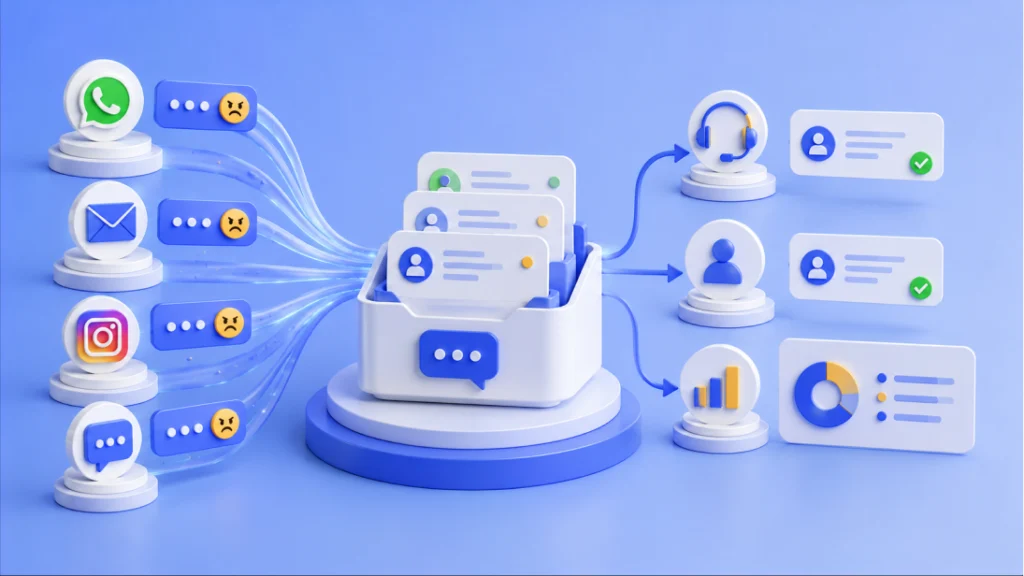
WhatsApp, Instagram DM, Twitter, email, live chat, Facebook, marketplace messages, and review platforms, every contact creates a single ticket in a unified inbox with an SLA clock, a routing assignment, and a customer record link. No manual transfer between WhatsApp and a separate ticketing tool. No separate queue for Instagram complaints. One system, one queue, one customer view.
CRM context surfaced before the first response
The agent who opens a ticket from a customer who has contacted three times this month, purchased eight times this year, and has a COD return pending, sees all of this in the ticket view before typing a word. The relationship intelligence that determines how the interaction should be handled is available at the moment it is needed, not buried in a separate CRM that the agent opens separately.
Konnect AI+ classification with regional language support
Every incoming contact is classified by query type, urgency, and sentiment, in English, Hindi, Tamil, Telugu, Marathi, and Bengali. A complaint submitted in Hindi is routed to a Hindi-capable agent with the same accuracy as an English complaint routed to an English agent. Regional language support is built into the classification layer, not a post-processing translation.
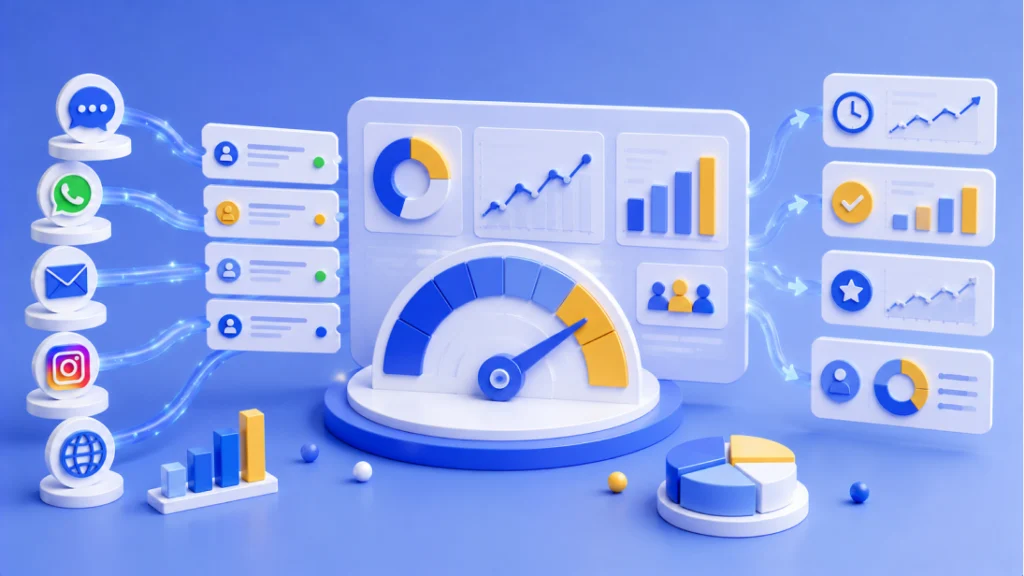
SLA management with proactive alerts
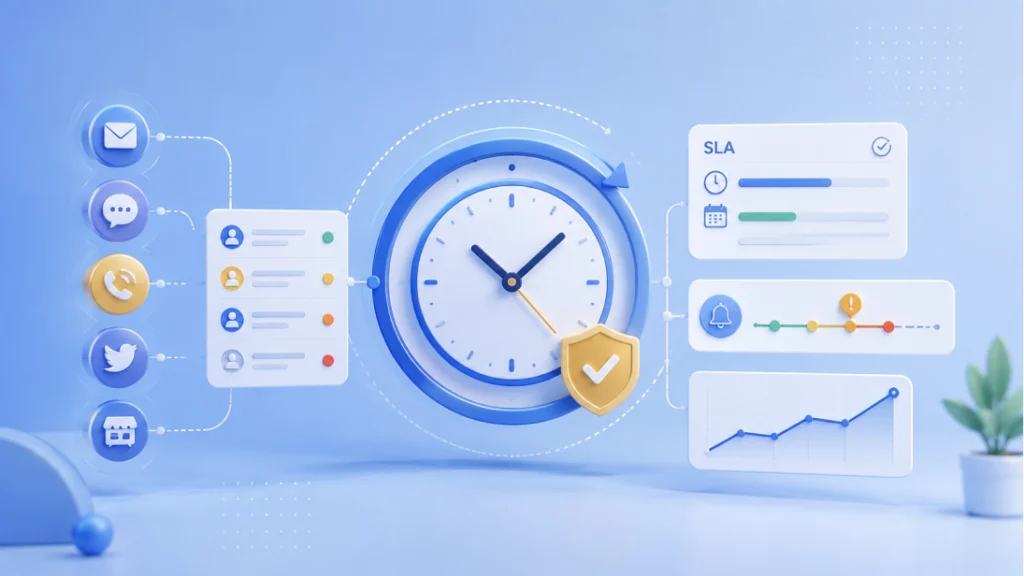
Every ticket has an active SLA clock calibrated to the channel (WhatsApp: 30 minutes; email: 4 hours; Instagram DM: 1 hour). Alerts fire at 70% of the SLA window, before breach. Supervisors see real-time SLA health across the entire queue. SLA compliance is operational, not aspirational.
WhatsApp Business API integration with Indian logistics connectivity
WISMO resolution in the customer’s preferred language, COD order confirmation workflows, and return initiation via WhatsApp, all connected to Shiprocket, Delhivery, and other Indian logistics partners, routing to the unified ticketing inbox when human resolution is required.
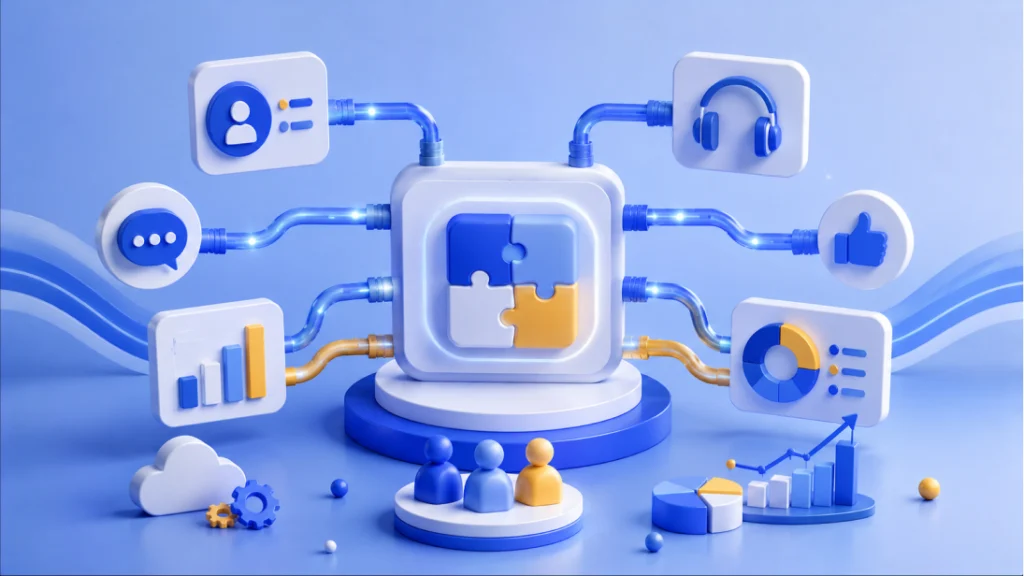
The help desk vs CRM distinction dissolves when both are part of the same platform. Every ticket has relationship context. Every CRM record has resolution history. The agent does not switch systems. The customer does not repeat themselves.
The right tool is the one that answers both questions at once
The D2C fashion brand running support on Zoho CRM has a tool that knows who the customer is and knows nothing about what they need resolved. The brand running a standalone ticketing system knows exactly what the problem is and has no idea who the customer is or how much they matter to the business.
Both brands are operating with half the information the interaction requires.
The right configuration answers both questions simultaneously, who is this customer and what is our history, and what is this problem and when will it be resolved, in the same view, for every agent, on every contact, across every channel.
In India’s support context, that configuration also needs to work in Hindi, handle WhatsApp at messaging speed, manage COD complexity, and route regional language complaints to the right agent without manual intervention. The global comparison between CRM and ticketing systems was not built with these requirements in mind. The evaluation Indian brands need is the one that starts here.
Frequently Asked Questions
A CRM manages customer relationships across the full lifecycle, purchases, deals, account history, and renewal. A ticketing system manages support interactions, issues, assignments, SLA tracking, and resolution. The CRM answers "who is this customer?" The ticketing system answers "what is their problem and when will it be resolved?" Both questions matter in support; most tools answer only one natively.
Most Indian support teams need both, or a unified platform that does both. A CRM alone for customer support India operations fails because it has no SLA management, no intelligent routing, and no native WhatsApp integration. A ticketing system alone fails because it has no relationship context, agents cannot see purchase history, account tier, or prior complaint history. The right configuration surfaces CRM context within every ticket before the agent responds.
A ticketing system with WhatsApp Business API integration is significantly better suited for WhatsApp support in India than a standard CRM. The API integration creates a ticket from every WhatsApp message in a unified queue with SLA tracking, routing logic, and customer record linking. Most CRMs have no native WhatsApp API integration, WhatsApp conversations must be manually transferred, losing context and creating delays that are incompatible with the messaging-speed expectations of Indian WhatsApp users.
Omnichannel ticketing means receiving every customer contact, WhatsApp, Instagram DM, email, live chat, marketplace message, and review platform alert, into a single unified queue with a shared customer record, consistent SLA management, and intelligent routing. Indian brands serving customers across multiple digital channels need it because multichannel support without a unified queue produces context loss, inconsistent response times, and customers who repeat themselves on every new channel contact.
Author