 Skip to content



An enterprise procurement team receives a proposal for customer experience management software. Before approving it, the finance director wants to know what the subscription covers, how costs will change as more teams join and whether the business needs every capability being purchased.
These are important questions for organisations researching Sprinklr pricing in 2026.
Sprinklr sells its enterprise software through customised quotations rather than a standard public price list. The final commercial arrangement depends on the products selected, user requirements, communication volumes and contract terms.
For businesses evaluating customer experience management software, this makes the purchasing process more involved than choosing a subscription from a pricing page.
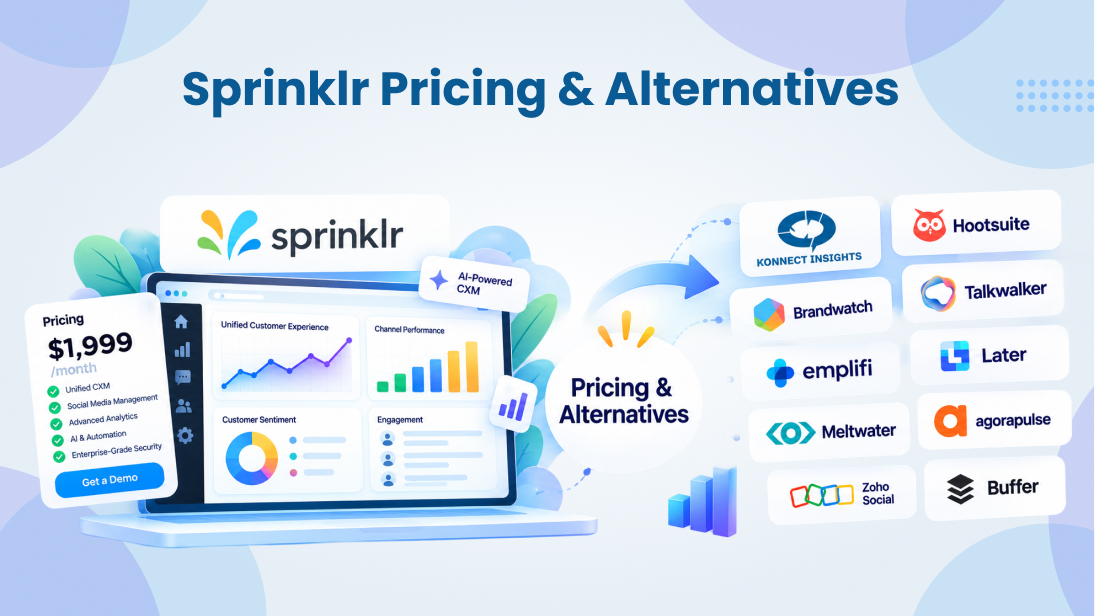
Konnect Insights offers another approach worth examining. Its AI-powered omnichannel CXM platform combines social listening, customer conversations, ticketing and intelligence, with published starting prices for its subscription plans.
This guide explains Sprinklr’s current pricing model, the factors that influence enterprise costs and how to evaluate Konnect Insights against your organisation’s requirements.
How Much Does Sprinklr Cost in 2026?

Sprinklr does not publish a universal starting price for its current enterprise offering. A custom quotation is required.
The company uses a subscription-based model tailored to each enterprise’s requirements. Buyers work with Sprinklr to determine the product scope, user licences and contractual arrangements.
That means two organisations purchasing Sprinklr may receive different proposals, even if they both describe their requirements as social media management or customer experience management.
The relevant variables include the number of users, selected product suites, channel coverage and expected message volumes. Professional services and contract duration can also affect the quotation.
| Pricing factor | What it means for enterprise buyers |
| Product suites | The required Social, Service, Insights or Marketing capabilities influence the proposal |
| User licences | The number of users and their roles affect licensing requirements |
| Channels and volume | Supported communication channels and expected message activity are considered |
| AI requirements | Buyers should clarify AI functionality, entitlements and consumption arrangements |
| Professional services | Implementation and onboarding requirements may form part of the commercial scope |
| Contract duration | Enterprise agreements may cover 12, 24 or 36 months, or longer |
| Support and integrations | Required service arrangements and connected systems should be included in the proposal |
Sprinklr’s official brand factsheet confirms that enterprise pricing is quote-based and identifies modules, users, channel volumes, professional services and contract terms as relevant factors.
Businesses should not use historical self-serve prices to estimate current enterprise costs.
A useful starting point is to document the workflows your organisation needs before requesting a quotation. Otherwise, it becomes difficult to distinguish necessary functionality from features that may not be used.
Understanding Sprinklr’s Four Product Suites

Sprinklr organises its enterprise offering around four major product suites.
Each addresses a different set of business requirements, although the suites operate within the company’s broader Unified-CXM architecture.
Understanding their scope is important because purchasing requirements often cross departmental boundaries.
Sprinklr Social
Sprinklr Social supports social media management, including publishing, engagement, content workflows and related reporting.
A marketing department managing accounts across several regions may use these capabilities to coordinate campaigns and customer interactions.
Its requirements might include publishing permissions, approval processes and performance analytics.
Sprinklr Service
Sprinklr Service addresses customer care operations.
Its capabilities include omnichannel service, case management, agent workflows and AI-supported customer service functions.
This suite is relevant to organisations managing customer enquiries through digital channels and contact centre environments.
A business requiring formal complaint ownership, escalation and service monitoring should evaluate the Service capabilities rather than assuming a social media management configuration covers its entire support operation.
Sprinklr Insights
Sprinklr Insights focuses on consumer intelligence and social listening.
It helps organisations examine public conversations, brand sentiment, relevant trends and customer feedback across supported digital sources.
Marketing, reputation management and research teams may use this information to understand how customers discuss a brand or product.
Sprinklr Marketing
Sprinklr Marketing supports marketing operations, including campaign planning, content processes and related coordination.
Its role is different from customer support, although marketing information may contribute to wider customer experience decisions.
The purchasing implication: An enterprise should identify the capabilities it needs across these areas before asking Sprinklr for a proposal.
The commercial arrangement may involve selected suites or bundled requirements. Buyers should confirm the exact configuration rather than assuming every suite requires a separate contract.
What Factors Influence Sprinklr’s Total Cost?

An enterprise subscription is only one part of the software investment.
A more useful calculation considers the resources needed to implement, operate and maintain the proposed system.
User Licences and Access Requirements
A company may initially expect its marketing department to use the software.
Once the project expands, customer service agents, supervisors, regional managers and administrators may also require access.
The number of users and their roles are documented factors in Sprinklr’s pricing model.
Before requesting a quote, identify who genuinely needs access and what each role must do.
Product Scope and Communication Volume
A business that needs social publishing has a different requirement from one handling customer service across messaging, email and other channels.
The selected product suites and expected channel or message volumes influence Sprinklr’s enterprise pricing.
Buyers should estimate current activity and consider likely growth.
A retailer experiencing seasonal complaint spikes, for example, should establish how the commercial arrangement handles higher message volumes.
AI Capabilities and Consumption
AI requirements deserve separate attention.
A business may want sentiment analysis and automated classification. Another may require agent assistance, conversational AI or more complex workflow automation.
The commercial implications of these capabilities should be confirmed during procurement.
Ask which AI functions are included, whether usage limits apply and how additional consumption would be charged.
Integrations and Implementation
Enterprise CXM software often needs to connect with CRM applications, customer support systems or internal databases.
Integration requirements can influence project scope and implementation effort.
Sprinklr identifies professional services and onboarding among the factors relevant to enterprise quotations.
For any vendor, businesses should establish whether integration work, data migration, configuration and training are included in the proposal or priced separately.
Support and Contract Commitments
Sprinklr describes enterprise contract terms that may run for 12, 24 or 36 months, or longer.
Longer agreements may involve negotiated commercial arrangements, but buyers should not assume that a particular discount will apply.
Support requirements, renewal conditions and the process for expanding or reducing usage also deserve review.
The objective is to understand the total cost of ownership, not just the initial subscription commitment.
What Happened to Sprinklr’s Self-Serve Pricing?
Some older articles still describe Sprinklr as offering self-serve social media subscriptions with published per-user prices.
Those descriptions are no longer suitable for evaluating its current offering.
Sprinklr discontinued its self-serve products, with service for existing self-serve customers ending on 30 April 2026.
The company’s enterprise platform remains available.
This distinction is important for businesses searching for Sprinklr Social pricing or Sprinklr Service pricing. Current enterprise purchasing involves requesting a tailored quotation rather than selecting a self-serve plan.
The discontinuation does not mean Sprinklr has stopped offering social media management or customer service software.
Its enterprise portfolio continues to cover social engagement, consumer intelligence, marketing and omnichannel service.
For procurement teams, the change means historical subscription figures should not be used as current price benchmarks.
A previously advertised self-serve rate may describe a product that is no longer sold under those terms.
Businesses should request a current proposal directly from Sprinklr and clarify the scope of the enterprise subscription being offered.
Organisations reviewing alternatives can use the same opportunity to compare the requirements of their customer experience operations against other available platforms.
Why Businesses Consider Sprinklr Alternatives
Not every organisation evaluating another vendor is dissatisfied with its existing software.
Sometimes the business has grown. Sometimes its customer service processes have changed. In other cases, the procurement team simply wants to understand whether a different commercial or technical arrangement would be more appropriate.
Greater Visibility Into Subscription Costs
Published starting prices can help businesses establish an initial budget before entering detailed procurement discussions.
Custom enterprise quotations serve a different purpose. They account for specific requirements but require more information from the buyer.
Organisations may therefore compare vendors offering transparent entry-level plans alongside those using fully customised pricing.
A Different Operational Scope
An enterprise may require social listening, customer support, ticketing and reporting, but not every available marketing or contact centre capability.
Another organisation may need a much broader system.
The relevant question is whether the proposed configuration matches the business’s actual processes.
A platform should not be selected simply because it offers the greatest number of functions.
Existing Technology and Integration Requirements
Businesses often have established CRM, helpdesk and analytics systems.
Replacing those applications may not be necessary.
When reviewing Sprinklr alternatives, IT and customer experience teams should decide which systems they intend to retain, which capabilities they want to consolidate and how information will move between applications.
AI and Reporting Priorities
Some organisations place greater emphasis on customer intelligence than campaign management.
Others need agent assistance, complaint classification and operational dashboards.
These priorities can influence vendor selection as much as subscription pricing.
Konnect Insights is relevant to this discussion because its offering combines customer conversations, service workflows and social intelligence within an omnichannel CXM environment.
Konnect Insights: An Alternative for Unified Customer Experience
Konnect Insights is an AI-powered omnichannel customer experience management platform built around connecting customer conversations with the operational processes that follow them.
Its capabilities include social listening, social CRM, omnichannel ticketing, workflow automation, publishing, analytics and AI-supported customer intelligence.
Rather than treating customer feedback and customer service as entirely separate activities, the platform brings these functions into a connected environment.
Consider a retail brand managing complaints across Instagram, WhatsApp, email and online review platforms.
A customer reports a delayed delivery publicly. Another customer contacts support about the same issue. Meanwhile, negative reviews begin appearing for several locations.
The organisation needs to respond to individual customers, but it also needs to understand whether a wider delivery problem is developing.
With an appropriately configured Konnect Insights workflow, social listening can help identify relevant public conversations.
Omnichannel ticketing supports case creation, assignment and escalation, while customer conversation information helps agents understand the context of ongoing interactions.
Reporting and analytics can then help management examine complaint volumes, sentiment patterns and service activity.
The value lies in connecting information with action.
A listening alert can prompt an investigation. A support ticket can establish ownership. Management reporting can help determine whether the underlying issue continues to affect customers.
Konnect Insights also provides social media publishing and engagement capabilities, allowing marketing teams to manage social activity alongside wider customer experience functions.
For enterprises evaluating customer experience management software, this combination deserves consideration when multiple teams are responsible for understanding and resolving customer concerns.
Not every business requires the same breadth of functionality.
A small marketing team focused primarily on publishing content may have simpler needs. An organisation managing customer care across departments should examine whether a unified CXM approach better supports its operations.
What Do You Get With Konnect Insights Pricing Plans?

Konnect Insights publishes subscription plans that provide a starting point for businesses evaluating its software.
The plans differ in their operational scope, reporting capabilities, automation and enterprise controls.
The latest official pricing page reviewed for this article lists the following annual-billing rates:
| Konnect Insights plan | Published starting price |
| Starter | $39/user/month |
| Professional | $79/user/month |
| Advanced | $119/user/month |
| Enterprise | Custom quotation |
These figures are in US dollars. Additional charges and plan-specific entitlements may apply.
Starter: Establishing Customer Care Operations
Starter is positioned as an entry point for organisations building their customer experience operations.
The published plan information includes core customer engagement, ticketing and social media functionality.
It can be relevant to teams that need to organise incoming conversations and establish a more consistent approach to customer interactions.
Buyers should verify which ticketing, SLA and reporting features are included before selecting the plan.
Professional: Expanding Automation and Intelligence
Professional is designed for organisations requiring additional functionality as their customer experience operations grow.
The published feature matrix includes expanded analytics, social listening capabilities, reporting and integration options.
It also introduces more advanced classification and workflow-related functions.
For a business operating across multiple teams or markets, these capabilities may support more detailed analysis of customer interactions.
The important consideration is whether the selected plan covers the required channels, automation and reporting workflows.
Advanced: Greater Operational Control
Advanced adds further automation and enterprise management capabilities.
The published matrix identifies features such as smart ticket routing, additional security controls, audit logs and advanced administration functions.
Konnect AI+ agent assistance and AI-powered quality assessment are listed as add-ons in the currently published feature table.
That distinction matters.
A buyer should not assume that every AI capability is included simply because a subscription is called Advanced.
Enterprise: Requirements Beyond Standard Plans
Larger organisations may need custom integration arrangements, additional governance requirements, specialised support or broader customer experience orchestration.
Konnect Insights offers enterprise discussions for such requirements.
A tailored proposal can establish the relevant capabilities, expected usage and implementation scope.
Additional Usage Considerations
The published pricing matrix also identifies separate charges for social profiles and social mentions.
Businesses should account for these alongside user licences.
A meaningful estimate should include expected listening volumes, required channels, AI functionality, integrations and support arrangements.
The Konnect Insights pricing page provides the starting point, but a tailored quote is the appropriate basis for enterprise purchasing decisions.
Konnect Insights vs Sprinklr: Pricing and Value Considerations
The pricing models differ in an important way.
Konnect Insights provides published entry prices that businesses can use for preliminary budgeting. Sprinklr requires enterprise buyers to request a customised quotation.
That difference affects how the procurement process begins, but it does not establish which platform will cost less for equivalent functionality.
| Evaluation area | Konnect Insights | Sprinklr |
| Published starting price | From $39/user/month, billed annually | Custom quote required |
| Pricing approach | User-based plans, usage charges and tailored enterprise arrangements | Custom enterprise subscription |
| Product scope | Omnichannel CXM, listening, ticketing, social CRM and intelligence | Unified-CXM across Social, Service, Insights and Marketing |
| Social listening | Available with plan-specific functionality and usage charges | Available through enterprise product configuration |
| Ticketing | Native omnichannel ticketing, with advanced functions varying by plan | Native enterprise case management |
| AI capabilities | Konnect AI+ and related modules, with some features sold as add-ons | AI capabilities across enterprise products; entitlements require confirmation |
| Integrations | Standard, expanded and custom options | Enterprise integrations and APIs |
| Implementation | Based on workflows, integrations and organisational requirements | Based on selected suites, configuration and services |
The Konnect Insights Starter price should not be compared directly with a Sprinklr enterprise proposal covering extensive customer service and intelligence requirements.
Those would not necessarily be equivalent configurations.
A more useful comparison starts with a common requirements document.
Specify the number of users, communication channels, listening volumes, ticketing workflows and reporting needs. Then request proposals that address those requirements.
For enterprises, the relevant measure is the cost of supporting the required customer experience operation, including implementation and ongoing administration.
Other Sprinklr Alternatives Worth Considering
Businesses researching Sprinklr competitors may encounter several products with different areas of emphasis.
Sprout Social provides social media publishing, engagement, listening, analytics and social customer care capabilities. It is relevant to organisations whose purchasing requirements centre on social operations and associated customer engagement workflows.
Hootsuite focuses on social media management, including publishing, monitoring, engagement and reporting. Buyers should evaluate its available integrations when broader customer service processes are required.
Brandwatch offers consumer intelligence, social listening and social media management capabilities. It is particularly relevant to organisations researching customer conversations, brand perception and audience trends.
Agorapulse provides social publishing, inbox management, analytics and collaboration functionality. Its scope is relevant to teams managing day-to-day social media operations.
These platforms are not interchangeable.
Some focus more closely on social publishing or consumer intelligence, while others support broader customer experience requirements.
Konnect Insights is worth evaluating when the business needs to connect social intelligence with omnichannel customer service, ticketing and operational reporting.
The right shortlist should reflect the work employees need to complete rather than the number of brands appearing in an alternatives roundup.
When Should Enterprises Evaluate Konnect Insights?
Published subscription prices may attract initial interest, but enterprise purchasing decisions ultimately depend on operational requirements.
Three situations illustrate where Konnect Insights’ capabilities may be relevant.
A Growing Retail Brand With Increasing Complaint Volumes
A retail business expands into several cities and begins receiving more customer enquiries through social media, messaging services and email.
Some customers ask about deliveries. Others report damaged products or request refunds.
The company needs a way to manage individual cases while understanding whether certain complaints are becoming more common.
Konnect Insights combines social listening with customer care and ticketing capabilities.
This can help the business identify relevant conversations, establish case ownership and examine complaint patterns through reporting.
Before implementation, the retailer should confirm compatibility with its order management and customer databases.
A Financial Services Organisation Managing Escalations
A financial services provider receives customer complaints about account access, transactions and service interruptions.
Some cases require investigation by specialist teams, while reputation managers monitor public discussions about the organisation.
Konnect Insights provides ticketing, workflow automation, sentiment analysis and reporting capabilities relevant to these requirements.
Its customer intelligence functions may also help managers examine recurring issues across supported channels.
Financial institutions must separately evaluate privacy, data retention, access controls and regulatory obligations.
No vendor should be assumed compliant with a particular regulatory requirement without appropriate documentation.
A Multi-Location Travel or Hospitality Business
A hotel group manages customer enquiries across several properties.
Complaints about reservations, room availability or service quality may arrive through social media, email and public reviews.
Local teams need to respond, while central management wants visibility into recurring problems.
Konnect Insights’ social listening and ticketing capabilities can support these workflows, with reporting providing information about customer activity across locations.
The organisation should evaluate regional permissions, language requirements and integration with its existing reservation systems.
These are illustrative business scenarios, not claims about specific customer deployments.
How to Compare Enterprise CXM Quotations

Comparing two enterprise software proposals requires more than placing their subscription totals side by side.
The configurations must cover equivalent requirements.
Before requesting final quotations, prepare a purchasing checklist that includes:
- Users and roles: Number of agents, supervisors, administrators and other employees requiring access.
- Communication channels: Social networks, messaging services, email and other required sources.
- Listening requirements: Expected mention volumes, monitoring sources and historical data needs.
- Customer care: Ticket routing, escalation rules, SLA management and case ownership.
- AI capabilities: Classification, response assistance, automation and usage entitlements.
- Reporting: Operational dashboards, analytics and management KPIs.
- Integrations: CRM, helpdesk, customer databases and other existing applications.
- Implementation: Configuration, migration, onboarding and training responsibilities.
- Support: Available service levels and any additional support charges.
- Contracts: Duration, renewal provisions, usage changes and termination conditions.
Ask each vendor to demonstrate an actual customer service workflow.
For example, follow a complaint from a social media mention through ticket assignment, escalation, resolution and reporting.
This helps determine whether the proposed configuration supports the organisation’s work without relying on assumptions about feature availability.
Explore Konnect Insights for Your CX Requirements
Understanding enterprise software costs begins with knowing what your business needs to manage.
If customer conversations, social listening, ticketing and operational intelligence are handled through separate processes, it may be worth evaluating whether a connected CXM environment would better support your teams.
At Konnect Insights, we bring these capabilities together to help organisations work with customer information across marketing, service and management functions.
Our published plans provide a starting point for pricing discussions, while tailored proposals allow enterprise buyers to evaluate their specific requirements.
Explore Konnect Insights or review our pricing and plans to begin the conversation.
You can also book a demonstration to see how our platform supports the customer experience workflows your organisation needs.
Frequently Asked Questions
Yes. Konnect Insights provides social listening, customer engagement, omnichannel ticketing and reporting capabilities. These functions can help organisations monitor relevant public conversations and manage customer enquiries through supported workflows. Plan-specific features, social profile charges, listening usage and advanced automation should be confirmed before purchasing.
Author


