 Skip to content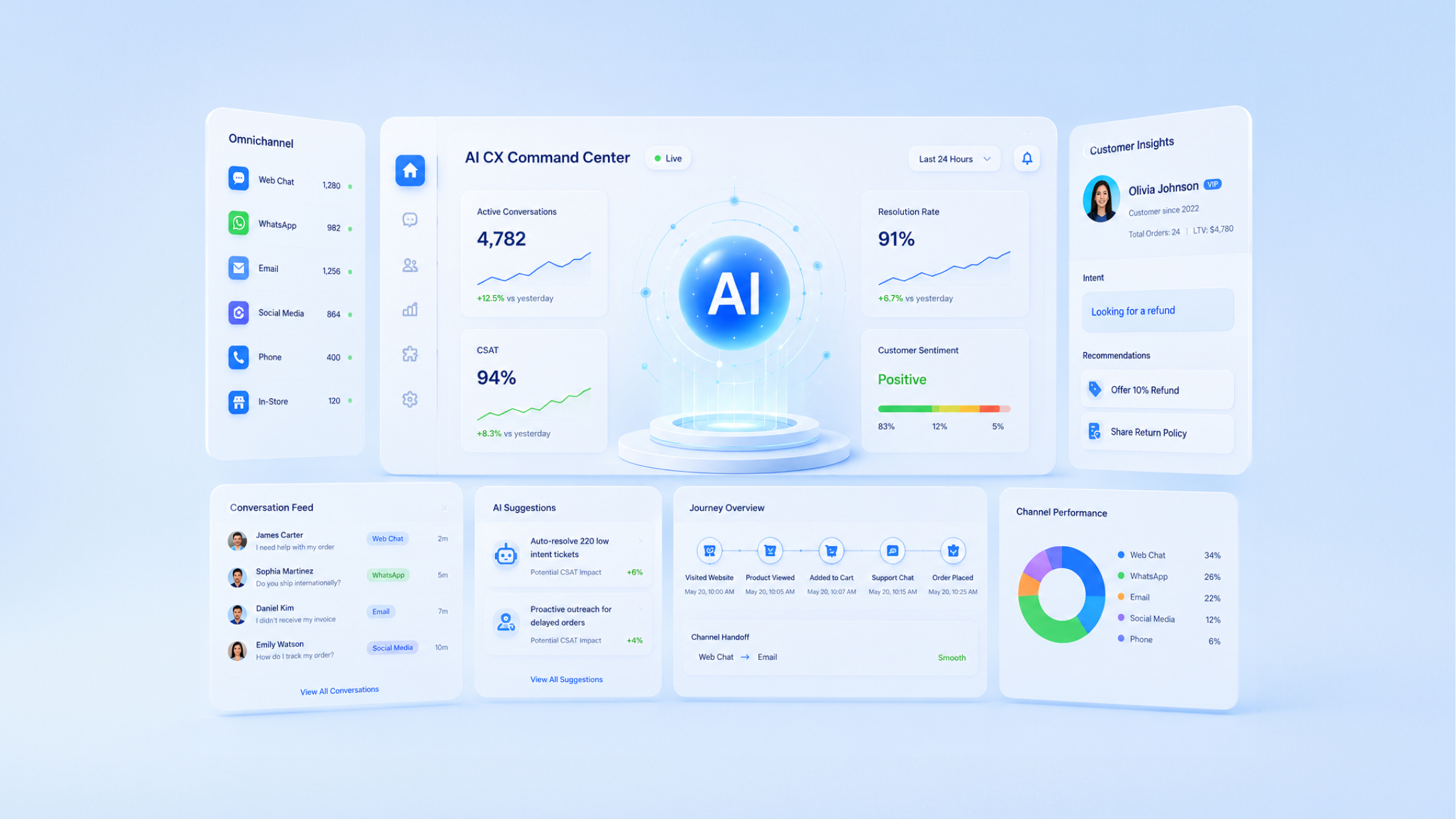


Your customer sends a WhatsApp message about a billing query. You respond. They follow up by email three days later, starting from scratch, explaining the same problem again. They call your support line and repeat everything a third time.
You have multiple channels. But you do not have omnichannel CX.
This guide explains exactly what omnichannel customer experience means in 2026, how it differs from what most brands are actually doing, and what it takes to implement it at enterprise scale. Every section includes data. Every recommendation is grounded in what actually moves revenue metrics, not CX theory.
TL;DR
Omnichannel CX is not the same as multichannel. Multichannel means customers can reach you on multiple platforms. Omnichannel means every channel shares one customer record so the conversation never restarts. Brands with strong omnichannel engagement retain 89% of customers versus 33% for those without. Only 33% of companies currently deliver connected cross-channel experiences. The guide covers the definition, why multichannel fails, implementation steps, and the measurable revenue difference.
Omnichannel CX: The Definition
Omnichannel customer experience (CX) is a strategy in which every channel a customer uses — phone, email, live chat, social media, in-store, mobile app — is connected through a single customer view, so that context, history, and sentiment travel seamlessly with the customer regardless of which channel they use next.
The word “omni” comes from the Latin for “all.” In CX, it does not mean being present on all channels. It means all channels being connected. That distinction is everything.
An omnichannel CX strategy ensures that when a customer moves from chat to phone to email, the conversation continues rather than restarts. Every agent, on every channel, already knows who the customer is, what they have been through, and what still needs resolving.
In practice, this requires a unified platform that ingests interactions from all channels into a single customer record, visible to every agent in real time. It requires shared sentiment signals. And it requires AI that can surface context at the moment of each new interaction rather than waiting for an agent to ask the customer to repeat themselves.
81% of brands say the customer experience would be significantly better if they could consolidate all conversations into one unified platform. The awareness exists. The implementation gap is where most enterprise teams are stuck. — Freshworks research
Omnichannel vs Multichannel: The Critical Difference
These two terms are used interchangeably by vendors and misunderstood by most buyers. They are not the same thing. The difference between them is the difference between being present everywhere and being useful everywhere.
Multichannel means your brand is reachable on multiple channels. Email, phone, Twitter, WhatsApp, live chat. Each channel is managed separately, often by different teams with different tools, different ticket systems, and zero shared context between them.
Omnichannel means all those channels share a single customer record. When a customer contacts you through any channel, every agent immediately sees the full interaction history across every other channel. The experience is continuous, not fragmented.
| Dimension | Multichannel | Omnichannel |
|---|---|---|
| Channel integration | Siloed — each channel operates independently | Unified — all channels share one customer view |
| Customer context | Resets on each channel contact | Travels automatically with the customer |
| Agent experience | “Can you tell me what happened?” | “I can see you contacted us yesterday about X” |
| Sentiment data | Invisible to other channel teams | Shared across all teams in real time |
| Escalation handling | Customer must re-explain to new agent | Full context carries through the handoff |
| Customer retention | ~33% | ~89% |
| Annual revenue growth | 3.4% | 9.5% |
| CSAT score (avg) | ~28% | ~67% |
Adding a new support channel without connecting it to existing channels does not improve the customer experience. It adds another silo. 95% of companies use multiple CX tools. Only 13% successfully carry context across all of them. The investment in channel presence is significant. The investment in channel integration is where most teams fall short.
Why Omnichannel CX Matters More Than Ever in 2026
Customer behaviour has fundamentally changed. The average customer now uses nine different channels to engage with a single company during a purchase or support journey. According to Salesforce, 73% of customers expect to start an interaction on one channel and finish it on another, without repeating themselves.
This expectation is not a premium demand. It is the baseline. And the gap between expectation and reality is enormous: only 33% of companies currently offer fully integrated omnichannel support.
The business consequence of that gap is quantifiable and significant.
The 2026 CX landscape adds two new pressures that make omnichannel even more urgent than it was three years ago.
AI expectations have reset the bar. Customers who have experienced AI that knows their full history — in banking apps, in healthcare portals, in retail — now expect every brand interaction to carry the same intelligence. A support agent who asks “Can you remind me what the issue is?” signals immediately that the brand’s systems are not working together.
Social media has become a primary service channel. More than 56% of businesses plan to invest in social media for customer engagement in 2025 and beyond. A customer who complains on Twitter and then calls your support line expects the phone agent to know about the tweet. When they do not, a private service failure becomes a public brand failure.
“Customer service is no longer a department. It is a data-driven discipline that requires every touchpoint to be informed by every other touchpoint. The brands that treat channels as separate functions are building a competitive disadvantage they may not see for another twelve months.”
Channels That Form an Omnichannel CX Strategy
An enterprise omnichannel CX strategy in 2026 must span every channel your customers actively use. Not just the channels you find easiest to manage. The benchmark for enterprise brands is 30 or more channels unified into a single view.
In a true omnichannel strategy, context from every highlighted step travels seamlessly to every subsequent interaction, regardless of channel.
The Revenue and Retention Impact of Omnichannel CX
This is the section that should be in every CFO presentation. Omnichannel CX is not a customer satisfaction investment. It is a revenue infrastructure investment. The data across multiple independent research programmes is consistent and significant.
The difference between 89% and 33% customer retention is not a CX metric. It is a compound revenue metric. A brand retaining 89% of customers vs 33% does not just have happier customers — it has a dramatically different revenue trajectory, lower acquisition cost burden, and a stronger referral flywheel. Omnichannel CX is the infrastructure behind that 56-point retention gap.
How to Implement Omnichannel CX at Enterprise Scale
Implementation is where most enterprise omnichannel projects fail — not because the technology does not exist, but because organisations underestimate the integration layer required to make it work. The platform decision is only one part. The data unification, the process redesign, and the cultural change are the harder parts.
Here is the framework that enterprise teams implementing omnichannel CX successfully have in common.
The Role of AI in Omnichannel CX
AI does not replace omnichannel strategy. It amplifies it. The combination of a unified customer record and AI that can interpret that record in real time is what creates the experience customers now expect — proactive, personalised, and context-aware.
Gartner predicted that proactive AI interactions would outnumber reactive ones by 2026. That means your platform is not just responding to what customers say — it is anticipating what they need based on their history, their sentiment pattern, and the patterns of similar customers who have had similar journeys.
Hyper-personalisation: AI surfaces purchase history, previous issues, sentiment signals, and product usage data before the agent says hello — enabling personalised responses at scale without manual lookup. Predictive escalation: AI identifies churn risk signals from cross-channel behaviour and routes at-risk customers to senior agents before they have to escalate themselves. Intelligent routing: AI matches each new interaction to the agent with the right skills, availability, and prior history with that customer — reducing handle time and improving first-contact resolution simultaneously.
The critical dependency: AI is only as good as the data it has access to. An AI layer sitting on top of siloed channels produces fragmented intelligence. An AI layer sitting on top of a unified omnichannel platform produces the kind of customer intelligence that drives the retention and revenue numbers cited throughout this guide.
Brands using AI with unified omnichannel data report significant lifts in both loyalty and revenue. McKinsey research on personalisation at scale shows 10–15% revenue uplifts for companies with connected data layers. Those results are not achievable with AI and siloed channels — only with AI and connected channels.
Common Challenges — and How to Address Them
Omnichannel implementation fails most often for predictable reasons. These are the ones that appear consistently across enterprise projects, and the practical mitigations for each.
Omnichannel CX in Practice: Examples by Industry
Omnichannel CX looks different across industries, but the underlying principle is identical. Context travels with the customer. Always.
A customer raises a failed transaction complaint on Twitter. The social team logs the issue. When the same customer calls the contact centre two hours later, the phone agent already sees the tweet, the transaction failure details, and the customer’s full interaction history. Resolution happens in one call. The customer is not asked to re-explain. Result: first-contact resolution, no repeat call, retained customer.
A customer emails about a delayed order. The email agent creates a ticket. The customer then messages on WhatsApp, and the WhatsApp agent immediately sees the email thread without the customer needing to forward it. The chatbot is also briefed — if the customer uses the app, it already knows about the delay. The customer experiences one conversation across three channels. That is omnichannel.
A passenger posts a complaint about a missed connection on Instagram. The social team responds and escalates internally. When the passenger visits the service desk in the terminal, the ground staff can already see the social complaint, the booking details, and the previous interactions. The ground agent resolves the disruption with full context, without the passenger needing to explain a frustrating experience twice.
A customer contacts live chat about a billing error. The chat agent escalates to email for documentation. The customer calls the next day and the phone agent opens the ticket showing the full chat transcript, the billing record, and the customer’s previous service history. Handle time drops. First-contact resolution improves. The customer does not need to repeat a word.


