

You have a strategy team. You have consultants. You probably have a few expensive off-sites every year where smart people debate the direction of your business.
But there is a strategist you are almost certainly ignoring. One that works 24 hours a day. One that talks directly to your customers, processes millions of signals, and knows things about your brand, your competitors, and your market that no consultant can tell you.
It is your customer experience platform.
The catch? Most CEOs have no idea.
What Is Actually Sitting in Your CX Platform
Every day, your CX platform is capturing something extraordinary.
Not just tickets and complaints. Not just CSAT scores and response times. It is capturing the unfiltered voice of your market.
What your customers love about you and what is quietly pushing them away. Which competitor they mention when they are frustrated. Which product feature they ask for that you have not built yet. Which geography is showing a spike in negative sentiment before it becomes a crisis. Which channel is driving the most loyal customers and which one is leaking them.
This is not operational data. This is strategic intelligence.
CX is no longer treated as a support function. It is now seen as a core driver of revenue, loyalty, and long-term differentiation. Organizations that outperform their competitors are increasingly the ones with a clearly defined CX strategy aligned with overall business goals.
The data to build that strategy already exists. It lives in your CX platform. The question is whether anyone is taking it to the boardroom.
The Gap Between the Data and the Decision Room
Here is what typically happens in most enterprises.
The CX team monitors dashboards. They track SLAs, ticket volumes, and response times. They report to a VP or a CCO. That data may surface in a quarterly review. By the time it reaches a strategic conversation, it is aggregated, delayed, and stripped of the nuance that made it valuable.

The CEO sees a number. Not a story. Not an insight. Not a decision.
CX professionals should not simply report on what customers are saying. They should elaborate on what changes need to be made to unlock greater value for the business. In 2026, talking about business value will no longer be enough. It has become a critical, must-have, non-negotiable for any successful CX leader.
The problem is structural. CX platforms were built to help operations teams manage volume. They were not designed to surface strategic intelligence for the C-suite. The data is there. The translation layer is missing.
What It Looks Like When It Works
The CEOs who get this right treat their CX intelligence like a live market research function.
Before launching into a new geography, they look at what customers in that region are saying about their category. Before a product decision, they ask what their top accounts have been asking for in support interactions. Before a board meeting, they want to know: what is the sentiment trend over the last 90 days, and how does it compare to our three closest competitors?
The organizations that perform best stop reacting to CX metrics and start using experience as a strategic operating model.
That shift, from reactive reporting to proactive intelligence, is the difference between a CX platform that costs money and one that makes money.
According to Forrester’s Total Experience Score research, brands that align customer experience and brand experience can unlock up to 3.5 times revenue growth. That multiple does not come from faster ticket resolution. It comes from strategic decisions made with better information.
Here Is the Catch
Most CX platforms are not built for this conversation.
They are built for agents, not executives. Built for operational efficiency, not strategic clarity. They generate reports, not recommendations. They show you what happened last month, not what your data is telling you to do next.
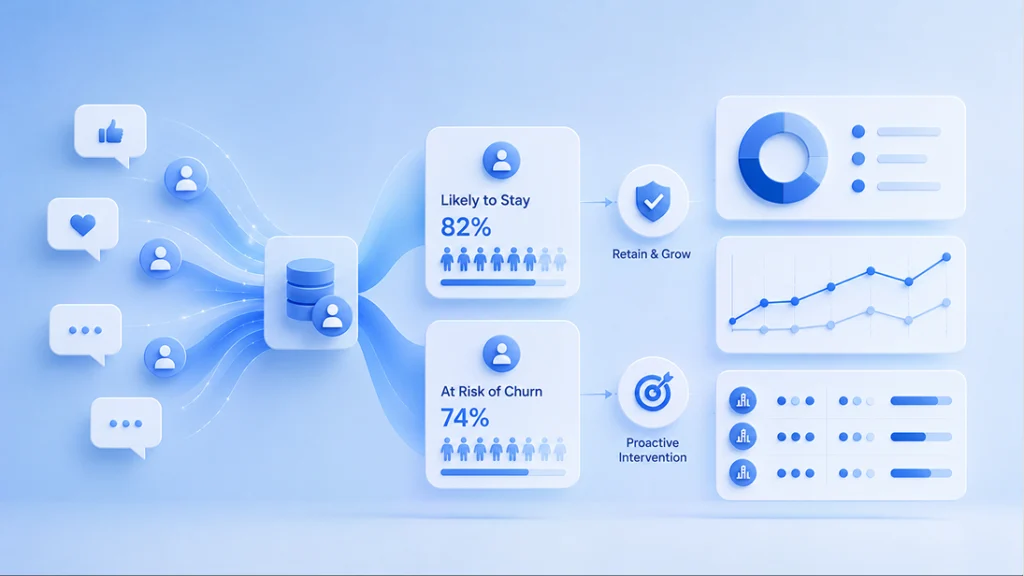
CX strategy must evolve into a living experience management system, capable of informing the business both descriptively, in terms of what is happening, and predictively, in terms of what will happen next.
That requires a different kind of platform thinking entirely.
It requires unified data across every channel, social, email, calls, chats, reviews, and forums, not siloed by team or tool. It requires AI that can synthesize millions of signals into a clear narrative. It requires dashboards built for a CEO’s questions, not an agent’s queue.
Most platforms give you the raw data. Very few give you the boardroom answer.
What CEOs Should Be Asking Right Now
If you lead a business that serves customers at scale, here are the questions your CX platform should be able to answer today:
- Where is our customer sentiment trending, and what is driving the shift?
- Which competitor is gaining ground in our core segment, and what are customers saying about them?
- What are our highest-value customers asking for that we have not delivered?
- Where are we losing customers silently before they ever raise a complaint?
- What does our CX data tell us about our next market or product priority?
If your current platform cannot answer these, the problem is not your customers. The problem is the intelligence layer sitting between your data and your decisions.
The Strategic Reframe
Stop thinking of your CX platform as a cost center that manages complaints.
Start treating it as the most honest, always-on strategist in your organization. One that has spoken to every customer, heard every frustration, tracked every competitor mention, and processed every signal your market has sent.
Make every insight actionable, relevant, and financially grounded. That is the standard your CX intelligence should be held to.
The brands winning in the next five years will not just be the ones with the best products or the biggest marketing budgets. They will be the ones whose leadership teams make faster, sharper decisions, informed by what their customers are actually experiencing.
Your CX platform already knows what your next strategic move should be.
The catch is whether you are listening.
KRC, the Konnect Research Cloud, was built for exactly this conversation. CX intelligence designed for the boardroom, not just the contact center.
Author