Skip to content


In the age of constant conversations, every tweet, review, and Reddit thread holds a mirror to how people feel about your brand. Yet, while most companies track what customers are saying, far fewer understand how they truly feel.
That’s where social listening comes in — the practice of tracking and interpreting online discussions about your brand, competitors, or industry to uncover deeper meaning. When paired with sentiment analysis, it transforms raw mentions into emotional intelligence, revealing whether your audience feels delighted, frustrated, or indifferent.
Understanding these emotional cues isn’t a “nice-to-have” anymore; it’s the new foundation of brand strategy. Whether it’s detecting early signs of a PR issue, learning what customers love about a campaign, or predicting product feedback, sentiment data helps brands stay proactive, not reactive.
Let’s explore how the world’s best brands measure, interpret, and act on sentiment — beyond just counting mentions.
TL;DR
- Sentiment analysis decodes how customers feel about your brand — turning emotion into actionable intelligence for CX and marketing.
- Top brands like Netflix, Amazon, and H&M use it to align campaigns, improve products, and predict market shifts.
- Advanced techniques—custom lexicons, emotion detection, and alert thresholds—make sentiment more precise and predictive.
- Dashboards and automation help teams act fast when sentiment dips or spikes, preventing crises and amplifying wins.
- Konnect Insights unifies listening, analytics, and alerts—helping brands operationalize sentiment in real time.
Why Sentiment Analysis Matters
Sentiment analysis isn’t just about tracking emotions — it’s about translating public opinion into measurable business intelligence. For brands navigating crowded markets, it acts as an early warning system for customer perception, guiding decisions across customer experience (CX), reputation management, and product innovation.
In CX, sentiment trends highlight what customers truly value and where frustration builds up. For reputation teams, it helps detect negative chatter before it turns into a crisis. In product development, analyzing recurring feedback about features or pricing can reveal hidden opportunities for improvement.
According to Bain & Company, the adoption rate of sentiment analysis technologies is projected to surpass 80% as brands realize the competitive edge of emotional data. Those that listen closely are able to respond faster, personalize communication, and protect loyalty at scale.
For example, a sudden 15% dip in positive sentiment after a product update can indicate usability issues — long before NPS or ticket volumes reflect it. Similarly, a spike in “love” or “recommend” mentions might signal campaign success worth amplifying.
Sentiment analysis turns emotion into action. It empowers teams to move from assumptions to awareness — and from delayed reactions to real-time brand intelligence.

How Leading Brands Use Sentiment Analysis
Sentiment analysis is something that all brands, big or small, should be taking very seriously. In this section, let’s look at how some of the leading brands utilize it. Learning this success stories can help you build your sentiment analysis process to guarantee success
Netflix – Aligning Content with Audience Emotion
Netflix has mastered the art of timing — not just what to release, but when to release it. By using sentiment analysis to monitor fan emotions across X (Twitter), Reddit, and TikTok, Netflix identifies when excitement, nostalgia, or curiosity peaks around a show.
For instance, before the launch of Stranger Things Season 4, social listening revealed rising anticipation through mentions like “can’t wait for Eleven’s return.” Instead of sticking to its internal calendar, Netflix aligned teaser drops with these emotional spikes.
The result? A 40% higher engagement rate than average teaser campaigns.
For Netflix, sentiment analysis isn’t just a reporting tool — it’s a creative compass that helps the brand sync its marketing rhythm with the emotional pulse of its audience.
Amazon – Turning Feedback into Product Improvement
Amazon’s listening engine doesn’t stop at star ratings — it dives into the why behind every review, comment, and thread. Through sentiment analysis across forums, social media, and product pages, the company detects emerging themes that shape product and packaging decisions.
One standout example came from growing online buzz around “sugar-free” and “zero-calorie” options. Mentions like “wish this came in sugar-free” surged across reviews and Reddit threads. Within weeks, Amazon’s category teams worked with partner brands to introduce new SKUs, optimized listings, and healthier variants.
The outcome: a 12% lift in category conversions and stronger brand affinity in the health-conscious segment.
By treating feedback as a data source, Amazon turns sentiment into strategy — evolving its marketplace in lockstep with customer emotion.
H&M – Predicting Fashion Mood Shifts
In fashion, timing trends is everything — and H&M uses sentiment analysis to sense them before they surface. By analyzing emotional tone across platforms like TikTok, Instagram, and fashion forums, the brand identifies shifts in how people feel about styles, not just what they wear.
When online chatter around “quiet luxury” and “neutral minimalism” began rising — marked by language like “elegant,” “timeless,” and “effortless” — H&M’s analytics team tagged it as a positive sentiment cluster. The brand fast-tracked design and promotion for these collections across Europe and Asia.
The result: an 18% higher sell-through rate compared to non-sentiment-aligned launches.
By combining creative instinct with emotional data, H&M turns audience mood into measurable merchandising advantage.
How brands use Konnect Insights for Sentiment Analysis
A leading telecom enterprise used Konnect Insights to monitor sentiment around its mobile app experience across Twitter, Play Store reviews, and support channels. Within the first month, automated sentiment dashboards revealed recurring spikes in “frustrated” mentions tied to payment failures and app crashes during peak hours.
Using this insight, the brand’s CX and product teams collaborated to release a targeted update and proactively communicate fixes. The result? A 27% drop in negative sentiment and a measurable lift in app ratings within two weeks.
With Konnect Insights’ unified listening and analytics platform, the brand could visualize sentiment trends, automate alerts, and act faster — turning what was once reactive support into a data-driven CX advantage.

Advanced Sentiment Analysis Strategies
Build Custom Lexicons
One of the most overlooked ways to improve sentiment accuracy is by building custom lexicons — curated word sets that reflect your industry’s unique tone, slang, and cultural nuances.
Generic sentiment models often misinterpret words that carry different meanings in specific contexts. For example, in the fashion industry, “cold” might describe a color palette or aesthetic, not a negative feeling. Similarly, in tech, “killer feature” is praise, not aggression. By teaching your sentiment model to understand these domain-specific expressions, brands can move beyond one-size-fits-all analysis.
Custom lexicons can be built by analyzing your existing mentions and manually tagging recurring terms for positive, neutral, or negative tone. Once trained, they can improve accuracy by 10–15% — a significant edge for brands managing high-volume conversations.
In essence, a tuned lexicon helps your sentiment analysis engine speak your brand’s language — literally and emotionally.
Multi-Language & Localization
Sentiment isn’t universal — it’s cultural. A phrase that sounds negative in one region can express delight in another. That’s why leading brands localize their sentiment models to account for regional tone, language structure, and idiomatic nuance.
Take a simple example: “too spicy.” For an American audience, it might signal discomfort; for an Indian food lover, it could mean perfection. Similarly, sarcasm and humor vary widely by language — what’s witty in Spanish might read as harsh in English translation.
By training sentiment models per locale or integrating multilingual datasets, brands can achieve far more accurate emotional detection. Localization also helps detect regional CX trends, like frustration with delivery speed in one market and excitement about new features in another.
The goal isn’t just translation — it’s emotional transposition. Adapting sentiment to cultural context ensures your insights reflect how people actually feel, not just what they say.
Set Threshold-Based Alerts
In sentiment analysis, speed matters as much as accuracy. The most effective brands don’t just measure emotions — they act the moment sentiment shifts. Setting threshold-based alerts ensures that no negative trend goes unnoticed or unresolved.
For instance, you can configure automated workflows to trigger when negative sentiment exceeds 15% within 24 hours. That signal can instantly notify CX teams, create tickets, or escalate responses before small frustrations turn into viral backlash.
This approach turns sentiment data from a passive metric into an active early-warning system. A telecom brand might receive an alert about billing complaints spiking overnight, while a fashion retailer could detect sudden drops in satisfaction after a new collection launch.
By combining thresholds with automation tools (like Konnect Insights), brands gain real-time emotional situational awareness — enabling faster crisis response, smarter communication, and measurable protection for brand reputation.
Track Trends vs Anomalies
Sentiment isn’t static — it fluctuates with seasons, campaigns, and customer expectations. The key is knowing whether a spike or dip is a normal trend or an anomaly worth investigating.
By tracking sentiment against historical baselines, brands can identify meaningful deviations rather than overreacting to one-off noise. For example, a 5% dip in sentiment might be expected during a product recall, but a sudden 20% drop overnight could signal a larger issue — like a viral complaint or influencer backlash.
On the positive side, tracking anomalies can also reveal unexpected wins. A surge in “love,” “recommend,” or “amazing” mentions might pinpoint an emerging campaign hero or viral moment worth amplifying.
Modern platforms visualize this through time-based sentiment graphs, where baselines, peaks, and troughs clearly indicate when to act. Tracking both trends and anomalies ensures teams stay grounded in context — not just data points.
Combine Sentiment with Other Metrics
Sentiment in isolation can be misleading. A surge in positive mentions might look great — until you realize overall conversation volume dropped, or that engagement came from a small subset of users. That’s why top brands layer sentiment data with other key metrics like volume, influencer reach, and engagement rate to reveal the full story.
For instance, tracking sentiment alongside influencer impact helps separate organic love from paid buzz. Similarly, combining engagement and sentiment identifies whether campaigns are both visible and emotionally resonant. A product launch that drives high mentions but mixed tone needs a different strategy than one with fewer, but deeply positive, interactions.
Overlaying these dimensions in a unified dashboard gives brands context, not just color codes. It transforms sentiment analysis from a diagnostic tool into a strategic performance lens — helping teams see what drives emotion, influence, and business outcomes together.
Handle Sarcasm & Mixed Sentiment
If there’s one thing algorithms struggle with, it’s sarcasm. A post that says “Great service — only waited two hours!” can easily confuse sentiment models. That’s why leading brands go beyond automation to train models that detect irony, context, and mixed emotions.
Modern NLP systems now analyze tonal cues, emojis, and punctuation to flag sarcastic or ambiguous statements. But no model is perfect — manual review remains essential. Reviewing a small subset of edge cases each week helps improve labeling accuracy and refine keyword associations over time.
Mixed sentiment is another challenge: customers often express both praise and frustration in a single post. Instead of forcing one label, assign weighted scores (e.g., 70% positive, 30% negative) for truer representation.
By blending AI precision with human oversight, brands can significantly reduce false positives — and turn sentiment analysis into a trustworthy reflection of real customer emotion.
Pro Tip — Sameer Narkar, Founder & CEO, Konnect Insights
“Always include a neutral category — it often hides the earliest signs of churn or advocacy shifts.”
From Insights to Action: Dashboards & Alerts
Measuring sentiment is only half the story — the real value lies in how quickly teams act on it. That’s where dashboards and automated alerts turn data into action.
Modern brands build unified sentiment dashboards that visualize real-time emotion across campaigns, products, and regions. These views combine metrics like sentiment score, conversation volume, and topic clusters, giving teams a live pulse on audience emotion. When a sudden dip or spike appears, they can respond instantly — before the story escalates.
For example, CX teams act within hours when alerts flag a >10% weekly drop in sentiment, enabling proactive outreach or policy changes before complaints pile up. Marketing and PR teams, meanwhile, use positive spikes to amplify successful campaigns or identify potential advocates worth engaging.
The real advantage comes from collaboration: marketing, support, and PR teams all working off the same dashboard. Instead of fragmented insights, every team sees one version of emotional truth — ensuring consistent messaging and faster alignment during crises or campaigns.
Platforms like Konnect Insights make this seamless with automated workflows: when negative sentiment crosses a set threshold, tickets are created, notifications are sent, and responses are routed to the right owners automatically.
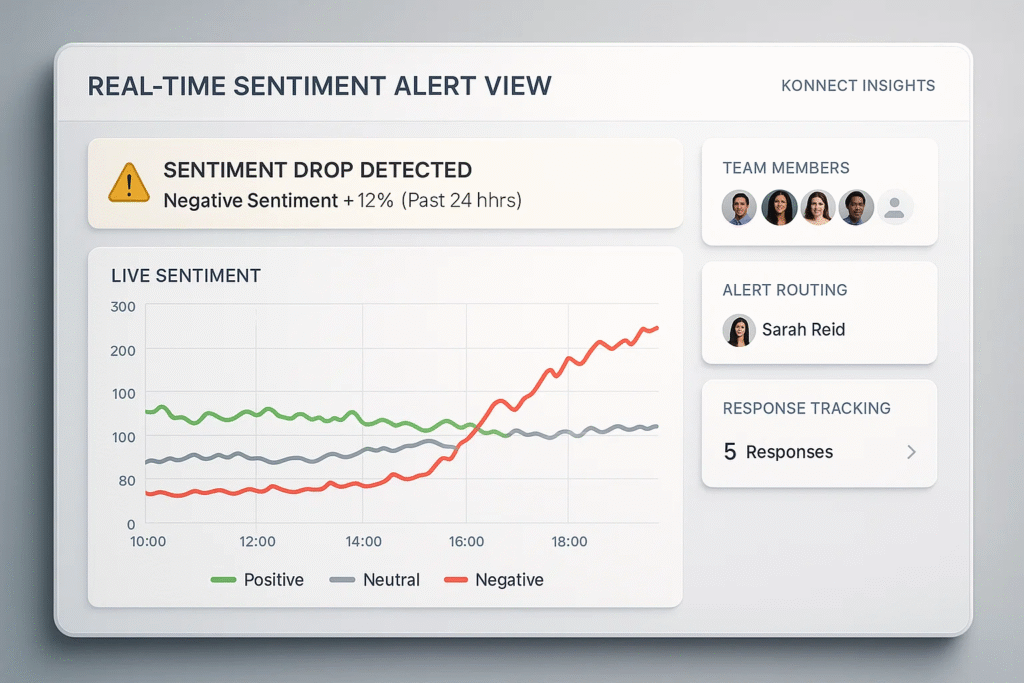
Set custom thresholds to trigger alerts and get functionalities to route insights to the right team automatically.
In short, sentiment dashboards don’t just measure mood — they orchestrate action, helping brands stay emotionally intelligent and operationally agile.
Tools & Platforms for Sentiment Analysis
Not all sentiment analysis tools are built equal. The most effective platforms go beyond text classification — they unify insights with action. When evaluating solutions, look for systems that combine depth of analysis with speed of response.
Here’s a quick checklist of key capabilities every enterprise platform should include:
- Multi-language NLP: Understand emotion across regions and dialects with localized accuracy.
- Emotion Detection: Move beyond positive or negative to detect nuanced tones like joy, frustration, or sarcasm.
- CRM/CX Integration: Link sentiment insights directly with customer profiles and support workflows for faster resolution.
- Custom Dashboards & Alerts: Visualize trends in real time and trigger instant alerts when sentiment thresholds are breached.
- Benchmarking & Competitor Tracking: Compare brand health and sentiment trends against industry averages or direct rivals.
The best sentiment analysis platforms bring these layers together to form a continuous feedback loop — where listening, interpretation, and action flow seamlessly.
Konnect Insights does exactly that. It unifies listening, analytics, and automation within a single workspace, enabling teams to see and act on sentiment faster. From real-time dashboards to automated ticketing, it ensures that every emotion expressed online becomes an opportunity to improve experience, loyalty, and brand trust.
Sentiment Analysis vs. Opinion Mining vs. Emotion Detection
These three terms are often used interchangeably, but they serve distinct purposes within modern syocial analytics. Together, they form a layered understanding of how audiences think, feel, and react.
| Term | What It Measures | Example Use Case |
| Sentiment Analysis | Classifies overall tone as positive, negative, or neutral. | Tracking campaign reception or brand reputation. |
| Opinion Mining | Extracts explicit opinions, preferences, or critiques from text. | Analyzing product reviews to guide improvements. |
| Emotion Detection | Identifies specific emotions such as joy, anger, fear, or surprise. | Adjusting customer service tone or ad messaging based on emotional response. |
While sentiment analysis offers the broad emotional temperature, opinion mining pinpoints why people feel that way, and emotion detection reveals how deeply they feel it.
Modern AI-driven platforms like Konnect Insights integrate all three layers to create a holistic emotional map of your audience — from detecting frustration before a churn event to amplifying delight after a great campaign.
Limitations & Best Practices
Even with advanced AI models, sentiment analysis isn’t foolproof. Sarcasm, cultural bias, and contextual ambiguity often trip up algorithms. A phrase like “just great” can mean praise or frustration, depending on tone and timing. Similarly, models trained primarily on English may misclassify emotional nuance in other languages or dialects.
To overcome these limitations, leading brands combine automation with human judgment. Here’s how:
- Regular Lexicon Updates: Refresh your keyword libraries to include evolving slang, emojis, and cultural expressions.
- Manual Validation for Edge Cases: Review samples of mixed or uncertain sentiment to fine-tune model accuracy.
- Combine Quantitative + Qualitative Review: Use numbers to spot trends, but human interpretation to understand why they happen.
By pairing smart models with smarter oversight, brands achieve a more reliable emotional pulse.
Don’t ignore neutral sentiment — it’s where future churn or loyalty begins.
FAQs
What exactly is sentiment analysis?
It’s the process of analyzing online conversations to determine whether people express positive, negative, or neutral feelings toward a brand, product, or topic.
How accurate is it?
Accuracy depends on data quality and lexicon tuning. With proper model training and manual validation, most enterprise systems achieve 75–90% accuracy across industries.
How often should brands track sentiment?
Monitor sentiment daily for active campaigns and weekly for brand health. Set real-time alerts for sudden spikes or drops to act immediately.
How do brands act on sentiment insights?
They link sentiment dashboards with CX or CRM systems to trigger workflows, prioritize outreach, or adjust messaging based on emotional shifts in customer conversations.
Which tools are most effective?
Platforms like Konnect Insights that unify listening, analytics, and automation—offering dashboards, multi-language NLP, and real-time alerts—deliver the fastest and most reliable insights.
What pitfalls should be avoided?
Avoid overreliance on automation, ignoring neutral sentiment, or tracking too many metrics without context—these dilute insight and delay meaningful action.
Conclusion
Sentiment analysis has evolved from a reporting feature into a strategic CX intelligence engine. It’s how leading brands understand not just what customers say, but how they feel—and why that matters.
When paired with social listening, sentiment becomes the connective tissue between marketing, product, and customer experience teams. It helps detect friction early, celebrate advocacy faster, and guide decisions grounded in emotion as much as data.
From Netflix aligning content with fan emotion to Amazon improving SKUs through customer feedback, the most successful brands share one trait—they listen deeply and act decisively.
With Konnect Insights, you can do the same. Real-time sentiment dashboards, multilingual NLP, and automated alerts empower your teams to turn every mention into measurable progress.
Book a demo with Konnect Insights and see how real-time sentiment tracking helps leading brands turn feedback into growth.