

Most brands still treat reputation management as crisis communications – something that kicks in after the press has already called. Social listening sits in a separate tool, owned by a separate team, used mostly for campaign reporting. Meanwhile, the reputation incidents that cost brands the most don’t start as crises.
They start as small posts, niche subreddit threads, one journalist’s tweet – exactly the signals a properly configured social media listening operation would catch hours before they break wide.
Social listening for brand reputation management in 2026 is a continuous discipline that runs every day – not a playbook pulled off a shelf when something goes wrong.
This guide turns that into a five-phase operational playbook: the anatomy of how modern reputation crises develop, the listening setup that catches signals early, how to run live incident response, the recovery phase most brands skip, and how to prevent the next one before it starts.
- Reputation crises rarely start as crises. They start as small signals in places most brands aren’t watching. Catching them early is the entire game.
- Social media listening for reputation is different from listening for marketing. Different keywords, different channels, different alert thresholds, different response speed.
- Five phases define the playbook: setup, detection, response, recovery, prevention. Most brands run phase 3 adequately and neglect all four others.
- Channel coverage is non-negotiable. Reddit, niche forums, YouTube comments, podcast transcripts, and review sites are where reputation issues incubate before they reach X or news.
- Speed and accuracy together define a good response. Fast and wrong amplifies the crisis. Slow and right is often too late.
- Recovery is where reputation gets rebuilt or permanently damaged. Most brands declare victory when the news cycle ends, leaving residual sentiment damage untouched.
- Konnect Insights provides the listening, ORM, sentiment, and unified-profile layer across 20+ channels – the operational backbone of a serious brand reputation management program.
Why Brand Reputation Now Lives Or Dies In Conversation
Reputation used to be managed through controlled channels. Press releases. Spokesperson statements. The news cycle. That model is gone.
The reputation landscape has changed structurally
Conversations that used to happen in private now happen in public – indexed by search engines, archived by AI, amplified by algorithms designed to surface the most emotionally resonant content first.
The structural shifts are real. Reddit and niche forums have become primary opinion-forming venues for specific demographics. AI-generated summaries pull directly from public conversation, meaning a negative review or incident report now appears in ChatGPT answers and Google AI Overviews weeks after it was written. Cross-platform amplification happens in hours: TikTok to X to news is a path that now runs in under a day for anything with emotional resonance.
Brand-controlled narratives have declined in parallel. Customers trust peer reviews more than press statements. They research brands through conversation aggregators and AI tools, not through brand websites. A complaint that would have lived in a single customer’s head a decade ago now lives on Google, in AI summaries, and in every potential customer’s research process for months.
Brand reputation has become simultaneously more durable and more fragile. More durable because positive accumulated sentiment compounds over time. More fragile because a single incident, caught at the wrong moment, can reshape that sentiment in hours.
The cost of a reputation incident in 2026
Reputation damage has a measurable, multi-layered cost. The immediate layer is visible: share price drops, sales declines, partnership risks materialising. The less-visible layer is what persists: customer acquisition cost inflation, conversion rate depression in search, and employer brand damage that takes 12-18 months to recover from.
Weber Shandwick’s research consistently shows that executives attribute roughly 63% of their company’s market value to reputation. The Edelman Trust Barometer shows that trust, once damaged, requires 3-5 years of sustained positive signal to recover across general audiences.
Reputation incidents have a tail. The cost shows up in CAC data and conversion rates months after the news cycle ends. The brand that didn’t monitor the incident closely enough to run a structured recovery is still paying for it when they think it’s over.
Why “PR will handle it” is no longer a strategy
A press statement built over four hours arrives in a conversation that has shifted three times. The journalist tweet that sparked the incident has 50 replies. The customer who originally posted has done three follow-up videos. Two competitor accounts have quietly boosted the original post. By the time the official response arrives, it’s responding to a conversation that no longer exists.
Modern reputation crisis management requires a cross-functional operating capability: CX, legal, marketing, and leadership working from the same signal in real time. PR is one function in that model – a critical one – but it is not the whole model. The teams that wait for PR to own the response lose the first hour. The first hour is often the only one that matters for containment.
What Social Listening For Brand Reputation Actually Is
Not all social listening is the same job. Conflating the two distinct uses produces a setup that does neither well.
Listening for marketing vs listening for reputation
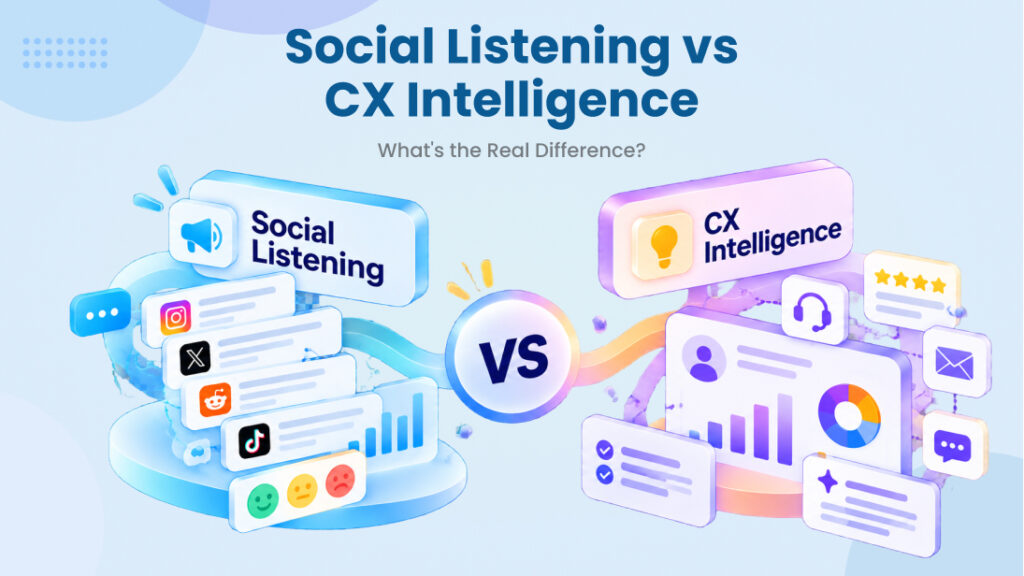
Marketing listening tracks campaign performance, share of voice, and category conversation. Reputation listening tracks risk. The differences are more fundamental than most teams realise.
Marketing listening watches positive sentiment for amplification. Reputation listening watches negative sentiment for containment. Marketing tolerates 24-hour latency on data. Reputation needs minutes. Marketing tracks broad keywords. Reputation tracks named risks, complaint vocabulary, leadership mentions, and regulatory terms.
Marketing listening is optimised to find things worth celebrating. Brand reputation monitoring is optimised to find things worth worrying about. Both jobs are valid. The mistake is assuming one platform configuration serves both purposes.
The four jobs reputation listening must do
A full reputation listening operation has four distinct functions. Most brands run one or two of them.
- Monitor – Continuous surveillance across all channels, 24 hours a day, detecting every mention of the brand, leadership, products, and category.
- Detect – Identifying early warning signals within the monitored volume, distinguishing noise from risk, and surfacing escalation indicators before they become public incidents.
- Inform response – Providing real-time intelligence to the cross-functional team during a live incident, including spread velocity, sentiment shift, channel-by-channel activity, and influencer involvement.
- Measure recovery – Tracking post-incident sentiment trajectory, residual damage in search results and AI summaries, and the effectiveness of recovery communication.
Most social listening software platforms support monitoring well, detection unevenly, response intelligence partially, and recovery measurement poorly. Evaluate platforms against all four jobs before buying. Most brands discover the gaps the first time something goes wrong.
How reputation listening fits with PR, CX, and Online Reputation
Reputation listening is the central nervous system. PR, CX, online reputation, and legal are the response organs. Without the central signal, each function operates on partial information – which is why, in most cross-functional post-mortems on reputation incidents, every team involved was watching a different data source and responding to a different version of the situation.
The strongest online reputation management programs use one listening layer feeding multiple response functions – not multiple fragmented listening layers feeding one response. That consolidation is operational, not just philosophical.
The Anatomy Of A Modern Reputation Crisis
Reputation crises don’t arrive fully formed. They develop through a consistent pattern most brands recognise only in retrospect.
The four phases every reputation incident follows
Spark
A single post, video, tweet, or review. Typically minutes to a few hours old. Still in niche circulation. Containable with immediate, accurate response.
Ignition
Early amplification by communities, influencers, or peer accounts. Hours 2-6 from the spark. The post has moved beyond the originator’s immediate audience. The brand may still respond to the core issue rather than the amplification.
Escalation
Mainstream and news pickup. Hours 6-24. Journalists have the story. Influencers with large audiences are commenting. The brand is no longer managing the incident – it’s managing the narrative around the incident. Significantly more expensive and complex.
Resolution or rebuild
Days to weeks. The news cycle has moved. But residual sentiment, search visibility damage, and AI-summary representation persist long after headlines stop.
The cheapest moment to intervene is spark phase. The most expensive is mid-escalation. The window between spark and ignition is usually 1-6 hours – exactly the window most brands miss.
Where most brands lose the window
Three failure modes consistently cause brands to miss the early window.
Channel blind spots
The team is watching X and Instagram. The incident started on Reddit, where a thread with detailed documentation and 300 upvotes has been visible for four hours. By the time it crosses to mainstream social, it’s already been screenshot, aggregated, and sent to two journalists.
Alert misconfiguration
The alerting system is set to trigger on volume spikes. But in the spark phase, volume is by definition low. The system stays silent while the conversation builds. The first alert fires at the moment the crisis has already broken.
Slow human routing
The alert reaches a social media manager’s inbox at 11 PM Friday. The social media manager isn’t on-call. The alert sits until 9 AM Monday. By then, three news articles exist.
The technology to catch the spark phase exists. Most brands miss it because of operational design choices, not tooling gaps.
What makes some incidents escalate and others fade
Not every spark becomes a fire. Understanding the difference is what determines whether to engage immediately or monitor closely.
The factors that predict escalation: emotional resonance in the content (anger, disgust, personal betrayal), visual or video evidence, an identifiable victim or villain, alignment with a live cultural narrative (a brand scandal dropping in the middle of a broader conversation about corporate accountability, for example), and amplification by an account with significant reach.
A complaint about a delivery delay that’s text-only, from an account with 200 followers, in a category not currently in cultural conversation, will usually fade. The same complaint, filmed on video, showing a damaged product, from a creator with 80,000 followers, two weeks into a public conversation about D2C quality standards – that is a different signal entirely.
AI can detect several of these escalation factors in real time. Emotion intensity. Influencer involvement. Rate of change. Narrative match requires more analyst judgment. The combination is what separates a well-calibrated brand reputation monitoring operation from an automated mention-counter.
The 5-Phase Brand Reputation Playbook (Overview)
| Phase | Purpose | Key activities | Typical cadence |
| Setup | Build the listening operation | Scope, channels, keywords, alerts, response team | One-time + quarterly review |
| Detection | Catch reputation risk early | Continuous monitoring, predictive alerts, triage | 24/7 |
| Response | Manage live incidents | Cross-functional response, channel strategy, public communication | Per incident |
| Recovery | Rebuild after an incident | Residual sentiment tracking, proof-driven communication | 30-90 days post-incident |
| Prevention | Operationalise as discipline | Lessons-learned, scorecards, cross-functional rituals | Continuous |
Most brands run phase 3 adequately and treat the other four as afterthoughts. The compounding advantage comes from running all five continuously.
Phase 1 – Setup: building a listening operation built for reputation
The listening setup determines whether the operation catches signals early or discovers crises late. Most brands configure their setup once and never revisit it. That’s the first structural weakness.
Define the listening scope: brand, leadership, product, category, competitors
Reputation listening must cover five surfaces.
- The brand itself – all variants, misspellings, abbreviations, and hashtag forms.
- Named leadership – CEO, founders, senior executives. Executive mentions often become brand stories before they reach the corporate account.
- Products and sub-brands – each major product line needs its own listening scope. A product quality issue will surface under the product name before it surfaces under the corporate brand.
- The broader category – issues affecting industry peers can reach your brand through association or through contagion.
- Key competitors – when a competitor faces a crisis, adjacent brands face scrutiny. Competitor listening informs response timing on shared issues.
Most brands listen for branded mentions only. That misses the executive surface, the category surface, and the competitor surface – exactly where reputation risk detection often starts.
Configure the right channels (and don’t skip the unglamorous ones)
This is where most listening setups have their most expensive blind spot.
The obvious channels – X, Instagram, Facebook, LinkedIn, TikTok – are table stakes.
The channels where reputation incidents typically incubate are less obvious: Reddit threads with detailed grievances and expert commentary, niche industry forums, YouTube comments on brand-adjacent videos, Glassdoor for employer reputation signals, Trustpilot and Google Reviews for long-tail consumer sentiment, podcast transcripts for long-form opinion-shaping, and news aggregators for journalist activity.
A platform that monitors only mainstream social media is one that will consistently surprise you with incidents that were visible for 24-96 hours before they reached X. Channel coverage is non-negotiable for serious brand reputation analytics.
Build the keyword and entity framework
Brand name alone is not a keyword strategy. A full reputation keyword framework includes:
- branded variants (common misspellings, abbreviations, handles)
- leadership names and variants
- product and sub-brand names
- complaint vocabulary (“scam,” “boycott,” “ripped off,” “avoid”)
- regulatory keywords (“investigation,” “lawsuit,” “recall,” “warning”)
- crisis-adjacent vocabulary (“exposé,” “whistleblower,” “fired,” “insider”)
- category risk terms relevant to your industry.
Entity-based listening – tracking specific named entities rather than keyword strings – significantly improves accuracy on leadership and product monitoring. Audit the keyword list quarterly. The complaint vocabulary that applies to a telecom brand differs from that of an FMCG brand. Refresh it when your product portfolio, leadership, or category conversation changes.
Set up sentiment, emotion, and intent classification
Volume alerts alone are structurally late. The earliest reputation signal is not a spike in mentions – it’s a shift in the emotional character of mentions.
AI-powered emotion and intent detection identifies anger, anxiety, disgust, and sarcasm at the individual mention level, before those emotions aggregate into volume. Intent classification identifies whether a mention is a complaint, an advocacy post, a media inquiry, or an organised action. The combination gives the team a risk signal that fires hours before volume-based alerts would trigger.
Emotion-aware listening is foundational for proactive reputation management, not optional. It’s the single most significant capability gap between basic brand monitoring and operational reputation intelligence.
Define alert thresholds and routing logic
Alert fatigue is the silent killer of reputation listening operations. A system that alerts on every negative mention trains the team to ignore alerts – which is exactly the wrong behaviour when a real signal arrives.
Tiered thresholds work best. Green: monitor only, no action required. Yellow: analyst review within 30 minutes, assess escalation probability. Red: immediate response team activation, all hands on.
The criteria for tier escalation: emotion intensity above threshold, influencer or journalist involvement, channel-jump event (same content appearing on multiple platforms), geographic clustering, or rapid rate of change in any metric. Route alerts by tier to the appropriate team via the appropriate channel – in-app for the social media manager, Slack for the PR team, SMS for after-hours on-call.
Review thresholds quarterly. What produced alert fatigue three months ago may need recalibration after a product launch or a market shift.
Establish the cross-functional response team and roles
The response team must exist before the incident. Building it during a live crisis is how brands lose the first four hours.
The typical composition: a PR lead with authority to approve public statements, a CX or social media lead with authority to respond on owned channels, legal counsel on standby with defined response time, a customer success or ORM lead for direct customer engagement, and a named leadership escalation path with defined trigger conditions.
Document decision rights explicitly.
- Who can approve a public statement without legal review?
- Who can authorize a product recall statement?
- Who escalates to the CEO and under what conditions?
- Who holds the authority to take a post down (and who is explicitly not allowed to do so unilaterally)?
On-call rotations for after-hours coverage are not optional for consumer brands with national or international reach. Most incidents do not respect business hours.
Phase 2 – Detection: Catching reputation risk before it breaks
A listening operation that monitors continuously but detects poorly is expensive infrastructure for slow news. Detection is the capability that converts monitoring data into operational intelligence.
The early warning signals that matter most
Six signals consistently precede reputation escalation.
- Emotion intensity spikes – a sudden increase in anger or disgust-coded language around a brand entity, even at low volume.
- Channel-jump events – the same content appearing on multiple platforms within hours, indicating deliberate amplification.
- Influencer involvement – an account with 10,000+ followers engaging with a negative mention changes the risk profile immediately.
- Geographic clustering – complaints concentrating in one city or region often indicate a specific operational failure.
- Narrative match with cultural moments – an incident landing while a broader cultural conversation is active on the same theme amplifies through association.
- Competitor or peer involvement – when adjacent brands face similar issues, journalists often aggregate the stories.
A single signal is a flag. Two or three firing together is a high-confidence escalation indicator. Train the team to respond to patterns, not isolated incidents.
Predictive alerts vs volume alerts
Volume alerts fire when mention count spikes. That’s usually after the crisis is already breaking – the escalation phase, not the spark phase.
Predictive alerts fire on early signal combinations that historically precede escalation: emotion shift above baseline, influencer involvement, channel-jump pattern, rate of change above threshold. They fire in the spark phase, when intervention costs the least and succeeds most often.
The difference isn’t subtle. A reputation operation running on volume alerts is structurally 4-12 hours behind a comparable operation running predictive alerts. That gap is the entire containment window on most incidents.
Distinguishing real risk from noise
Not every negative mention is reputation risk. A single complaint about a delayed delivery is not the same as a viral video alleging discrimination. Treating every negative mention as a potential crisis is how teams burn out, and how they become unable to respond effectively when an actual crisis arrives.
Triage criteria for distinguishing risk from noise:
- Emotion intensity (is this anger or mild frustration?)
- Audience size of the originator (100 followers vs 100,000 followers are categorically different risks)
- Presence of visual or video evidence (which dramatically accelerates virality)
- Identifiable victim or villain (personalised stories spread faster than abstract complaints)
- Narrative alignment with live cultural conversations
- Replication across multiple independent accounts (organised action vs isolated complaint).
AI can score several of these factors automatically. Others require analyst judgment. The combination is what makes triage fast and accurate.
The 60-minute reputation risk triage framework
Within 60 minutes of any alert, the team should classify the signal into one of four categories: false alarm, monitor-only, active response required, or full crisis activation.
Assess the originator
Who posted it? What’s their audience size? Do they have a pattern of brand criticism or is this isolated?
Assess the content
Is it factually based? Is there visual evidence? What is the emotional intensity?
Assess the spread
What is the engagement velocity? Has it jumped channels? Are journalists or large accounts engaging?
Classify
Based on assessment, assign the classification and activate the corresponding response tier.
Document the triage decision and the reasoning. The record of how similar signals were classified builds the institutional knowledge that makes future triage faster and more accurate.
Phase 3 – Response: managing a live reputation incident
This is the phase most brands run best. It’s also the phase where the most visible – and most damaging – mistakes happen.
The first 60 minutes
The first 60 minutes determine whether the incident is contained or amplified. The priority is alignment, not speed. Speed without alignment is how brands say contradictory things publicly in the first hour.
The 60-minute checklist: assemble the response team using the pre-defined contact path, confirm the facts internally before any public communication, monitor spread in real time to understand what’s moving and where, prepare the initial holding statement (acknowledging awareness, promising follow-up, avoiding premature specifics), identify the channels to respond on, and agree on the response timing.
Pre-aligned response playbooks are how brands achieve both speed and accuracy simultaneously. Without pre-alignment, the team debates while the conversation moves.
The first 24 hours
The first 24 hours determine the trajectory. Most brands respond once and disappear. In a live incident, disappearing is interpreted as guilt. The audience is watching the brand’s reaction as closely as it’s watching the original incident.
The 24-hour playbook:
- Sustained public communication cadence on the channels where the conversation is most active, channel-by-channel messaging that matches the native voice of each platform
- A CX response surge on direct messages and support channels from affected customers, leadership visibility if the incident warrants it
- Continuous listening to track narrative shifts in real time.
Sustained, coordinated action for 24 hours is difficult operationally. It’s the only response model that consistently contains the spread before it crystallises into a durable negative narrative.
Channel-by-channel response strategy
Cross-posting the same statement everywhere reads as PR theatre and signals that no one is actually engaging with the conversation.
X (Formerly Twitter)
Needs concise, frequent updates – the platform’s native mode is rapid back-and-forth, not formal statements.
Benefits from a visual response when the original incident was visual.
TikTok
Incidents often require a same-format video response – text statements on a video platform are noticed for their absence of video.
Demands authentic engagement in the community’s own voice, or strategic non-engagement if the community has already turned hostile. Formal PR language on Reddit accelerates the problem.
Requires corporate-grade communication appropriate for a professional audience that will include media, partners, and employees.
Review platforms
Need individual, on-record responses that acknowledge the specific complaint without generic language.
Each channel has a native voice and a native response expectation. Social media reputation management done well means speaking each channel’s language, not broadcasting the same message.
Aligning legal, PR, CX, and leadership in real time
The biggest internal failure during a live incident is misalignment. Legal wants to say less. CX wants to apologise. PR wants to manage the tone. Leadership wants the situation to be over. Without a pre-defined alignment ritual, the brand says contradictory things publicly – which makes the response the second story.
The alignment ritual:
- 30-minute cross-functional standups during any active incident, a shared decision log that all functions update in real time
- A single communications owner with final authority on external messaging
- A defined escalation path when functions disagree.
- The communications owner is the only one who approves what goes public. Everyone else informs that decision.
Pre-rehearsed alignment rituals are why some brands navigate crises calmly. The rituals are the discipline.
When to respond publicly vs when to engage privately
Public response amplifies. Private engagement de-escalates. The choice between them is judgment work, not policy.
Respond publicly when the complaint is public and material (others are seeing it and forming opinions from it), when the brand’s position is defensible and worth sharing, and when silence would read as confirmation.
Engage privately when the complaint is contained (low reach, low engagement), when resolution requires personal information the customer shouldn’t share publicly, and when public response would amplify something currently receiving limited attention.
Defaulting to public response on every complaint creates the perception that the brand is perpetually in conflict with its customers. Triage the public-versus-private decision consciously, per incident, per channel.
Common response mistakes that escalate the situation
Most reputation explosions are caused by the response, not by the original incident. These mistakes turn containable situations into reputational disasters.
- Denying without facts – issuing a denial before internal investigation is complete, only to retract it later.
- Deleting critical comments – which gets screenshot, reported, and amplified as evidence of guilt.
- Blaming the customer – publicly defending the brand at the customer’s expense, which makes every observer a proxy victim.
- Using corporate-speak when humanity is required – a formal statement in response to a genuine human complaint signals that no person at the brand read it.
- Going silent for too long – more than a few hours of silence during an active incident reads as absence of ownership.
- Over-apologising in ways that imply legal liability – language that goes beyond responsibility acknowledgment creates its own risk.
The second story is almost always the most damaging one. Avoiding it is often more important than managing the first.
Phase 4 – Recovery: Rebuilding after an incident
This is the phase most brands skip. It’s also the phase where the long-term reputation loss gets locked in or reversed.
Why most brands declare victory too early
When the press stops calling, brands often consider the crisis resolved and return to normal programming. That timing is almost always premature.
Reputation incidents persist long after the news cycle ends. Negative articles rank in search results. AI-generated summaries include them in brand research for years. Customers who search the brand in the months following an incident encounter the residual content as part of their research process. A potential customer researching a brand three months after an incident often sees the incident in the top five results.
Declaring victory when the news cycle ends is what locks in the long-tail damage. Reputation recovery has its own timeline – months, not days – entirely separate from the news cycle.
Measuring residual sentiment damage
Recovery cannot be managed without measurement. The starting point is honest assessment of the damage across four dimensions.
- Sentiment trajectory across channels – what is the current baseline vs the pre-incident baseline?
- Share-of-voice composition – what percentage of brand conversation is incident-related vs category-related?
- Search result first-page composition – what does a user searching the brand name see on page one?
- Survey-based trust metrics – has NPS or brand trust shifted in affected customer segments?
Without a pre-incident baseline, recovery measurement is estimation. Capture pre-incident metrics whenever possible as part of ongoing reputation health monitoring.
The 90-day recovery framework
Days 1 – 30
Action on the root cause, publicly communicated. The brand doesn’t just say it’s fixing the problem – it shows the first concrete step. Proactive outreach to directly affected customers, personally, with resolution authority. Not a batch email. Individual contact.
Days 31 – 60
Proof points. Third-party validation of the fix if available. Customer stories of resolution, gathered and shared with permission. Leadership accountability statement that references what changed, not what will change. The distinction matters – customers and journalists discount promises. They evaluate actions.
Days 61 – 90
Narrative reset. Sustained positive content demonstrating category leadership, brand values in action, and community engagement. Not a campaign pivot that ignores the incident – a demonstration that the brand is operational, improving, and present.
Throughout all 90 days: Sentiment monitoring at weekly cadence, search visibility audit at monthly cadence, and a recovery scorecard that tracks all four dimensions above.
Earning back trust with proof, not promises
Trust is rebuilt through demonstrated change over time. After a reputation incident, customers and journalists operate with elevated skepticism. Statements of intent, promises of improvement, and commitments to review processes are the floor, not the ceiling.
The proof tactics that move the needle: third-party audits with published results, transparent reporting on corrective actions with named owners and deadlines, customer advisory board input that shapes the changes (and that the customers in it can speak to publicly), and consistent leadership behaviour over the months following the incident that reflects the stated values.
Customers evaluate brands by actions over months. Build the recovery for the audit, not for the press release.
Phase 5 – Prevention: Operationalising reputation as a discipline
Prevention is the phase that converts reputation management from a reaction function into a competitive advantage.
Closing the loop: Feeding incidents back into prevention
Every incident produces lessons.
The lessons matter only if they re-shape three things:
- The listening setup (what signals were missed?)
- The response playbook (what decision failed, and why?)
- And the underlying business practices (if the incident reflected a real product or service issue, what changed operationally?).
The post-incident review has four components:
- Root cause analysis on the incident itself
- Listening gap audit on what signals were missed and why
- Response playbook update on the decisions that worked and those that failed
- And operational change commitment for business issues identified in the incident.
Brands that survive one crisis and face a similar one a year later usually skipped the prevention loop. The lesson existed. It didn’t change anything operationally. The second incident carries a double cost – the incident itself, and the compounding credibility damage of a pattern.
Building a reputation scorecard
A continuous reputation scorecard makes the brand’s standing visible as a managed asset rather than an occasional concern.
The scorecard components:
- Sentiment trend over 12 months (rolling)
- share-of-voice composition (how much of brand conversation is positive, neutral, negative, incident-related)
- complaint volume by channel and category, emerging topic clusters that may carry future risk
- search visibility audits of first-page brand results
- And survey-based trust scores in core customer segments.
Reporting cadence: weekly for the operating team, monthly for leadership, quarterly for board and senior leadership. A scorecard that reaches leadership quarterly gets managed quarterly. One that reaches them monthly gets managed monthly. Build reporting cadence around the speed you want the organisation to manage reputation.
Cross-functional rituals that prevent the next incident
Rituals create organisational muscle. Brands that regularly rehearse reputation response react faster and better when real incidents hit – not because they’re smarter, but because the actions are familiar.
Monthly cross-functional reputation reviews bring PR, CX, legal, and product into the same room with the listening data. They look at emerging complaint clusters, sentiment shifts, and early warning signals before they require a response.
Quarterly tabletop crisis drills run the team through a simulated incident using real recent data patterns. An after-action review process for every incident – even minor ones – builds the institutional knowledge that reduces the next response time.
Proactive reputation management is largely built through these rituals. Not through technology alone.
Training the org for reputation-first response
Reputation isn’t only the PR team’s job. Frontline support agents who respond to customers on social media, salespeople who speak publicly about the brand, social media managers who post daily, and executives who communicate externally all contribute to or erode the brand’s reputation through their individual behaviours.
The training components that matter: response do’s and don’ts for frontline staff, escalation paths for any interaction that feels unusual or escalated, social media guidelines for employees covering both personal and professional accounts, and tabletop scenarios for leadership that build judgment rather than compliance.
Compliance tells people what not to do. Judgment training tells people why – which produces better decisions in the situations the policy didn’t anticipate.
Reputation Listening Channels: Where To Watch And Why
| Channel | Why it matters for reputation | Typical lead time before mainstream pickup |
| X (Twitter) | Fastest amplification, journalist hub | 0 – 4 hours |
| Incubator for niche grievances and detailed exposés | 12 – 48 hours | |
| TikTok | Video evidence plus youth amplification | 4 – 24 hours |
| Visual complaints, influencer activation | 6 – 24 hours | |
| YouTube (comments and videos) | Detailed complaint videos, long-form investigations | 24 – 72 hours |
| Niche forums (industry, hobbyist) | Specialised communities, expert critique | 24 – 96 hours |
| Review platforms (Google, Trustpilot, Glassdoor) | Long-tail reputation, search visibility, employer brand | Continuous |
| Podcasts (transcribed) | Long-form opinion-shaping, journalist research source | Days to weeks |
| News sites and blogs | Mainstream pickup, reputation crystallisation | Immediate impact when present |
| Dark social (WhatsApp, Discord, Slack communities) | Hardest to monitor, often where coordinated action originates | Variable |
Brands that watch only X and Instagram miss reputation incidents that incubate in Reddit, niche forums, and YouTube comments for 24-96 hours before crossing to mainstream social. The unglamorous channels often produce the highest-risk signals.
The Brand Reputation Metrics That Actually Matter
Metrics serve different audiences. Conflating operational metrics, incident metrics, and long-term health metrics produces reporting that serves none of them well.
Real-time signal metrics
Real-time metrics measure whether the listening operation is functioning correctly.
- Alert volume (how many signals are being surfaced)
- Alert accuracy (true positive rate – what percentage of alerts reflected genuine risk)
- Time from spark to alert (how quickly is the system catching early signals?)
- And time from alert to first response (how quickly is the human layer acting on the signal?) are the four that tell the team whether their operational setup works.
Track these daily. Share them in weekly operational reviews. Declining alert accuracy or increasing time-to-response are early signs of operational drift that compound over time.
Incident response metrics
Incident metrics measure performance during a live incident.
- Time to public response from first alert.
- Time to internal alignment – the gap between signal receipt and coordinated cross-functional action.
- Sentiment shifts in the 24 hours following the first response, which indicates whether the response helped or hurt. Peak negative mention volume.
- Recovery half-life – the time it takes for incident-related sentiment to return to baseline.
Track per-incident metrics in an after-action review. Individual incident numbers are less useful than the pattern across incidents over time.
Long-term reputation health metrics
Long-term metrics measure whether the brand is winning or losing the reputation game over months and quarters. Sentiment trend on a 12-month rolling basis. Share-of-voice composition – how much of brand conversation is positive, neutral, negative, and incident-related. NPS or brand trust survey trend in core segments. Search result first-page composition for brand name and category terms. Competitor benchmarking on the same dimensions.
Reputation is a long-term asset. Resist the urge to over-manage short-term sentiment swings that don’t reflect durable trend. The signal that matters is the 12-month direction, not last week’s dip.
Industry-Specific Reputation Risk Patterns
Every industry has its own risk signature. The response principles are the same. The signals and timelines differ.
BFSI
Reputation crises in banking and insurance cluster around fraud allegations, mis-selling, and executive misconduct. Anxiety and anger-coded language around a specific product, combined with regulatory keywords (SEBI, RBI, FCA, IRDAI), is a high-confidence early warning pattern. BFSI has the lowest tolerance for delayed response in any sector – regulators and customers both interpret silence as guilt, and regulatory bodies watch public conversation as part of ongoing supervision.
Retail and D2C
Quality-driven and influencer-driven crises dominate. Quality issues typically emerge in reviews before reaching social – the pattern is review cluster, then social amplification. Influencer crisis contagion is a separate risk: a creator associated with the brand facing personal controversy brings the association to the brand regardless of the brand’s involvement. Both surfaces require active listening.
Travel and hospitality
Service-failure driven crises with disproportionate virality, because passengers and guests film everything and share it immediately. Delay-driven anger, security incidents, and customer service interactions that look bad on video are the recurring patterns. Every operational failure potentially has an audience and evidence. Pre-empted response and genuine operational improvement are the only durable defenses.
Healthcare
Patient safety incidents, billing transparency disputes, and provider-review trust dominate the healthcare reputation landscape. Clinical incident exposure and billing dispute reviews have the longest recovery half-life of any category. Patients research healthcare providers for months before making decisions – a damaging review from 18 months ago still shapes decisions being made today. Regulatory considerations layer compliance requirements on top of the standard reputation response model.
FMCG and food
Contamination incidents, ingredient controversies, supply chain ethics, and packaging issues are the category’s reputation risks. Single contamination videos can achieve millions of views in hours – the visual nature of food incidents makes them disproportionately viral. Listening for video content specifically is essential. Ingredient transparency activism and ethics-driven boycotts often start in niche food communities weeks before reaching mainstream social.
Telecom
Outages, billing disputes, and policy backlash drive telecom reputation crises. Outage-driven complaint clusters are volume-visible and fast-moving. Billing dispute virality often comes from a single customer’s detailed, documented thread that resonates with a large audience of similarly frustrated customers. Listening for complaint velocity and sentiment clustering around billing and service terms can surface policy-change backlash before the change goes live.
How Konnect Insights Powers Brand Reputation Management
Konnect Insights provides the listening, ORM, sentiment, and unified-profile layer that sits at the operational center of a serious brand reputation management program.
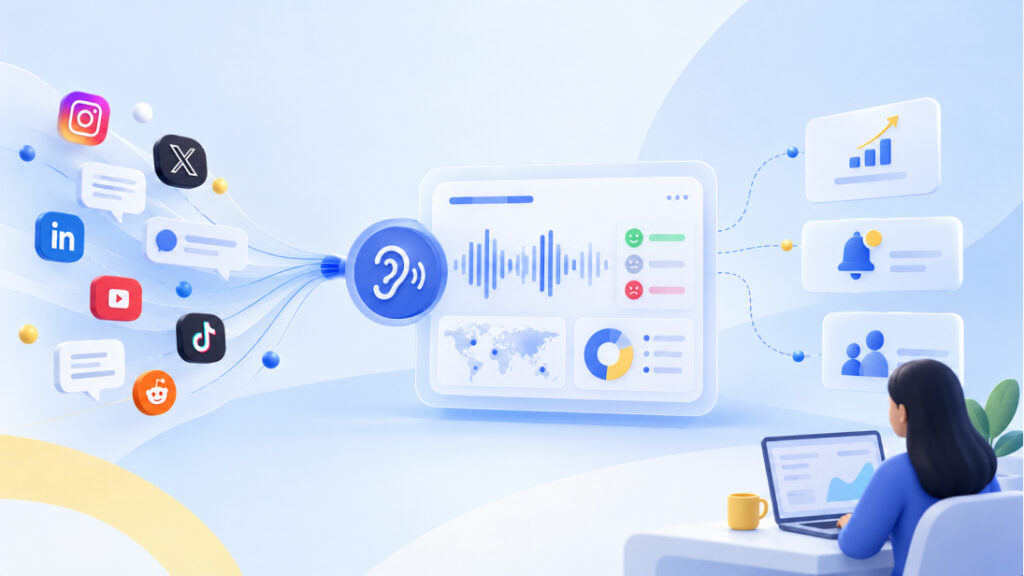
Channel coverage across 20+ surfaces
X, Instagram, Facebook, LinkedIn, YouTube including comments, TikTok, Reddit, niche forums, review platforms (Google, Trustpilot, Glassdoor), news, blogs, and podcasts. Including the channels where reputation crises typically incubate – not just the ones where they eventually break.
Real-time monitoring with multi-language support
Coverage in 20+ languages, including Indian and South Asian languages essential for regional brand monitoring across the subcontinent. A crisis that starts in Hindi on regional forums is not a crisis that a English-only listening operation catches early.
AI-powered sentiment and emotion detection via Konnect AI+
Detects emotion intensity, intent, and risk signals at the individual mention level – surfacing early warning brand reputation signals hours before volume alerts would trigger. The system distinguishes anger from frustration, genuine complaint from sarcasm, organised action from isolated dissatisfaction.
Predictive alerting
Pattern-based alerts on rate of change, emotion shift, channel-jump events, and influencer involvement give the response team early warning in the spark phase. The first alert fires before the crisis, not during it.
Unified customer profile in the Social CRM
Connects every public complaint to that customer’s full interaction history, enabling contextual response rather than generic statements. The response team knows what the customer has experienced before they write a word.
Omnichannel ticketing and routing
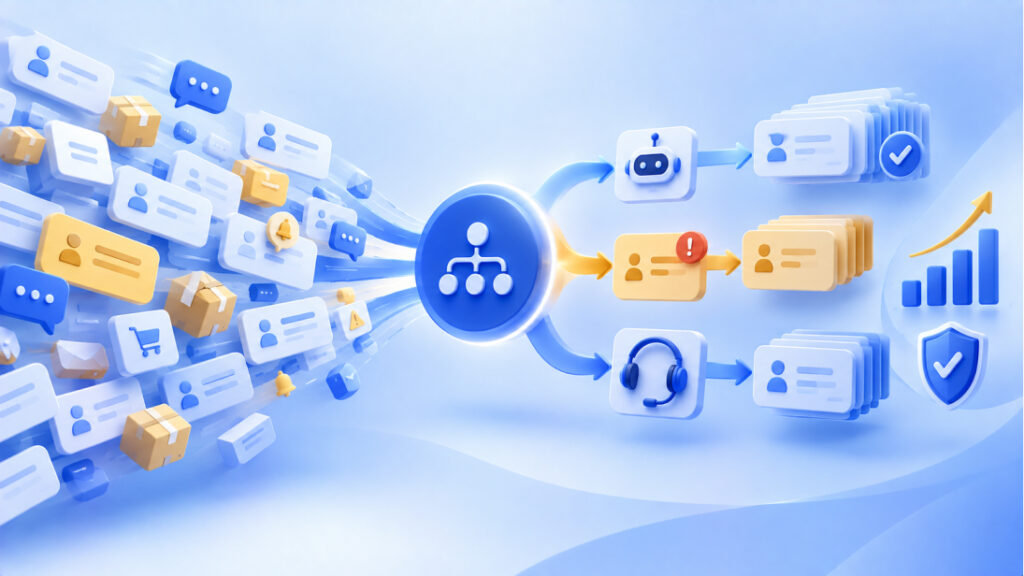
Routes reputation-sensitive cases to PR, CX, or legal automatically with full context attached. No manual triage. No signal lost between detection and response.
Cross-functional collaboration
PR, CX, legal, and leadership operate on the same listening data and case workflow. The misalignment that wrecks live response is structurally prevented, not just managed.
BI dashboards and reputation scorecards
Sentiment trend, share-of-voice composition, complaint volume, emerging topic clusters, and recovery trajectory – the longitudinal view the playbook requires. Both real-time operational dashboards and long-term health scorecards, in one platform.
Compliance and audit logs
Built for regulated industries – BFSI, healthcare, government-adjacent operations – where reputation work must be fully auditable and defensible to regulators.
Konnect Insights doesn’t just monitor mentions. It runs the entire operational stack a reputation program needs – listening, sentiment, ticketing, response, recovery measurement – in one platform. That’s what makes the five-phase playbook actually executable rather than theoretical.
Reputation Is Built Slowly And Lost Fast
Brand reputation is the slowest asset to build and the fastest to lose. The brands that protect it well aren’t the ones with the cleverest crisis communications. They’re the ones running reputation as a continuous operating discipline – listening every day, detecting early, triaging accurately, responding with alignment, recovering with proof, and feeding every incident back into prevention.
The five-phase playbook in this guide is the operational shape of that discipline. None of it is theoretical. All of it is executable today with the right tooling and the right cross-functional setup. The brands that run this playbook consistently describe their reputation work the same way: rarely surprised, never panicked, always measuring.
The brands that don’t describe it as a series of fire drills with diminishing room for recovery each time.
The strategic question isn’t whether to invest in reputation listening. The speed of social, the permanence of AI-summarised content, and the erosion of brand-controlled narrative have already made that decision. The question is whether the operation is built to catch the spark before it becomes a fire – and to rebuild durably when an incident does break.
If you want to see what a serious social listening for brand reputation operation looks like across 20+ channels, in real time, with listening, omnichannel ticketing, sentiment, and recovery measurement integrated, book a demo with Konnect Insights and we’ll walk you through how leading brands run the full reputation playbook.
Frequently Asked Questions
Social listening surfaces early warning signals - emotion intensity spikes, channel-jump events, influencer involvement - often hours before a crisis reaches mainstream attention. It provides real-time intelligence during a live incident, supports cross-functional response coordination, and measures recovery trajectory after the news cycle ends. The discipline shifts brand reputation management from reactive to predictive.
Online reputation management is the broader practice of monitoring, influencing, and recovering brand reputation across digital channels. Social listening is one foundational capability within ORM - providing the real-time signal layer. ORM includes social listening plus response workflows, review management, search visibility management, and long-term reputation strategy.
The strongest early signals: emotion intensity spikes (anger, anxiety, disgust), channel-jump events (complaint moving across platforms), influencer or journalist involvement, geographic clustering of complaints, narrative match with live cultural moments, and replication across multiple independent accounts. Two or three of these signals firing together is a high-confidence escalation indicator.
Measure across three layers: real-time signals (alert accuracy, time to response), incident metrics (peak negative volume, sentiment shift post-response, recovery half-life), and long-term health (12-month sentiment trend, share-of-voice composition, NPS trend, search result first-page composition). All three layers together give the full picture.
Treating reputation as a crisis-only function rather than a continuous discipline. Most brands invest in response and neglect setup, detection, recovery, and prevention. They lose the early-warning window where intervention costs least, declare victory when the news cycle ends, and skip the prevention loop - so similar incidents recur.
AI detects early-warning patterns - rate of change in volume, emotion mix shift, channel-jump events, influencer involvement - that historically precede crises, providing 2-6 hours of advance notice in most cases. It cannot predict from zero data or guarantee outcomes. Predictive accuracy improves as the model learns from your brand's specific incident history.
Author