Skip to content


For U.S. businesses, social media is no longer just a marketing channel. It is one of the most reliable sources of real-time customer sentiment, early risk signals, and product feedback. Conversations on platforms like X, Reddit, LinkedIn, and review sites often surface issues days or weeks before they show up in surveys or support data.
That creates both opportunity and risk. U.S. brands operate at scale, with high conversation volumes, strict data privacy expectations, and little margin for delayed responses or misread sentiment. In this environment, generic social listening tools fall short. They struggle with contextual accuracy, lack enterprise-grade compliance, or operate in isolation from customer experience and support workflows.
Choosing the right social listening platform is therefore a business decision, not a marketing one. The best tools for U.S. businesses combine deep channel coverage, reliable AI-driven insights, strong security controls, and the ability to turn social data into actions across marketing, CX, and leadership teams.
What U.S. Businesses Should Look for in a Social Listening Tool
For U.S. brands, social listening cannot sit outside the customer experience stack. At scale, it needs to function as a core CX capability, not just a marketing add-on. Tracking mentions alone is no longer enough when customer conversations span social, reviews, support channels, and public forums.
Many tools focus on volume and surface metrics but fail to unify interactions or connect insights to action. That disconnect makes it hard to improve customer experience or demonstrate ROI. U.S. businesses need social listening platforms that bring conversations into a single CX view, support multiple teams, meet compliance expectations, and turn signals into decisions that actually improve outcomes.
1. Data Coverage & U.S.-Focused Channels
For U.S. brands, coverage depth matters more than raw volume. A useful social listening tool must capture conversations across platforms where U.S. audiences actually speak freely, including X, Reddit, LinkedIn, YouTube, major review sites, forums, and digital news. Each channel carries a different type of signal. Reddit surfaces unfiltered opinions, X reflects real-time reactions, reviews expose recurring product and service issues, and LinkedIn often signals brand trust and employer perception.
Equally important is language and cultural nuance. American English is highly contextual. Sarcasm, slang, and regional phrasing can completely change meaning. Tools that rely on surface-level keyword matching often misread sentiment, which leads to bad decisions at scale.

2. AI & Sentiment Accuracy
Sentiment analysis is only valuable if it understands context. Keyword polarity alone cannot distinguish between frustration, humor, or criticism aimed at competitors. U.S. brands should prioritize platforms that use contextual AI models trained on real conversational data rather than static dictionaries.
Beyond sentiment, strong tools identify emerging trends and anomalies. Sudden spikes in negative conversation, coordinated narratives, or early signs of product issues should trigger alerts before they escalate. Accuracy here directly affects crisis response, customer trust, and internal credibility.
3. Enterprise-Grade Compliance & Security
U.S. businesses face increasing scrutiny around data privacy and governance. A social listening platform should demonstrate readiness for frameworks like SOC 2 and CCPA, with GDPR alignment for brands operating internationally. This is not just about certifications. It is about operational controls.
Role-based access, audit logs, and clear data handling practices matter when insights are shared across teams and leadership. Without them, social data becomes a risk instead of an asset.
4. Cross-Team Usability
Social listening fails when it lives only inside marketing. U.S. organizations need tools that serve CX, PR, and leadership teams without friction. Dashboards should reflect different priorities, from customer complaints to brand risk to strategic insights.
Alerting and workflow features are critical. Insights must move quickly to the teams that can act on them, not sit in reports.
5. Integrations & Data Export
The value of social listening increases when it connects to existing systems. Integration with CRM, helpdesk, BI tools, and CDPs allows social signals to influence support decisions, customer profiles, and performance reporting. Without this, social data remains isolated and underused.
Quick Comparison of the Best Social Listening Tools for the USA Market
The social listening landscape offers no shortage of options, but not all platforms are built for the same purpose. Some are designed primarily for marketing and campaign analysis, while others are meant to support deeper use cases like market research, brand risk monitoring, or customer experience management.
Choosing the right tool depends on how you plan to use social data today and how that usage will evolve as your business scales. U.S. brands, in particular, need platforms that can handle volume, integrate with existing workflows, and grow alongside expanding teams and data demands.
| Tool | Best For | Channels Covered | AI Sentiment | Enterprise Readiness | Pricing Model |
| Konnect Insights | CX-led U.S. brands needing unified customer intelligence | X, Reddit, LinkedIn, Instagram, Facebook, YouTube, reviews, news, forums | Contextual, CX-aware sentiment with alerts | High – built for multi-team CX, compliance-ready | Custom / Enterprise |
| Hootsuite | Marketing teams managing publishing + basic listening | X, Instagram, Facebook, LinkedIn, YouTube | Basic keyword-based sentiment | Medium – limited CX depth | Tiered / Public |
| Sprout Social | U.S. marketing teams focused on engagement and reporting | X, Instagram, Facebook, LinkedIn, YouTube | Moderate AI sentiment with trend views | Medium – marketing-first, limited CX workflows | Tiered / Public |
| Sprinklr | Large enterprises with complex omnichannel needs | Social, reviews, news, forums, messaging | Advanced AI models at scale | Very High – enterprise-grade CX suite | Enterprise-only |
| Talkwalker | Brands focused on analytics, trends, and visual listening | Social, news, blogs, forums, visual media | Strong AI with visual recognition | High – analytics-heavy enterprise use | Custom / Enterprise |
Not every platform is designed to support the same level of scale, risk, or customer experience maturity. Some are optimized for marketing teams and campaign tracking, while others are built to support enterprise-wide decision-making across CX, PR, and leadership.
The key is alignment. The right social listening tool should match how your organization operates today and where it is headed. In the sections that follow, each platform is examined through the lens of real-world usage, strengths, limitations, and suitability for U.S. businesses with different priorities.
5 Best Social Listening Tools for U.S. Businesses
In this section, we take a closer look at five social listening platforms that are widely used by U.S. businesses. The goal is not to rank tools based on feature count, but to understand what each platform is actually built to do and where it fits best.
Each tool is evaluated based on how well it supports U.S. market requirements such as data accuracy, compliance readiness, integration with CX and marketing workflows, and the ability to scale across teams. This breakdown is designed to help you identify the platform that aligns most closely with your specific use case, team structure, and customer experience goals.
1. Konnect Insights
Best for:
U.S. enterprises and growing brands that want social listening tightly integrated with customer experience management.
Overview
Konnect Insights is positioned as a CX-led, AI-first social listening platform rather than a standalone marketing tool. It focuses on unifying social conversations, reviews, and public feedback with broader customer experience workflows. For U.S. businesses dealing with high conversation volumes, brand risk, and strict compliance expectations, this approach helps move social listening closer to operational decision-making. Instead of stopping at insights, the platform is designed to connect listening data to action across marketing, CX, and leadership teams.

Key Social Listening Features
- AI-powered contextual sentiment analysis tuned for real-world conversations
- Coverage across major U.S.-relevant channels including X, Reddit, LinkedIn, YouTube, reviews, forums, and news
- Real-time alerts for sentiment spikes, emerging issues, and potential brand risks
- Unified dashboards that combine social listening with CX and service insights
- Advanced reporting designed for both operational teams and leadership
- Workflow enablement to route insights to CX, PR, or support teams
Pros
- Strong focus on customer experience, not just brand monitoring
- Context-aware sentiment reduces false positives at scale
- Built to support multiple teams without data silos
- Well-suited for U.S. brands needing actionable insights, not just visibility
Cons
- Not designed for lightweight, publishing-only use cases
- Requires organizational buy-in to fully leverage CX integration
- May be more than needed for very small teams with basic listening needs
Pricing
Custom / Enterprise-focused pricing
Ideal For
- Mid-market to large U.S. businesses
- CX, marketing, PR, and customer support teams that need shared visibility and actionable insights
2. Hootsuite
Best for:
Marketing teams focused on social publishing with basic listening and reporting needs.
Overview
Hootsuite is primarily a social media management platform with listening capabilities layered on top. Its core strength lies in helping marketing teams schedule, publish, and monitor content across major social networks. For U.S. businesses, Hootsuite works best when social listening is a supporting function rather than a core CX or intelligence capability. It provides visibility into brand mentions and keywords but is not designed to unify social data with broader customer experience or service workflows.
Key Social Listening Features
- Monitoring of brand mentions and keywords across major social platforms
- Coverage for X, Instagram, Facebook, LinkedIn, and YouTube
- Basic sentiment tagging based on keyword polarity
- Stream-based dashboards for tracking conversations in real time
- Standard reporting for engagement and mention volume
- Integration with publishing and social management workflows
Pros
- Easy to use for marketing teams already managing social publishing
- Broad coverage of major social platforms popular in the U.S.
- Lower barrier to entry compared to enterprise-focused tools
- Suitable for teams that want listening alongside scheduling
Cons
- Sentiment analysis lacks contextual depth
- Limited support for CX, PR, or risk monitoring use cases
- Not built for enterprise-scale insights or cross-team workflows
Pricing
Tiered / Public pricing
Ideal For
- Small to mid-sized U.S. marketing teams
- Teams prioritizing content management and basic listening over CX-driven insights
3. Sprout Social
Best for:
U.S. marketing teams that want structured reporting and engagement insights alongside social listening.
Overview
Sprout Social is a marketing-focused social media management platform with built-in listening and analytics. It is designed to help teams understand audience engagement, track brand mentions, and measure campaign performance across major social networks. For U.S. businesses, Sprout Social works well when social listening is primarily used to support marketing decisions rather than enterprise-wide CX or risk management. Its strength lies in usability and reporting clarity, not in unifying social data with service or operational workflows.

Key Social Listening Features
- Brand and keyword monitoring across major social platforms
- Coverage for X, Instagram, Facebook, LinkedIn, and YouTube
- AI-assisted sentiment and trend summaries
- Topic and hashtag tracking for campaign analysis
- Clean, presentation-ready reports for marketing teams
- Engagement insights tied directly to social performance metrics
Pros
- Strong reporting and visualization for marketing stakeholders
- Easy adoption for teams already focused on social engagement
- Useful audience and campaign-level insights
- Well-supported integrations within marketing tool stacks
Cons
- Listening capabilities are secondary to publishing and engagement
- Limited CX and support workflow integration
- Not designed for high-volume enterprise risk monitoring
Pricing
Tiered / Public pricing
Ideal For
- Small to mid-sized U.S. businesses
- Marketing and social media teams focused on engagement, reporting, and campaign optimization
4. Sprinklr
Best for:
Large enterprises managing complex, omnichannel customer experience and brand risk at scale.
Overview
Sprinklr is an enterprise-grade customer experience management platform with social listening as a core component of a much broader CX suite. It is designed for organizations with high interaction volumes, multiple business units, and strict governance requirements. For U.S. enterprises, Sprinklr’s strength lies in scale, control, and depth across social, service, and engagement channels. Social listening within Sprinklr is tightly connected to workflows, analytics, and governance rather than operating as a standalone function.
Key Social Listening Features
- Coverage across social media, reviews, news, forums, and digital communities
- Advanced AI-driven sentiment and intent analysis at enterprise scale
- Real-time alerts for brand risk, crises, and compliance issues
- Unified dashboards spanning marketing, CX, PR, and service teams
- Strong governance controls, audit trails, and role-based access
- Deep workflow automation across customer engagement and support
Pros
- Built for very large organizations with complex CX requirements
- Strong governance, security, and compliance capabilities
- Highly configurable workflows across multiple teams and regions
- Handles high data volumes reliably
Cons
- Steep learning curve for smaller or less mature teams
- Implementation and customization can be time-intensive
- Often more platform than mid-sized teams require
Pricing
Enterprise-only / Custom pricing
Ideal For
- Large enterprises and global brands
- CX, digital, PR, compliance, and customer service teams operating at scale
5. Talkwalker
Best for:
U.S. brands that prioritize advanced analytics, trend detection, and large-scale consumer insights.
Overview
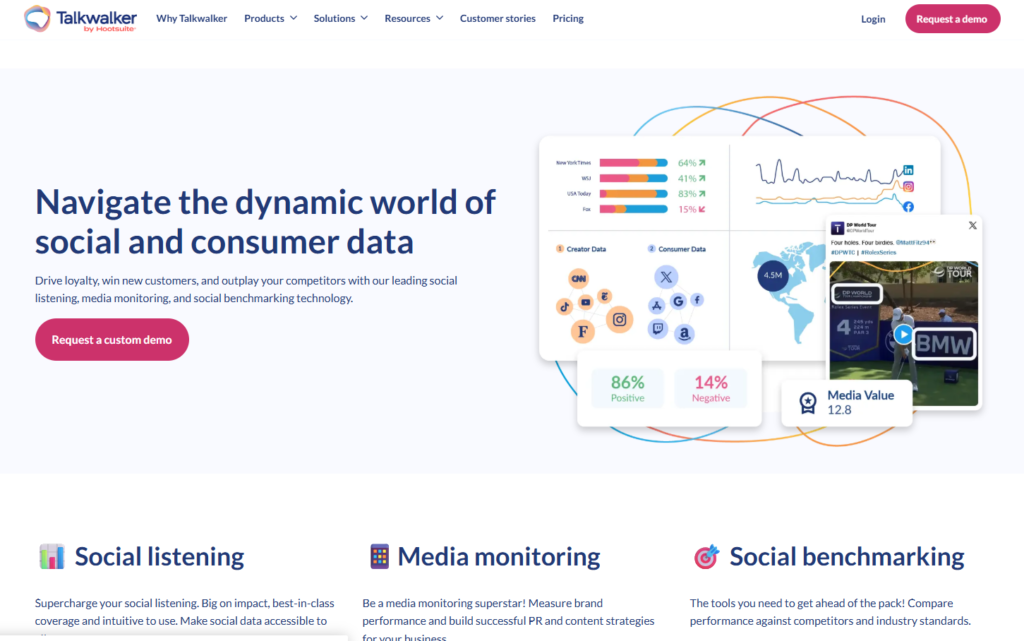
Talkwalker is a social listening and consumer intelligence platform known for its strong analytical depth and AI-driven insight discovery. It is widely used by U.S. brands that rely on social data for market research, brand tracking, and trend analysis rather than day-to-day customer experience workflows. The platform excels at processing large data sets across social, news, and online media, making it a strong fit for organizations that need macro-level visibility into brand perception and emerging narratives.
Key Social Listening Features
- Broad coverage across social media, news, blogs, forums, and online publications
- AI-driven sentiment analysis with trend and theme clustering
- Visual listening for image and logo recognition
- Real-time alerts for emerging topics and reputational risks
- Advanced dashboards and analytics for research-driven teams
- Historical data access for long-term trend analysis
Pros
- Strong analytics and insight discovery capabilities
- Effective for large-scale trend and market research
- Visual listening adds depth beyond text-based analysis
- Scales well for high data volumes
Cons
- Less focused on CX and operational workflows
- Insights often require analyst interpretation to drive action
- Limited native support for support or service teams
Pricing
Custom / Enterprise pricing
Ideal For
- Mid-market to large U.S. brands
- Market research, brand, and insights teams focused on analysis and reporting
How to Choose the Right Social Listening Tool for Your Business
Finalizing a single platform can feel intimidating when there are so many options available. That’s why it’s often worth starting with a free trial before committing to a purchase. Beyond that, the scenarios below can help you assess your priorities more clearly and choose the platform that best aligns with how your teams work and what outcomes you expect from social listening.
If you’re a mid-market U.S. brand
If your priority is gaining visibility into brand conversations without heavy operational complexity, choose a tool that balances usability with meaningful insights. Mid-market teams often need faster setup, clear reporting, and manageable costs. Platforms that combine social listening with marketing analytics can work well here, as long as sentiment accuracy is reliable and data volume limits are not restrictive. Avoid tools built exclusively for very large enterprises if they introduce overhead your team cannot realistically support.
If you’re an enterprise with multiple teams
If your organization spans marketing, CX, PR, and leadership functions, choose a platform designed for cross-team use. Enterprise environments require role-based access, governance controls, and shared dashboards that serve different stakeholders without duplicating effort. Tools that treat social listening as part of a broader customer experience or engagement platform are better suited here. Standalone listening tools may provide insights, but they often struggle to scale across departments.
If CX and support matter more than marketing
If improving customer experience and service quality is your main goal, choose a platform that integrates social listening directly with CX and support workflows. Social signals should inform ticket prioritization, escalation, and quality analysis, not live in separate reports. Tools built around CXM make it easier to connect public feedback with service outcomes and demonstrate ROI beyond marketing metrics.
If you need real-time risk monitoring
If brand risk, compliance, or crisis response is a concern, choose a tool that emphasizes real-time alerts, anomaly detection, and governance. The ability to catch sentiment shifts early and route them to the right teams is critical. Platforms built for enterprise-scale monitoring and rapid response are better suited than tools focused primarily on publishing or post-level engagement.
Common Mistakes U.S. Businesses Make When Buying Social Listening Tools
- Choosing volume over signal quality
High mention counts look impressive, but volume without context leads to noise. U.S. brands often miss critical issues when sentiment accuracy and relevance are sacrificed for scale. - Treating social listening as a marketing-only tool
When listening lives only within marketing, valuable insights never reach CX, support, or leadership teams. This limits impact and makes it harder to justify ROI. - Ignoring integration with CX and service workflows
Insights that cannot flow into CRMs, helpdesks, or support systems rarely drive action. Social feedback should inform real decisions, not remain in isolated reports. - Overpaying for unused enterprise features
Many businesses buy platforms designed for far larger organizations than they need. This increases cost and complexity without improving outcomes. - Underestimating compliance and governance needs
Data access controls, audit logs, and privacy readiness are often overlooked during evaluation, only to become issues later as teams and data volumes grow.
Conclusion
Social listening has moved far beyond tracking mentions or measuring engagement. For U.S. businesses, it now functions as a form of business intelligence, shaping how brands understand customers, manage risk, and improve experience across touchpoints. At scale, accuracy matters more than volume, and insights are only valuable if they can be acted on securely and consistently.
This is why tool selection should align with your CX maturity. Platforms built purely for marketing struggle to support enterprise workflows, compliance needs, and cross-team visibility. Konnect Insights stands out for U.S. brands because it combines contextual AI sentiment, broad channel coverage, real-time alerts, enterprise-grade security, and deep integration with CX and service workflows. It is designed to unify social listening with customer experience, not isolate it.
If you are evaluating platforms with long-term scale and CX impact in mind, book a demo to see how Konnect Insights fits into your existing ecosystem and business goals.
FAQs
What is the best social listening tool for U.S. enterprises?
The best tool depends on how social data is used inside the organization. Enterprises that need scale, governance, and CX integration typically benefit from platforms built beyond marketing use cases. Tools that unify social listening with customer experience workflows are often a better long-term fit than standalone listening products.
Are social listening tools compliant with U.S. data regulations?
Most enterprise-focused platforms are designed with U.S. data regulations in mind, including CCPA readiness and SOC 2–aligned controls. However, compliance varies by vendor. It is important to review data handling practices, access controls, and audit capabilities during evaluation.
What’s the difference between Konnect Insights and Sprinklr?
Sprinklr is a broad enterprise CX suite designed for very large organizations with complex requirements. Konnect Insights focuses on unifying social listening with CX in a more streamlined, AI-led platform, making it easier to operationalize insights without excessive complexity.
Can social listening improve customer support?
Yes. When integrated with CX and service workflows, social listening helps teams identify issues earlier, prioritize responses, and connect public feedback to support outcomes.Are there affordable social listening tools for mid-sized U.S. businesses?
Mid-sized businesses often find value in platforms that balance cost with insight depth. Tools that offer flexible pricing and scalable features can support growth without forcing teams to overpay for unused enterprise functionality.