Skip to content


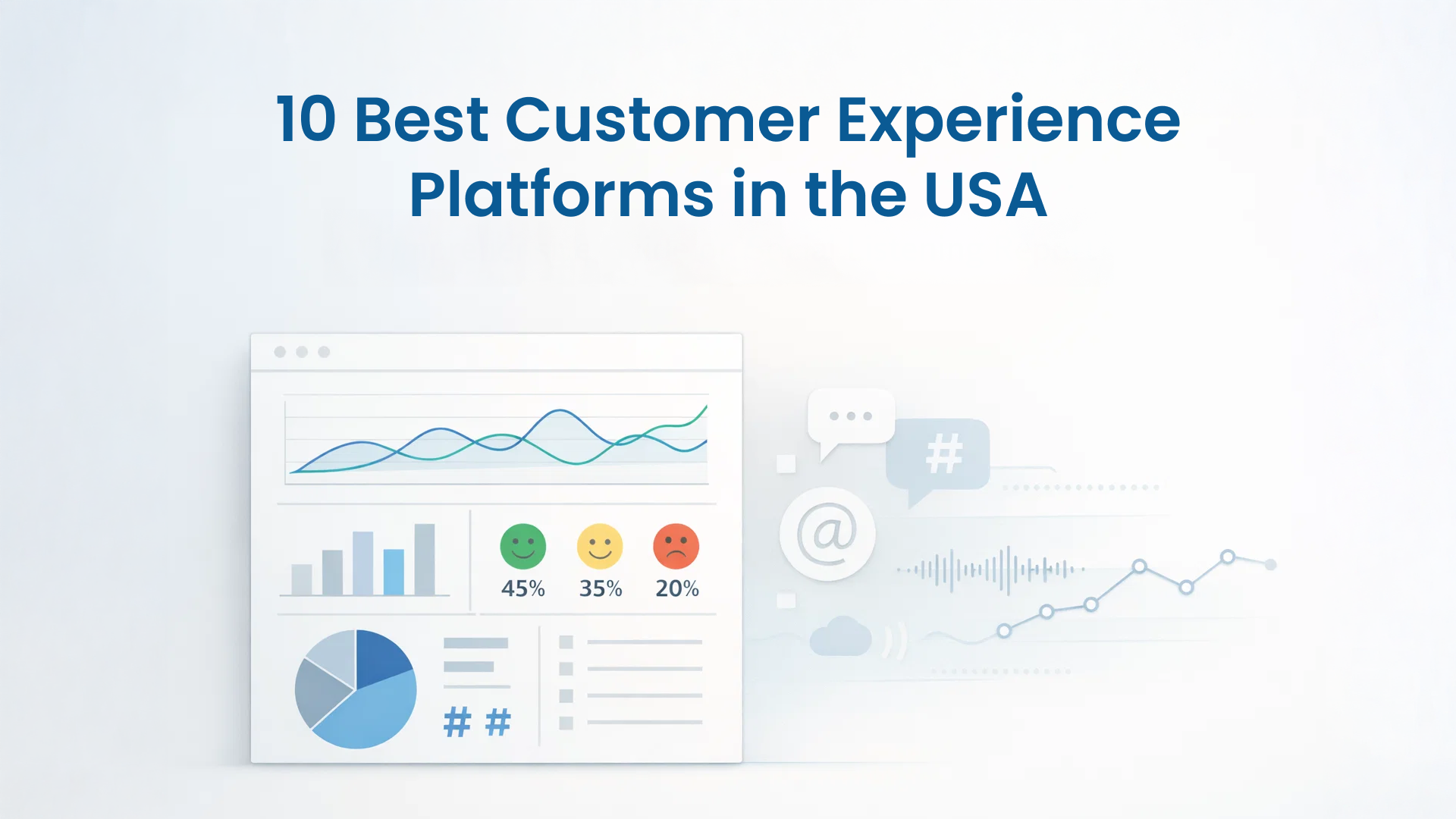
The US customer experience market is crowded. Hundreds of platforms promise better CX, faster responses, and happier customers. Yet for US businesses, the bar is far higher. Customers expect instant responses, consistent experiences across channels, and near-zero tolerance for errors. One poor interaction can damage brand trust, trigger negative reviews, and push customers directly to competitors.
This is why US businesses need customer experience platforms that are mature, reliable, and built to handle complex, high-volume interactions at scale. Customer experience in the USA is no longer just a support function. It is a core growth and retention driver, where response speed, consistency, and visibility across channels directly influence revenue.
At the same time, many brands are overpaying for bloated platforms without realizing that several underrated CX solutions deliver equal or greater value with far better efficiency. In this guide, we break down the 10 best customer experience platforms in the USA for 2026, selected based on real capabilities, adoption by US businesses, scalability, and long-term business impact.
What are Customer Experience Platforms?
Customer experience platforms in the USA are software solutions that help businesses manage, analyze, and improve customer interactions across every channel. These platforms bring together touchpoints such as email, chat, social media, reviews, calls, and surveys into a single system, giving teams a complete view of each customer.
For US businesses, customer experience platforms need to go beyond support ticketing. They have to enable real-time analytics, automation, customer feedback tracking, and compliance with regional data standards. The goal is to deliver fast, consistent, and personalized experiences at scale while giving teams the visibility needed to act on customer insights.
10 Best Customer Experience Platforms for Businesses in the USA
Here’s a quick-reference list of the 10 best customer experience platforms in the USA, based on maturity, breadth of capabilities, and suitability for modern US businesses:
- Konnect Insights: Best for unified omnichannel CX, social listening, and AI-driven insights
- Salesforce Experience Cloud: Best for CRM-led customer experience at enterprise scale
- Qualtrics XM: Best for experience measurement and customer feedback analytics
- Medallia Experience Cloud: Best for enterprise-grade customer and employee experience analytics
- Sprinklr: Best for large-scale omnichannel engagement and social CX
- Zendesk: Best for ticketing-focused customer support teams
- HubSpot Service Hub: Best for CRM-connected customer service for growing teams
- Freshdesk: Best for cost-effective helpdesk and basic omnichannel support
- Oracle CX Suite: Best for large enterprises already invested in Oracle ecosystems
- SentiSum: Best for AI-driven customer feedback and sentiment analysis
Compare Specs of the Best CX Platforms in the USA
Below is a side-by-side comparison of the 10 best customer experience platforms in the USA, based on core capabilities, ideal use cases, and pricing approach.
| CX Platform | Key Features | Best For | Pricing |
| Konnect Insights | Omnichannel CX across social, chat, email, and reviews; social listening and reputation management; AI analytics, sentiment analysis, and unified dashboards | Mid-market and enterprise teams that need unified CX and actionable insights | Custom pricing based on business requirements |
| Salesforce Experience Cloud | CRM-based customer portals, case management and workflows, personalization using Salesforce data | Large enterprises already using Salesforce | Tiered and bundled pricing with custom enterprise quotes |
| Qualtrics XM | CX and EX surveys, NPS CSAT CES tracking, experience analytics and reporting | Experience measurement and research teams | Custom pricing, module-based |
| Medallia Experience Cloud | Voice of Customer analytics, journey and sentiment analysis, enterprise CX reporting | Large enterprises focused on CX analytics | Custom enterprise pricing |
| Sprinklr | Social CX and engagement, enterprise automation and governance, omnichannel case management | Global enterprises with large CX operations | Premium enterprise pricing |
| Zendesk | Ticketing and case management, help center and self-service, support analytics | Support-focused teams | Tiered per-agent pricing |
| HubSpot Service Hub | CRM-connected support, automation and SLAs, customer feedback tools | SMBs and mid-market teams using HubSpot | Free plan plus tiered pricing |
| Freshdesk | Helpdesk and ticketing, email chat and phone support, basic automation and reporting | SMBs with support-heavy needs | Free plan plus tiered pricing |
| Oracle CX Suite | Enterprise CRM and CX tools, AI-driven insights, ERP and data integrations | Oracle-centric enterprises | Custom enterprise pricing |
| SentiSum | AI text and sentiment analysis, feedback categorization, CX insight dashboards | CX and product insight teams | Custom pricing based on data volume |
1. Konnect Insights: The Best Customer Experience Platform in the USA

Konnect Insights is a unified customer experience platform designed to help US businesses manage every customer interaction from a single, connected workspace. It brings together social conversations, support tickets, reviews, surveys, and analytics into one dashboard, giving teams full visibility across the customer lifecycle.
Instead of sales, marketing, and support working in silos, Konnect Insights centralizes customer data so every team operates with the same context. This makes it easier to respond faster, personalize interactions, and make CX decisions backed by real-time data.
Key Features
- Omnichannel customer engagement across social, email, chat, reviews, and messaging apps
- Advanced social listening and brand monitoring
- Reputation management for reviews and public feedback
- Unified customer profiles and interaction history
- AI-powered analytics, sentiment analysis, and insights
- Integrations with CRMs, helpdesk tools, and marketing platforms
- Custom dashboards and reporting for CX, marketing, and operations teams
Pros
- Truly unified CX data across teams and channels
- Strong balance of analytics, automation, and usability
- Flexible integrations with existing customer systems
- Scales well for mid-market and enterprise US businesses
Cons
- Initial setup may require alignment across internal teams
- Advanced customization options may need onboarding support
Pricing
- Starter plans for growing teams
- Advanced plans for mid-market organizations
- Enterprise plans with full customization
- Custom pricing based on business requirements and usage
What makes Konnect Insights the Best CX Platform for USA Businesses
Konnect Insights is a well-established platform with a growing presence across industries in the USA. It integrates seamlessly with existing customer channels, allowing businesses to improve CX without replacing their entire tech stack. Compared to many enterprise tools, it offers significantly better value, delivering advanced capabilities without excessive licensing costs.
The data accuracy and depth of insights set it apart, helping teams act on customer feedback with confidence. Many brands are actively switching to Konnect Insights for its clarity, flexibility, and reliability. Backed by a responsive and knowledgeable customer support team, businesses get hands-on guidance at every stage of adoption.
Book a demo to see how Konnect Insights can transform customer experience for your US business.
2. Salesforce Experience Cloud
Salesforce Experience Cloud is a customer experience platform built to help US enterprises create connected customer portals, communities, and self-service experiences on top of the Salesforce CRM ecosystem. It enables businesses to extend customer interactions beyond support tickets by offering personalized portals for service, sales, and partner engagement.

Salesforce Experience Cloud works best for organizations already deeply invested in Salesforce products. Customer data flows directly from CRM records into portals and workflows, allowing teams to manage interactions with shared context. However, most CX capabilities depend heavily on Salesforce’s broader stack rather than functioning as a standalone CX platform.
Key Features
- Customer portals and self-service communities
- Deep integration with Salesforce CRM and Service Cloud
- Case management and workflow automation
- Personalization based on CRM data
- Partner and customer community management
- Low-code tools for building branded experiences
Pros
- Strong CRM-native customer experience capabilities
- Highly customizable for enterprise use cases
- Scales well for large US organizations
- Robust ecosystem of third-party apps and integrations
Cons
- Requires heavy reliance on the Salesforce ecosystem
- Complex setup and configuration for non-Salesforce teams
- Costs increase significantly as features and users scale
Pricing
- Pricing varies by edition and usage
- Typically bundled with other Salesforce products
- Custom enterprise pricing based on requirements
Salesforce Experience Cloud is well-suited for large US enterprises that already run their operations on Salesforce. It offers strong portal and CRM-linked experiences, making it effective for customer and partner engagement at scale. However, its CX capabilities are largely CRM-centric and often require additional Salesforce products to achieve full omnichannel visibility. For businesses seeking a more unified, out-of-the-box CX platform without heavy dependency on a single ecosystem, alternatives may offer greater flexibility and value.
3. Qualtrics XM
Qualtrics XM is an experience management platform widely used by US enterprises to measure customer, employee, and brand experience. It is best known for its advanced survey capabilities and experience analytics rather than real-time customer engagement. Qualtrics XM helps organizations capture structured feedback at scale and turn it into reports and insights for leadership and CX teams.

The platform is primarily insight-driven, focusing on measurement and analysis rather than managing live customer interactions across channels.
Key Features
- Advanced customer and employee experience surveys
- CSAT, NPS, and CES measurement tools
- Experience analytics and reporting dashboards
- Text and sentiment analysis for feedback data
- Integration with CRMs and data warehouses
- Role-based reporting and enterprise governance
Pros
- Strong experience measurement and survey capabilities
- Trusted by large US enterprises and global brands
- Powerful analytics and reporting for CX teams
- Highly scalable for complex organizations
Cons
- Limited real-time omnichannel engagement capabilities
- Not designed to manage live customer conversations
- Requires additional platforms for unified CX execution
- Can feel disconnected from day-to-day support and social CX workflows
Pricing
- Custom pricing based on modules and usage
- Enterprise-focused pricing model
- Cost increases with advanced analytics and add-ons
4. Medallia Experience Cloud
Medallia Experience Cloud is an enterprise-focused customer experience platform used by many large US organizations to collect and analyze customer and employee feedback. It is primarily designed for experience measurement at scale, helping leadership teams understand sentiment, trends, and performance across touchpoints. Medallia excels in capturing structured and unstructured feedback but is less focused on managing live, omnichannel customer interactions in real time.

Key Features
- Customer and employee experience feedback collection
- Voice of Customer (VoC) analytics
- Text and sentiment analysis
- Journey analytics and experience tracking
- Enterprise-grade reporting and dashboards
- Integrations with CRM and operational systems
Pros
- Strong experience measurement and VoC capabilities
- Widely adopted by large US enterprises
- Advanced analytics for long-term CX strategy
- Handles large volumes of feedback data reliably
Cons
- Limited real-time omnichannel engagement and response capabilities
- Primarily insight-driven rather than action-oriented
- Requires additional platforms to execute unified CX workflows
- High implementation effort compared to more agile CX platforms
Pricing
- Enterprise-only pricing model
- Custom pricing based on modules, scale, and usage
- Typically positioned at the higher end of the CX market
5. Sprinklr
Sprinklr is an enterprise customer experience platform built for managing large-scale social, marketing, and customer service operations. It is widely used by global brands in the USA to handle high volumes of social conversations and digital engagement across multiple teams. Sprinklr positions itself as an all-in-one CX suite, though much of its strength lies in social media management and enterprise-level governance rather than day-to-day CX agility.

Key Features
- Omnichannel customer engagement across social and digital channels
- Enterprise-grade social listening and publishing
- Social customer care and case management
- AI-driven insights and automation workflows
- Advanced governance, compliance, and access controls
- Scalable infrastructure for global teams
Pros
- Built for very large enterprises with complex CX operations
- Strong social media and digital engagement capabilities
- Highly configurable workflows and governance controls
- Handles massive volumes of customer interactions
Cons
- High licensing and implementation costs
- Complex user interface with a steep learning curve
- Overkill for mid-market and fast-moving CX teams
- Many features go underutilized despite the premium pricing
Pricing
- Enterprise-only pricing
- Custom quotes based on users, modules, and volume
- Positioned among the most expensive CX platforms in the market
6. Zendesk
Zendesk is a widely adopted customer support platform used by many US businesses to manage tickets, helpdesk workflows, and customer inquiries. It is best known for its ease of use and strong ticketing system rather than full-scale customer experience management. Zendesk works well for support-heavy teams but often requires additional tools to deliver a truly unified, omnichannel CX strategy.

Key Features
- Ticketing and case management
- Email, chat, and messaging-based support
- Help center and self-service knowledge base
- Automation rules and SLA management
- Reporting and support performance analytics
- Marketplace integrations with third-party tools
Pros
- Easy to set up and use for support teams
- Strong ticketing and helpdesk capabilities
- Large ecosystem of integrations and apps
- Suitable for SMBs and mid-market businesses
Cons
- Primarily support-focused, not a full CX platform
- Limited native social listening and reputation management
- Fragmented customer data across channels without add-ons
- Scaling omnichannel CX often increases cost and complexity
Pricing
- Tiered pricing based on features and agent count
- Additional costs for advanced CX capabilities
- Enterprise plans priced at a premium
7. HubSpot Service Hub
HubSpot Service Hub is a customer service platform designed for US businesses that want to manage support within the broader HubSpot CRM ecosystem. It focuses on aligning customer service with sales and marketing data, making it useful for teams already using HubSpot tools. While it offers solid automation and reporting, it is primarily geared toward inbound support rather than full omnichannel customer experience management.

Key Features
- Ticketing and case management
- Shared inbox for email and chat support
- Knowledge base and customer self-service tools
- Automation workflows and SLAs
- Customer feedback surveys (CSAT, NPS)
- Native integration with HubSpot CRM
Pros
- Seamless integration with HubSpot CRM
- Clean and easy-to-use interface
- Good visibility into customer history for service teams
- Suitable for growing US businesses
Cons
- Limited omnichannel and social CX capabilities
- Advanced features locked behind higher-tier plans
- Not designed for deep CX analytics or social listening
- Less effective for high-volume, multi-channel CX operations
Pricing
- Free plan with basic support features
- Starter, Professional, and Enterprise tiers
- Pricing increases as automation and reporting needs grow
8. Freshdesk (Freshworks)
Freshdesk is a customer support platform widely used by US SMBs and mid-market businesses to manage tickets and basic omnichannel interactions. It focuses on simplifying helpdesk operations across email, chat, phone, and messaging channels. Freshdesk is easy to adopt and cost-effective, but it is primarily designed for support workflows rather than end-to-end customer experience management across marketing, social, and reputation channels.

Key Features
- Ticketing and case management
- Email, chat, phone, and messaging support
- Automation rules and SLA management
- Self-service knowledge base
- Basic analytics and reporting
- App marketplace and integrations
Pros
- Quick to set up and easy to use
- Cost-effective for small and growing teams
- Solid helpdesk and ticketing capabilities
- Supports multiple support channels
Cons
- Limited CX analytics and customer journey visibility
- Minimal native social listening and reputation management
- Customer data remains support-centric rather than unified
- Not built for advanced, multi-team CX strategies
Pricing
- Free plan with basic ticketing
- Growth, Pro, and Enterprise plans
- Pricing scales based on features and agent count
9. Oracle CX Suite
Oracle CX Suite is an enterprise customer experience solution designed for large US organizations that already operate within the Oracle ecosystem. It combines CRM, sales, marketing, and service tools into a broad CX stack aimed at managing complex customer operations. Oracle CX Suite is powerful at scale, but its strength lies in enterprise process management rather than agile, day-to-day omnichannel customer engagement.
Key Features
- CRM, sales, service, and marketing automation
- Customer data management and analytics
- Enterprise-grade reporting and dashboards
- AI-driven recommendations and insights
- Integration with Oracle ERP and enterprise systems
- Security, governance, and compliance controls
Pros
- Built for large-scale enterprise environments
- Strong integration across Oracle products
- Robust data management and analytics capabilities
- Suitable for regulated and complex industries
Cons
- Heavy implementation and long setup cycles
- Less flexible for fast-moving CX teams
- Requires significant dependency on Oracle’s ecosystem
- Higher total cost compared to more unified CX platforms
Pricing
- Enterprise-only pricing
- Custom pricing based on modules and scale
- Typically positioned at the higher end of the market
10. SentiSum
SentiSum is a customer experience analytics platform focused on extracting insights from large volumes of customer feedback. It is primarily used by US businesses to analyze support tickets, reviews, and survey responses using AI-driven text classification. SentiSum is strong in surfacing trends and root causes from feedback data, but it does not manage customer interactions or omnichannel CX workflows end to end.
Key Features
- AI-based text and sentiment analysis
- Automated feedback categorization and tagging
- Root cause analysis for customer issues
- Integration with helpdesks and survey tools
- CX dashboards and insight reporting
- Feedback trend detection over time
Pros
- Strong feedback intelligence and insight discovery
- Reduces manual effort in tagging and analysis
- Useful for CX and product teams focused on insights
- Works well alongside existing support tools
Cons
- Not a full customer experience management platform
- No native omnichannel engagement or case handling
- Requires separate tools for CX execution and automation
- Limited visibility into live customer journeys
Pricing
- Custom pricing based on data volume and integrations
- Typically positioned for mid-market and enterprise teams
How to Choose the Right CX Platform for Your USA Business
Choosing the right customer experience platform is not about picking the most popular tool. It is about finding a solution that aligns with how your customers interact with your brand and how your teams operate. For US businesses, this decision directly impacts response speed, consistency, and long-term customer loyalty.
Define Your CX Goals and Business Needs
Start by identifying the specific customer experience challenges your business is facing. This could include slow response times, lack of personalization, or inconsistent experiences across channels. Once these gaps are clear, define what success looks like, whether that means improving CSAT scores, increasing retention, or centralizing customer interactions into one system. Finally, consider the scale of your operations. The needs of a growing small business are very different from those of a large US enterprise, and your CX platform should match that complexity without creating unnecessary overhead.
Map Out Your Customer Journey
Begin by understanding where and how customers interact with your brand across the entire journey. This includes channels such as phone, email, social media, SMS, live chat, and even in-store interactions where applicable. Once these touchpoints are mapped, identify the stages where a CX platform can create the most impact, such as faster first responses, smoother handoffs between teams, or better visibility into customer history. For US businesses, it is also critical to spot market-specific pain points, especially expectations around speed, availability, and consistency of support.
Evaluate Essential CX Platform Features
Not all CX platforms offer the same depth of functionality, so it is important to evaluate features that directly support your customer experience goals. Look for strong omnichannel communication capabilities that allow teams to manage conversations across email, chat, social, and messaging apps from one place. AI chatbots and automation can help reduce manual effort and improve response times, while robust ticketing and case management ensure accountability. Real-time analytics, customer feedback tools such as CSAT, NPS, and CES, and seamless integrations with CRM, e-commerce, and payment systems are equally important. For US businesses, data security and compliance with standards like HIPAA, SOC 2, and CCPA should be non-negotiable.
Consider US-Specific Compliance and Data Requirements
For businesses operating in the USA, compliance and data governance are critical when selecting a CX platform. Review how the platform aligns with regional privacy regulations such as CCPA and CPRA, especially if you handle large volumes of customer data. Data residency also matters. Check whether the platform offers US-based data storage to meet regulatory and security expectations. Additionally, if you operate in regulated industries like healthcare, finance, or retail, ensure the platform supports industry-specific compliance requirements without relying on complex workarounds.
Assess Integration Capabilities
A CX platform should fit into your existing technology stack without creating friction. Evaluate whether it integrates easily with core systems such as CRM platforms like Salesforce or HubSpot, along with your marketing tools, inventory or ERP systems, and telephony services. Strong integration ensures customer data flows seamlessly between teams and channels, preventing fragmented experiences. In addition to pre-built integrations, look for reliable API access and active integration support so your CX platform can adapt as your US business grows and your tech stack evolves.
Compare Pricing Models and Scalability
Pricing structures can vary widely across CX platforms, so it is important to understand what each subscription tier includes and where limitations apply. Compare how cost-effective the platform is for American SMBs versus enterprise-level businesses, especially as features and user counts increase. Just as important, evaluate whether the platform can scale with your customer base. A CX solution should support higher volumes, additional channels, and more users without forcing a costly platform switch later.
ROI is an important aspect to look at while allocating a budget for a CX platform. Expensive doesnt necessarily mean better. Checkout how enterprises save millions of dollars with Konnect Insigts.
Review Vendor Reputation and Case Studies
Before committing to a CX platform, take time to evaluate the vendor’s reputation in the US market. Look for reviews and feedback from other US-based businesses that operate at a similar scale or within your industry. Case studies and testimonials can provide insight into real-world performance, implementation experience, and measurable outcomes. It is also important to assess the platform’s long-term reliability and track record for innovation to ensure it can continue supporting your CX strategy as expectations evolve.
Test the Platform With a Free Trial or Demo
Whenever possible, test the CX platform through a free trial or live demo before making a commitment. Involve your team in hands-on testing to evaluate usability, performance, and how well the platform supports real customer interactions. This step helps uncover practical gaps, workflow limitations, or adoption challenges that may not be obvious in product documentation. For US businesses, testing ensures the platform can meet expectations around speed, reliability, and ease of use in real-world scenarios.
Make a Decision Based on Value, Not Just Cost
The right CX platform is not always the cheapest option. Focus on the overall value it delivers by balancing features, scalability, and long-term ROI. A platform that improves efficiency, reduces churn, and supports growth will often justify a higher upfront investment. For US businesses, the final decision should align with your long-term market strategy, customer expectations, and ability to scale without compromising experience quality.
Features of Customer Experience Platform You Should Look Out For
Here are some features you should look out for when selecting a customer experience platform for your US-based organization:
- Omnichannel Support: Manage customer interactions across email, chat, social media, phone, and SMS in one place.
- AI & Automation: Chatbots, automated workflows, and smart routing to speed up responses and reduce manual work.
- Customer Journey Mapping: Tools to visualize and optimize the end-to-end customer experience.
- Advanced Analytics & Reporting: Real-time dashboards, sentiment analysis, and performance metrics like CSAT, NPS, and CES.
- Personalization Tools: Features that tailor interactions based on customer data, history, and preferences.
- Integration Capabilities: Easy connection to CRMs, e-commerce platforms, marketing tools, and payment systems.
- Unified Customer Profiles: A single view of each customer with all interactions, behaviors, and history.
- Self-Service Options: Knowledge bases, FAQs, and community forums to help customers find answers quickly.
- Feedback & Survey Tools: Built-in ways to collect and analyze customer feedback at key moments.
- Security & Compliance: Data protection features and compliance with standards such as SOC 2 and CCPA.
- Scalability & Flexibility: Ability to grow with your business and adapt to new channels or workflows.
Conclusion
The customer experience platform you choose has a direct impact on how customers perceive your brand, how quickly issues are resolved, and how well your teams operate together. In the US market, where expectations are high and switching costs for customers are low, the wrong CX platform can lead to fragmented experiences, slower responses, and lost revenue. The right one, however, creates consistency, visibility, and trust at every stage of the customer journey.
Among the platforms covered in this guide, Konnect Insights stands out as the best CX platform for businesses in the USA. It offers a truly unified view of customer interactions, integrates seamlessly with existing channels, delivers accurate and actionable insights, and does so at a price point that offers far more value than many overbuilt enterprise alternatives. Backed by a responsive support team and a growing US presence, it is built for teams that want clarity, speed, and control over their customer experience.
If you are looking to improve CX without unnecessary complexity or inflated costs, book a demo of Konnect Insights and see how it fits into your US business today.
FAQs
- How much do customer experience platforms typically cost in the USA?
Customer experience platforms in the USA typically range from a few hundred dollars per month for basic plans to several thousands of dollars per month for enterprise-grade solutions. Pricing depends on factors such as the number of users, channels supported, automation features, analytics depth, and data volume. Enterprise platforms with advanced governance and customization usually sit at the higher end of this range.
- What are the pricing models for customer experience platforms in the USA?
Most CX platforms in the USA follow subscription-based pricing models. These may be priced per user, per agent, per channel, or based on usage such as conversation volume or data processed. Some enterprise platforms offer modular pricing, where features like analytics, automation, or integrations are charged separately, while others provide custom pricing based on business requirements.
- What is the most value-for-money customer experience platform?
The most value-for-money CX platform is one that delivers unified customer visibility, strong automation, and actionable insights without unnecessary complexity. Platforms like Konnect Insights stand out by offering advanced omnichannel capabilities, analytics, and integrations at a more balanced price point compared to many enterprise-heavy alternatives.
- What is the most expensive customer experience automation software?
Sprinklr is often considered one of the most expensive customer experience automation platforms in the market. While it offers extensive enterprise features, many US businesses find that its high licensing costs, complex setup, and underutilized features make it less cost-effective compared to more flexible and focused CX platforms.
- Are there any free customer experience automation tools available?
Some platforms offer free plans or limited free tiers that include basic ticketing or support features. However, these are usually restricted in functionality and do not provide full customer experience automation. For US businesses managing multiple channels and higher customer volumes, free tools are best suited for testing rather than long-term CX execution.