 Skip to content
Automobile Industry Monthly CXM Report: October 2025

October marked another high-engagement month for the automobile sector, underscoring the continued passion customers have for brands in this space. With an impressive engagement rate of 29.87%, auto manufacturers and dealers are successfully keeping conversations alive—fueled by new launches, EV innovations, and festive campaigns. However, behind the buzz lies a slowdown in responsiveness: FRT has stretched to nearly 9 hours, and average resolution time has crossed 18 hours, revealing mounting service strain as engagement rises.
The NPS of 11.34% remains positive but noticeably softer compared to earlier months, suggesting that while overall sentiment is stable, the cracks are beginning to show. The industry’s biggest challenge is now balancing enthusiasm with execution—turning excitement into satisfaction through faster, more proactive service.
KPI Snapshot
| KPI | Value |
| Follower Growth | 1.58% |
| Engagement Rate | 29.87% |
| Post Frequency (per day) | 4.18 |
| First Response Time (FRT) | 8 hours, 55 minutes |
| Average Resolution Time | 18 hours, 7 minutes |
| Net Promoter Score (NPS) | 11.34% |
| Average Daily Tickets | 546 |
CXM Diagnosis: What the Data Tells Us
Customer enthusiasm is evident—30% engagement places the automobile sector among the top-performing industries for interaction. However, this engagement brings complexity. With 546 daily tickets, service teams are dealing with higher expectations and heavier volumes, and that pressure is visible in the longer FRT and resolution times.
The positive but moderate NPS shows customers are still loyal, but their patience is thinning. Delays in response and follow-up weaken the emotional connection that automakers work so hard to build through marketing and product storytelling. The takeaway: the industry has mastered engagement but must now master agility.
What’s Driving Customer Frustration or Sentiment
- Slow acknowledgment of service and dealership-related inquiries.
- Delays in delivery updates and test-drive confirmations.
- Gaps in communication around EV charging and after-sales support.
- Inconsistent escalation handling between corporate and dealer teams.
- Positive: strong brand love around new model launches and sustainable mobility campaigns.
CX Priorities for November
- Accelerate FRT: Target under-3-hour acknowledgment for all inbound customer queries.
- Shorten resolution cycles: Aim for sub-12-hour closures for service and delivery-related tickets.
- Align dealer and brand communication: Create unified workflows to prevent customers from being bounced between channels.
- Leverage campaign energy: Use high engagement to promote after-sales programs and loyalty initiatives.
- Reinforce empathy: Train support teams to mirror the brand’s premium tone even in high-pressure interactions.
Final Word
The automobile sector continues to lead in customer attention—but attention alone doesn’t guarantee satisfaction. October’s data shows a highly engaged audience waiting longer for answers. The road ahead lies in turning responsiveness into reliability—where every conversation, whether about a new car or a service query, reinforces trust and admiration for the brand.

Fast-Moving Consumer Goods (FMCG) Beverage Industry Monthly CXM Report: October 2025

October’s performance for the FMCG sector revealed progress in engagement but persistent challenges in responsiveness. With an engagement rate of 7.09%, customers are interacting more with campaigns and product updates, especially during the festive season. However, service metrics continue to lag: an FRT of 18+ hours and nearly 21-hour resolution time show that customers are still waiting far too long for acknowledgment and closure on everyday issues.
The NPS of -16.72% reinforces that frustration outweighs satisfaction, despite healthy visibility and interaction. While brands are active—posting over 4 times a day and handling 402 daily tickets—the lack of real-time service weakens the emotional connection that strong marketing efforts create.
KPI Snapshot
KPI | Value |
Follower Growth | 1.34% |
Engagement Rate | 7.09% |
Post Frequency (per day) | 4.03 |
First Response Time (FRT) | 18 hours, 16 minutes |
Average Resolution Time | 20 hours, 33 minutes |
Net Promoter Score (NPS) | -16.72% |
Average Daily Tickets | 402 |
CXM Diagnosis: What the Data Tells Us
The FMCG sector thrives on immediacy—products are bought and consumed daily, and customer patience is short. Yet the 18-hour FRT suggests a reactive, not real-time, service culture. For an industry that deals with simple, repetitive queries (returns, product issues, retailer complaints), such delays are costly to trust.
Resolution time has improved slightly compared to previous months, but the negative NPS shows that customers perceive interactions as slow or indifferent. With 7% engagement, the opportunity is there: customers are talking, but brands aren’t capitalizing on those conversations fast enough to convert them into loyalty.
What’s Driving Customer Frustration or Sentiment
- Long acknowledgment delays for product and packaging complaints.
- Confusion about ongoing promotions or discounts.
- Delays in replacements or refunds for faulty products.
- Lack of proactive follow-up once issues are logged.
- Positive: customers respond well to festive campaigns and sustainability-focused initiatives.
CX Priorities for November
- Accelerate acknowledgment: Cut FRT from 18 hours to under 3 hours to meet consumer expectations.
- Enhance escalation management: Fast-track safety or quality issues with dedicated service queues.
- Streamline complaint workflows: Use automation to speed up common refund and replacement processes.
- Clarify promotional messaging: Preempt confusion with transparent terms for offers and discounts.
- Build advocacy: Re-engage satisfied customers to share testimonials and product experiences.
Final Word
FMCG brands are built on accessibility and trust—but slow service risks undermining both. October’s data shows that marketing is driving attention, yet CX isn’t keeping pace. The path forward is clear: match product speed with service speed. The brands that acknowledge fast, resolve faster, and follow up sincerely will turn casual consumers into long-term advocates.

Airlines Industry Monthly CXM Report: October 2025

October saw the aviation industry juggling high demand with high emotion. While travel volumes remained strong, customer sentiment continued to be turbulent. Engagement dropped slightly from the previous month but remained robust at 9.82%, suggesting passengers are still highly vocal about their experiences. Airlines responded faster than ever, with an impressive FRT of just 1 hour, but resolution gaps persist—issues still take over 15 hours on average to close.
The disconnect between quick acknowledgment and slower resolution continues to define the sector’s CX challenge. Despite operational responsiveness, an NPS of -38.34% underscores that customers are not feeling the improvement. For most travelers, acknowledgment isn’t enough—they expect empathy, clarity, and closure, especially when disruptions or delays affect their plans.
KPI Snapshot
KPI | Value |
Follower Growth | 1.28% |
Engagement Rate | 9.82% |
Post Frequency (per day) | 2.80 |
First Response Time (FRT) | 1 hour, 6 minutes |
Average Resolution Time | 15 hours, 13 minutes |
Net Promoter Score (NPS) | -38.34% |
Average Daily Tickets | 325 |
CXM Diagnosis: What the Data Tells Us
The 1-hour FRT shows that airlines are mastering real-time responsiveness—a significant operational achievement. However, the 15-hour resolution cycle means passengers still face long waits for fixes, refunds, or follow-ups. With 325 daily tickets, teams are handling substantial volumes, but the persistence of negative sentiment suggests many of those interactions aren’t ending on a positive note.
The NPS decline points to deeper pain points in service consistency and transparency. Customers appreciate acknowledgment but grow frustrated when issues require multiple follow-ups or lack clear timelines. The challenge now is to close the gap between being “present” and being “effective.”
What’s Driving Customer Frustration or Sentiment
- Delays in processing refunds or flight rebookings.
- Poor communication during disruptions or last-minute schedule changes.
- Baggage handling complaints and lost-luggage escalations.
- Repetitive verification requests across touchpoints.
- Positive: faster first responses and proactive updates from some brands during weather-related delays.
CX Priorities for November
- Improve resolution velocity: Target under-8-hour closures for refund, reschedule, and baggage-related tickets.
- Enhance communication clarity: Provide passengers with real-time updates during flight changes or cancellations.
- Empower frontlines: Allow agents greater flexibility to resolve common issues without long escalation chains.
- Humanize automation: Use AI-driven responses as assistive tools, not replacements for empathetic engagement.
- Rebuild sentiment through follow-ups: Re-engage dissatisfied travelers to turn negative experiences into loyalty opportunities.
Final Word
October’s metrics confirm that airlines are fast but not yet fulfilling. Speedy responses have become the norm—but travelers measure satisfaction by resolution and reassurance. The next phase of CX maturity for aviation lies in closing that gap, blending operational agility with empathy, transparency, and meaningful outcomes.

EdTech Industry Monthly CXM Report: October 2025

October was a high-engagement, high-expectation month for the Edtech sector. With an exceptional engagement rate of 35.27%, the industry continues to lead the conversation around digital learning, student outcomes, and personalized education. The data shows a healthy balance between visibility and responsiveness—FRT at just under 5 hours and resolution time averaging 11 hours—placing Edtech among the top-performing industries in CX efficiency.
Most notably, sentiment remains positive with an NPS of 22.61%, indicating that learners and parents are largely satisfied with their interactions. The challenge ahead isn’t fixing problems—it’s maintaining this level of responsiveness and empathy as demand and volume grow.
KPI Snapshot
KPI | Value |
Follower Growth | 2.40% |
Engagement Rate | 35.27% |
Post Frequency (per day) | 1.99 |
First Response Time (FRT) | 4 hours, 56 minutes |
Average Resolution Time | 11 hours, 12 minutes |
Net Promoter Score (NPS) | 22.61% |
Average Daily Tickets | 105 |
CXM Diagnosis: What the Data Tells Us
Edtech brands continue to master engagement-driven growth, with 35% engagement reflecting strong interest and advocacy from learners, parents, and educators. The FRT of under 5 hours and same-day resolution times indicate that support teams are both attentive and effective—an achievement for an industry balancing emotional, technical, and transactional queries.
However, as engagement intensifies, the risk lies in maintaining service quality at scale. With 105 daily tickets, volume is manageable today, but brands will need smarter automation, AI-driven triage, and proactive communication to sustain this performance as enrollment seasons peak.
What’s Driving Customer Frustration or Sentiment
- Occasional access and login issues during live sessions or assessments.
- Delays in resolving billing or subscription-related queries.
- Confusion around course renewals and certification timelines.
- Positive: strong appreciation for quick, empathetic replies and instructor-led support.
- Positive: excitement around new course launches and interactive community engagement.
CX Priorities for November
- Maintain service consistency: Keep FRT below 5 hours and resolution under 12 hours as volumes increase.
- Proactive communication: Send real-time updates during platform downtime or content refreshes to prevent spikes in queries.
- Scale with smart automation: Use AI to handle repetitive issues while routing complex ones to human agents.
- Invest in emotional intelligence: Continue to train support teams to respond with warmth and empathy—key in education CX.
- Leverage engagement: Turn active learners into advocates by amplifying testimonials and success stories.
Final Word
Edtech’s strength lies in connection—and October’s benchmarks prove that connection is thriving. With high engagement, fast responses, and positive sentiment, the sector exemplifies how technology and empathy can work hand-in-hand. The next milestone is scalability: sustaining this balance of speed and care as more learners join the digital classroom.

Apparel Industry Monthly CXM Report: October 2025

October brought a welcome turnaround for the apparel and lifestyle industry. After a period of uneven sentiment earlier this year, brands closed the month with an NPS of 51.54%, reflecting renewed customer satisfaction and confidence. While engagement (2.03%) and follower growth (3.74%) remain moderate, service responsiveness has improved significantly—FRT at 10 hours and resolution time under 12 hours signal that teams are acting faster and more effectively than in previous cycles.
This progress highlights a shift from reactive to responsive service. Customers aren’t just receiving acknowledgment—they’re getting meaningful resolutions within the same day. The result: happier customers, fewer escalations, and growing brand advocacy in a space where experience often defines loyalty more than price.
KPI Snapshot
KPI | Value |
Follower Growth | 3.74% |
Engagement Rate | 2.03% |
Post Frequency (per day) | 2.67 |
First Response Time (FRT) | 10 hours, 25 minutes |
Average Resolution Time | 11 hours, 51 minutes |
Net Promoter Score (NPS) | 51.54% |
Average Daily Tickets | 61 |
CXM Diagnosis: What the Data Tells Us
The positive NPS above 50% is a strong signal that customers are not only satisfied but beginning to advocate for their favorite apparel brands. The experience gap that once frustrated shoppers—slow exchanges, poor communication, or inconsistent tone—appears to be narrowing.
Although FRT remains around 10 hours, it’s balanced by quick resolutions and effective issue handling. With only 61 daily tickets, volumes are low enough to maintain quality, and brands seem to be prioritizing empathy and clarity in responses. The 2% engagement rate suggests customers interact less frequently but are more satisfied when they do—a sign of stability rather than disengagement.
What’s Driving Customer Frustration or Sentiment
- Delays in acknowledgment for order tracking or return queries.
- Occasional confusion around discount eligibility or size exchanges.
- Inconsistent omnichannel updates between online and store orders.
- Positive: smooth exchange and refund experiences once tickets are handled.
- Positive: growing appreciation for personalized responses and brand follow-ups post-purchase.
CX Priorities for November
- Shorten acknowledgment gaps: Bring FRT down from 10 hours to under 3 hours to build on rising sentiment.
- Proactive order tracking: Provide automated, transparent status updates to reduce inbound queries.
- Sustain personalization: Keep leveraging tone and empathy as differentiators in fashion CX.
- Leverage loyalty: Turn high NPS into advocacy through referral programs or UGC-driven campaigns.
- Optimize omnichannel flow: Ensure seamless information sync between physical stores and e-commerce support.
Final Word
October marks a turning point for apparel CX—where service quality finally matches product appeal. With sentiment soaring and resolution times improving, brands now have momentum on their side. The next challenge is consistency: maintaining empathy and speed at scale so that every interaction feels as personal and polished as the products themselves.

Consumer Packaged Goods (CPG) Industry Monthly CXM Report: October 2025

October’s CX performance for the Consumer Packaged Goods (CPG) sector reflects a steady but cautious landscape. Engagement slipped to 2.28%, signaling that while brands continue to maintain visibility, customer interactions have slowed. The sector’s approachable image and product familiarity are no longer enough to sustain loyalty—customers now expect faster and more transparent communication, especially when issues arise.
The data reveals operational sluggishness: an FRT of nearly 18 hours and resolution times exceeding 2 days indicate that response workflows remain too slow for a fast-moving category. With an NPS of -11.46%, sentiment is teetering on the edge—customers are dissatisfied but not yet disengaged. To shift momentum, CPG brands need to modernize service responsiveness and reintroduce proactive care.
KPI Snapshot
KPI | Value |
Follower Growth | 2.07% |
Engagement Rate | 2.28% |
Post Frequency (per day) | 1.61 |
First Response Time (FRT) | 17 hours, 45 minutes |
Average Resolution Time | 2 days, 5 hours, 31 minutes |
Net Promoter Score (NPS) | -11.46% |
Average Daily Tickets | 34 |
CXM Diagnosis: What the Data Tells Us
The sector’s strength lies in its familiarity—CPG brands enjoy regular consumer touchpoints and strong brand recall. However, 2.28% engagement suggests that while customers are buying, they’re not talking. The low ticket volume (34 per day) makes the slow response cycle even more concerning—it’s not about capacity but about efficiency and prioritization.
The negative NPS highlights growing impatience with how long it takes to receive acknowledgment or resolution. In categories where purchases are frequent and issues simple—such as packaging concerns, replacements, or feedback—two-day resolution timelines feel excessive. The opportunity lies in automation and better escalation mapping to restore customer faith.
What’s Driving Customer Frustration or Sentiment
- Long wait times for basic queries, complaints, or replacements.
- Lack of proactive updates once a ticket is raised.
- Inconsistent communication tone across regions or campaigns.
- Minimal engagement on social platforms despite regular product mentions.
- Positive: appreciation for transparent labeling, CSR initiatives, and new product innovations.
CX Priorities for November
- Cut acknowledgment times: Reduce FRT from 17+ hours to under 3 hours to reassure customers early.
- Simplify resolution workflows: Automate low-complexity cases to achieve sub-24-hour closures.
- Reignite engagement: Reintroduce campaigns that connect emotionally and invite consumer participation.
- Ensure consistency: Standardize tone and response guidelines across all markets and channels.
- Proactive care: Monitor complaints for recurring issues (packaging, delivery, quality) and address them preemptively.
Final Word
CPG brands have trust on their side—but trust erodes when speed falters. October’s data shows an industry that’s visible but slow, present but passive. To stay competitive, CPG leaders must translate their product familiarity into service reliability, ensuring that customer experience matches the agility of the products they sell.

Real Estate Industry Monthly CXM Report: October 2025

In October, the real estate sector maintained steady growth and healthy engagement but continued to struggle with sluggish service timelines. With follower growth at 2.08% and engagement at 6.17%, brands are successfully drawing attention, especially through digital walkthroughs, property showcases, and investment-related content. However, delays in acknowledgment and resolution—often spanning multiple days—risk diluting the positive brand perception reflected in a strong NPS of 26.75%.
The industry’s challenge isn’t customer satisfaction—it’s customer speed. With relatively low ticket volumes (40 per day), the delays in FRT (12 hours) and resolution (over 2.5 days) point to process inefficiencies rather than volume overload. Customers looking to invest, rent, or inquire about projects expect immediate reassurance, and the current pace simply doesn’t match that expectation.
KPI Snapshot
KPI | Value |
Follower Growth | 2.08% |
Engagement Rate | 6.17% |
Post Frequency (per day) | 3.53 |
First Response Time (FRT) | 11 hours, 58 minutes |
Average Resolution Time | 2 days, 9 hours, 34 minutes |
Net Promoter Score (NPS) | 26.75% |
Average Daily Tickets | 40 |
CXM Diagnosis: What the Data Tells Us
Real estate continues to be a high-consideration, high-trust industry. The positive NPS of 26.75% shows that customers who receive attention and support are largely satisfied. But the long response and resolution times show missed opportunities—potential buyers and tenants often disengage or move on when updates take too long.
The 6.17% engagement rate highlights growing interest in digital-first experiences like virtual tours and investment explainers. Yet, service workflows haven’t caught up with this new digital momentum. The lag between inquiry and action makes even well-intentioned CX efforts feel reactive rather than proactive.
What’s Driving Customer Frustration or Sentiment
- Long waits for acknowledgment of property or price inquiries.
- Delayed updates on booking confirmations, site visits, or documentation.
- Inconsistent communication between sales and support teams.
- Lack of proactive updates during ongoing transactions.
- Positive: customers appreciate personalized attention and transparent communication when provided.
CX Priorities for November
- Reduce FRT below 3 hours: Quick acknowledgment can keep potential leads warm and engaged.
- Accelerate transaction updates: Aim for same-day responses for inquiries about availability, pricing, or documents.
- Unify communication channels: Ensure sales, marketing, and support teams operate with shared visibility on leads.
- Proactive follow-ups: Don’t wait for customers to ask for updates—anticipate and inform.
- Leverage positive sentiment: Use testimonials and NPS feedback in campaigns to reinforce brand credibility.
Final Word
Real estate success hinges on trust and timing. October’s numbers show that brands are inspiring confidence but losing momentum due to slow communication cycles. The next step for the industry is clear—combine transparency with speed. The brands that do will convert interest into investment and inquiries into long-term relationships.

Hospitality Industry Monthly CXM Report: October 2025

October’s data for the hospitality industry underscores its core strength—creating positive, memorable guest experiences. With an NPS of 31.68%, sentiment remains strong, even as response and resolution times fluctuate. The sector continues to enjoy lively engagement at 11.54%, driven by seasonal travel content, festive campaigns, and guest storytelling. Yet, the service side shows some slowdown compared to September: FRT has risen to 4 hours, and resolution time now averages 17.5 hours, suggesting that while service remains effective, it’s less immediate.
The 0.90% follower growth and 1.67 daily posts reflect consistency rather than expansion. The industry’s challenge now lies in maintaining its reputation for warmth and agility while addressing operational slowdowns that could dull the guest experience.
KPI Snapshot
KPI | Value |
Follower Growth | 0.90% |
Engagement Rate | 11.54% |
Post Frequency (per day) | 1.67 |
First Response Time (FRT) | 4 hours, 14 minutes |
Average Resolution Time | 17 hours, 28 minutes |
Net Promoter Score (NPS) | 31.68% |
Average Daily Tickets | 39 |
CXM Diagnosis: What the Data Tells Us
The double-digit engagement rate highlights how emotionally connected guests remain to hospitality brands. Customer service performance is solid, but the widening gap between fast acknowledgment and slower resolution suggests coordination issues across departments—particularly between digital teams and on-site operations.
With only 39 daily tickets, the volume is easily manageable. The issue isn’t capacity—it’s consistency. The NPS of 31.68% shows that most experiences still end positively, but longer wait times risk eroding the goodwill hospitality is built on. Proactive, preemptive service—anticipating needs before guests raise them—will be key to maintaining this edge.
What’s Driving Customer Frustration or Sentiment
- Longer wait times for booking changes, cancellations, or confirmations.
- Delays in addressing property-specific service concerns.
- Gaps between online promises (offers, upgrades) and on-site delivery.
- Positive: guests consistently praise staff hospitality, personalized touches, and quick empathy in problem-solving.
- Positive: strong buzz from festive campaigns and loyalty-driven offers.
CX Priorities for November
- Tighten resolution workflows: Bring resolution times down to under 10 hours through better cross-team coordination.
- Reinforce pre-arrival communication: Confirm bookings, upgrades, and requests proactively to reduce inbound queries.
- Empower on-site teams: Enable faster approvals for refunds, upgrades, or compensations to minimize delays.
- Maintain human warmth: Continue leveraging empathy and tone as differentiators in service communication.
- Optimize digital touchpoints: Simplify booking journeys and automate follow-ups for post-stay feedback.
Final Word
Hospitality is built on anticipation—and October’s numbers show that while guests still leave happy, patience is shrinking. To sustain high sentiment, the industry must pair empathy with efficiency. The brands that predict needs, respond instantly, and resolve seamlessly will continue turning satisfied guests into lifelong advocates.

Telecommunications (Telecom) Industry Monthly CXM Report: October 2025
October was a month of high engagement and high tension for the telecom industry. Customer interaction soared, with an impressive engagement rate of 56.64%—a clear sign that consumers are actively voicing experiences, questions, and frustrations. Despite strong responsiveness (FRT at under 5 hours) and same-day resolutions (8 hours, 26 minutes), sentiment remains negative, reflected in an NPS of -9.45%.
This paradox underscores a core industry truth: customers expect flawless connectivity and transparent communication. Even small lapses—dropped calls, billing surprises, or vague responses—trigger strong reactions. The data suggests that telecom brands are listening quickly but not always resolving deeply enough to restore confidence.
KPI Snapshot
KPI | Value |
Follower Growth | 0.94% |
Engagement Rate | 56.64% |
Post Frequency (per day) | 4.52 |
First Response Time (FRT) | 4 hours, 53 minutes |
Average Resolution Time | 8 hours, 26 minutes |
Net Promoter Score (NPS) | -9.45% |
Average Daily Tickets | 202 |
CXM Diagnosis: What the Data Tells Us
The 56.64% engagement rate shows that customers are not passive—they’re invested and vocal about their telecom experiences. This level of activity creates both opportunity and pressure: while brands are responding faster, the negative NPS indicates that issues often require multiple touchpoints before true resolution.
The 4-hour FRT is commendable, suggesting that digital care teams are alert and responsive. However, the 8-hour resolution window, though operationally sound, may not align with the emotional urgency customers feel when service disruptions occur. With 202 tickets per day, teams have manageable volumes—the challenge lies in improving resolution depth and empathy to match technical efficiency.
What’s Driving Customer Frustration or Sentiment
- Repeated complaints about billing inconsistencies or hidden charges.
- Network reliability issues during high-traffic periods.
- Incomplete communication about downtime or maintenance schedules.
- Perceived lack of empathy in interactions around recurring technical issues.
- Positive: quick acknowledgment and responsive digital support channels appreciated by customers.
CX Priorities for November
- Go beyond acknowledgment: Pair quick responses with detailed, proactive fixes to prevent repeated complaints.
- Communicate outages clearly: Use automated alerts and transparent messaging to manage expectations.
- Rebuild billing transparency: Simplify statements and clarify offers to reduce confusion-driven dissatisfaction.
- Train for empathy at scale: Equip agents to handle frustrated customers with calm and reassurance.
- Leverage engagement positively: Use high social activity to educate customers and celebrate service improvements.
Final Word
Telecom remains one of the most emotionally charged industries for CX—customers don’t just use the product; they live through it. October’s data shows that brands are listening faster but still not restoring faith fast enough. The path forward is clear: maintain operational speed, deepen communication transparency, and bring empathy to every interaction. Reliability is no longer just a network metric—it’s the heart of customer trust.

Electronics Industry Monthly CXM Report: October 2025

October’s CX performance in the electronic accessories sector reveals an industry stuck in neutral—visible, responsive enough to stay relevant, but not fast or consistent enough to inspire true loyalty. With an NPS of -0.72%, customer sentiment hovers on the edge of neutral, reflecting uneven service quality. Brands are highly active online, posting an average of 11.45 times per day, yet engagement remains low at 3.04%, suggesting that volume is not translating into connection.
Service responsiveness continues to lag expectations. A 15-hour FRT and resolution cycle averaging just over 24 hours mean that customers—often seeking simple product fixes or warranty clarifications—are waiting far longer than necessary. In a category dominated by impulse buying and rapid replacement, such delays can quickly send customers elsewhere.
KPI Snapshot
KPI | Value |
Follower Growth | 0.99% |
Engagement Rate | 3.04% |
Post Frequency (per day) | 11.45 |
First Response Time (FRT) | 15 hours, 46 minutes |
Average Resolution Time | 1 day, 0 hours, 35 minutes |
Net Promoter Score (NPS) | -0.72% |
Average Daily Tickets | 235 |
CXM Diagnosis: What the Data Tells Us
The high posting frequency indicates that electronic accessory brands are heavily focused on visibility and product promotion. However, engagement tells another story—customers are tuning out generic content and tuning in only when issues arise. With 235 daily tickets, volume is moderate, yet delays in acknowledgment and resolution continue to weigh down sentiment.
The near-neutral NPS shows that while customers aren’t outright dissatisfied, they’re not delighted either. This “service plateau” suggests that brands are handling problems adequately but not proactively—reacting rather than anticipating. A shift toward real-time acknowledgment and smarter automation could significantly improve experience quality without scaling costs.
What’s Driving Customer Frustration or Sentiment
- Long wait times for warranty claims and product replacement updates.
- Slow acknowledgment of order or compatibility-related queries.
- Confusion around technical specs and missing documentation.
- Limited follow-ups once cases are logged.
- Positive: appreciation for fast resolutions once service teams engage and product quality meets expectations.
CX Priorities for November
- Cut FRT sharply: Move acknowledgment times from 15+ hours to under 3 hours to signal attentiveness.
- Shorten resolution cycles: Aim for sub-12-hour closures, especially for warranty and logistics queries.
- Prioritize quality over quantity in content: Reduce posting frequency and focus on support-driven, helpful engagement.
- Enhance proactive service: Use AI alerts and self-service tools to handle common issues before escalation.
- Stabilize sentiment: Follow up with detractors to turn neutral experiences into positive testimonials.
Final Word
For electronic accessories, speed and simplicity define loyalty. October’s numbers show an industry that’s highly visible but not sufficiently responsive. The brands that will win are those that value precision over presence—acknowledging faster, resolving smarter, and turning every support interaction into a moment of reliability.

Gaming Industry Monthly CXM Report: October 2025

October reaffirmed gaming as one of the most dynamic and volatile industries in customer experience. Engagement skyrocketed to an extraordinary 44.94%, showing that gamers remain deeply invested in their communities and vocal about every update, event, and bug. However, this passion cuts both ways—while conversations are abundant, sentiment remains challenging, with an NPS of -17.95% indicating widespread frustration despite fast service metrics.
Service speed continues to be a strength: FRT at 2 hours, 50 minutes and resolution times under 5 hours reflect some of the best turnaround figures across industries. Yet, the emotional intensity of gaming audiences means speed alone isn’t enough—players expect fairness, empathy, and clear communication. With over 1,000 daily tickets, the sector’s CX teams are moving fast, but often without the emotional calibration needed to turn quick fixes into lasting satisfaction.
KPI Snapshot
KPI | Value |
Follower Growth | 1.82% |
Engagement Rate | 44.94% |
Post Frequency (per day) | 2.90 |
First Response Time (FRT) | 2 hours, 50 minutes |
Average Resolution Time | 4 hours, 53 minutes |
Net Promoter Score (NPS) | -17.95% |
Average Daily Tickets | 1,064 |
CXM Diagnosis: What the Data Tells Us
The gaming sector thrives on community-driven engagement, and 44.94% engagement is proof of how active players are. However, the same energy that drives loyalty can quickly fuel frustration when experiences fall short. Ticket volumes remain extremely high (1,064 per day), demanding not just fast responses but consistent quality across interactions.
The strong operational performance in FRT and resolution shows CX efficiency is intact, but the negative NPS reflects emotional dissatisfaction—players feel their concerns are heard but not always understood. This sentiment gap often stems from recurring issues like account bans, server outages, or game balance disputes that require context, not canned responses.
What’s Driving Customer Frustration or Sentiment
- Server instability and lag during live events or updates.
- Frustration around in-game purchases, refunds, and monetization fairness.
- Limited transparency in explaining bans or account suspensions.
- Players feeling dismissed by automated or generic replies.
- Positive: appreciation for rapid replies, developer patch notes, and transparent community engagement.
CX Priorities for November
- Enhance empathy in speed: Pair quick responses with deeper context and personalized messaging.
- Strengthen transparency: Clearly communicate the reasons for gameplay or policy decisions to reduce speculation.
- Invest in proactive service: Use monitoring tools to address common bugs or outages before they trigger mass complaints.
- Re-engage detractors: Target dissatisfied users with goodwill gestures—beta access, credits, or personalized outreach.
- Balance automation with authenticity: Use AI to triage, not replace, human judgment in emotionally charged tickets.
Final Word
Gaming CX operates in real time—and so does gamer sentiment. October’s metrics show an industry that’s operationally strong but emotionally brittle. The next frontier isn’t just faster service—it’s smarter, more human service that respects the passion behind every player interaction. The brands that master that balance will earn not just loyalty, but genuine fandom.

Over-The-Top (OTT) Platform Industry Monthly CXM Report: April 2025
April 2025 showcased the paradox of digital entertainment: massive engagement, rapid growth, and yet a deepening challenge with customer sentiment. OTT platforms continue to dominate user attention spans, but delivering seamless, always-on experiences across millions of screens has never been more demanding. While operational metrics like response and resolution times are impressive, the low NPS reveals an urgent need for better customer experience design.
Digital Engagement and Growth Metrics
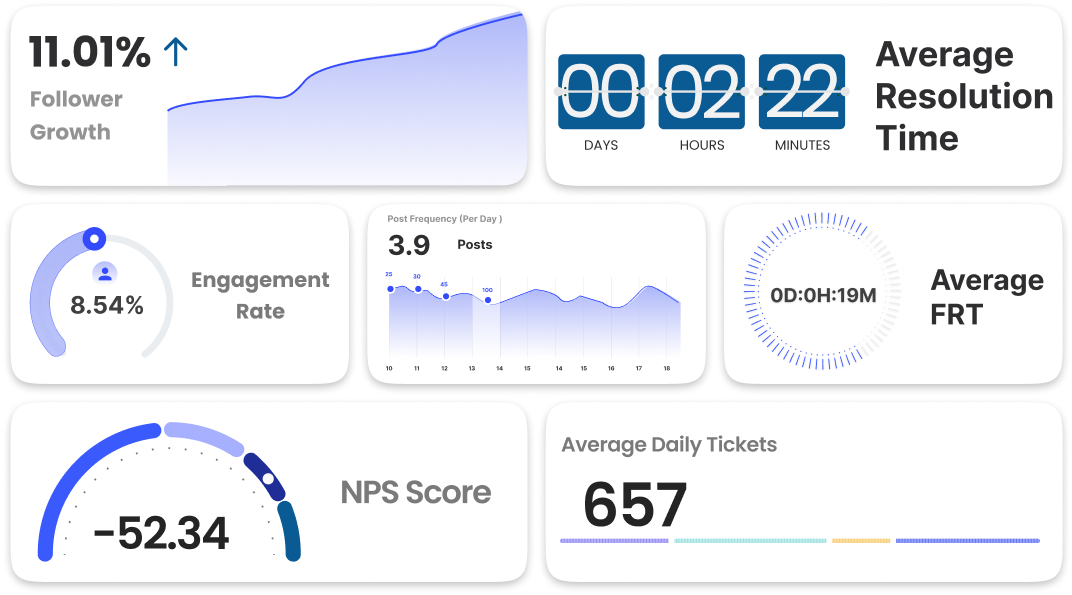
- Follower Growth: 11.01%
The OTT industry continues its steep digital ascent. With more users subscribing and following across social platforms, brands must be prepared to handle higher volumes of interaction—not just in content promotion but in real-time customer support. - Engagement Rate: 8.54%
Strong engagement underscores audience interest in show announcements, trailers, cast interactions, and meme-worthy moments. However, rising engagement also acts as a double-edged sword—exposing service issues, pricing dissatisfaction, and content criticisms in equal measure. - Post Frequency: 3.90 per day
A high publishing cadence keeps OTT brands top-of-mind. The opportunity here is to strike a balance between promotional posts and service-oriented communication that addresses user concerns (e.g., outage clarifications, subscription guides, and content navigation tips).
Customer Service Performance
- Average First Response Time (FRT): 19 minutes
Exceptionally fast. Most OTT platforms have mastered real-time triaging using automation, which sets a high industry benchmark for others. Maintaining this pace during peak traffic moments (e.g., premiere weekends or outages) will be crucial. - Average Resolution Time: 2 hours, 22 minutes
A stellar resolution time, especially considering the scale. However, resolving quickly is not always equivalent to resolving well. Negative sentiment suggests that many users still leave these interactions unsatisfied. - Net Promoter Score (NPS): -52.34
A deeply concerning figure. While users flock to OTT platforms for entertainment, loyalty suffers due to pricing confusion, poor content recommendations, login or playback issues, and generic support responses. The emotional connection is shallow, and frustration escalates quickly. - Average Daily Tickets: 657
A high volume reflective of the low barrier to customer outreach. Platforms must not only scale efficiently but ensure that responses are empathetic and personalized—not just fast.
Strategic Recommendations for May 2025
- Rebuild Trust Through Personalization
Negative NPS often stems from users feeling unheard or underserved. Start by refining content recommendation algorithms, offering more control over profiles and billing, and personalizing support interactions beyond templated replies. - Use Social Listening to Pre-Empt Escalations
Customer complaints rarely start as tickets. By proactively monitoring social buzz around playback glitches, price hikes, or unpopular UI changes, platforms can get ahead of discontent and win back goodwill. - Balance Automation With Human Touch
While response speed is a win, low NPS suggests a disconnect. Introduce hybrid resolution flows—use bots for basics but escalate billing, access, and account complaints to trained agents. - Invest in Clearer Communication
Many users are confused by pricing tiers, trial cut-offs, and regional availability of content. Clear in-app guides, billing breakdowns, and proactive notifications can resolve friction before it becomes anger.
Looking Ahead to May 2025
The OTT industry doesn’t lack attention—it commands it. But attention isn’t loyalty. CX leaders in this space must move beyond vanity metrics and focus on delivering consistent, transparent, and emotionally intelligent service. Because in a world where switching platforms takes seconds, experience is the only long-term differentiator.
Manufacturing Industry Monthly CXM Report: October 2025

October’s benchmarks paint a picture of a steady, well-regarded manufacturing sector that continues to maintain customer trust despite slower service timelines. The industry recorded a positive NPS of 33.28%, signaling strong satisfaction with product quality and issue resolution. However, while customers trust the outcomes, they’re waiting too long to get them—FRT averages 14.5 hours, and resolutions stretch close to 22 hours on average.
With follower growth at 1.57% and engagement at 3.70%, brands are maintaining a consistent digital footprint, even if conversations remain primarily functional. The key opportunity for manufacturers lies in improving responsiveness to match their reputation for reliability—closing the communication gap without compromising precision or professionalism.
KPI Snapshot
KPI | Value |
Follower Growth | 1.57% |
Engagement Rate | 3.70% |
Post Frequency (per day) | 2.16 |
First Response Time (FRT) | 14 hours, 32 minutes |
Average Resolution Time | 21 hours, 58 minutes |
Net Promoter Score (NPS) | 33.28% |
Average Daily Tickets | 89 |
CXM Diagnosis: What the Data Tells Us
The positive NPS confirms that customers appreciate the dependability and technical competence that manufacturing brands deliver. However, response and resolution timelines are dragging overall experience scores down. For an industry with only 89 daily tickets, these delays reflect internal inefficiencies rather than overwhelming volume.
The 3.70% engagement rate suggests that customer interaction is more service-oriented than conversational—stakeholders engage primarily for updates, inquiries, or support rather than content-driven engagement. The challenge ahead is not visibility but agility—how quickly brands can reassure customers while maintaining the rigor required in a technical industry.
What’s Driving Customer Frustration or Sentiment
- Long acknowledgment delays for urgent technical or service issues.
- Bottlenecks in resolving supply chain or delivery-related concerns.
- Perceived lack of proactive communication during disruptions.
- Complex escalation for warranty or after-sales support.
- Positive: customers praise transparency in service communication and product reliability when issues are addressed.
CX Priorities for November
- Accelerate FRT: Bring acknowledgment down from 12+ hours to under 3 hours to reassure partners quickly.
- Shorten resolution cycles: Aim for sub-12-hour resolutions by streamlining internal workflows.
- Strengthen proactive updates: Provide real-time alerts on delays, disruptions, or service changes.
- Empower frontline teams: Equip service agents with authority and tools to resolve without multiple handoffs.
- Leverage strong NPS: Turn satisfied customers into advocates by highlighting testimonials and case studies.
Final Word
In manufacturing, reliability is reputation. September’s benchmarks reveal a sector with strong customer trust but lagging responsiveness. The opportunity now is to match positive sentiment with faster, more proactive service. Those who close the speed gap will not only protect trust but also strengthen their role as indispensable partners in the value chain.3.70%
