 Skip to content
Automobile Industry Monthly CXM Report: August 2025

August 2025 reaffirmed a pattern we’ve been watching all year in the automotive industry: high engagement, decent responsiveness, but still a struggle to convert CX efforts into stronger loyalty. With over 500 daily support tickets and a rapidly growing digital audience, automotive brands are clearly in the spotlight—but the NPS shows that trust is still being earned, not assumed.
KPI Snapshot
KPI | Value |
Follower Growth | 1.69% |
Engagement Rate | 28.75% |
Post Frequency (per day) | 4.43 |
First Response Time (FRT) | 6 hours, 44 minutes |
Average Resolution Time | 13 hours, 13 minutes |
Net Promoter Score (NPS) | 10.74% |
Average Daily Tickets | 505 |
CXM Diagnosis: What the Data Tells Us
Engagement is strong—but trust is lagging.
An engagement rate close to 29% confirms that automotive content is resonating. Whether it’s EV innovation, design drops, or ownership stories—audiences are leaning in. But the NPS of 10.74% suggests that while people love the brand moment, the brand experience still needs work.
Response and resolution times are steady, but not industry-leading.
Responding within 7 hours and resolving within half a day is solid—but in a space where service complaints, delivery delays, and post-sale issues are time-sensitive, the bar is higher. Automotive brands must continue to optimize case routing and agent enablement.
Support volume is growing.
505 daily tickets mean CX teams are under consistent pressure. This isn’t a volume spike—it’s the new baseline. That signals a growing digital user base, but also underscores the need to scale support without burning out agents or letting quality drop.
CX Signals from August
- Warranty and service center friction continues to drive negative sentiment.
- EV-related inquiries—especially around charging and battery performance—are climbing steadily.
- Brands using live video consults and digital test drive booking systems are seeing stronger CSAT scores.
CX Priorities for September
- Upgrade post-sale experience visibility
Customers want more transparency—on vehicle delivery timelines, service ticket status, or warranty eligibility. Build this into your CX stack. - Capture the EV curiosity loop
Leverage engagement into education. FAQs aren’t enough. Build CX content pipelines around EV myths, charging network updates, and peer comparisons. - Arm support teams with better tools
If your agents are switching between CRMs, spreadsheets, and service databases—stop. Unify views. Context switching is killing productivity and consistency. - Close the loop on complaints
Resolution is not the same as closure. Implement callback or follow-up mechanisms, especially on high-friction issues. Let the customer know they’ve been heard and remembered.
Final Word
The automotive industry continues to command attention—but attention doesn’t equal affection. The numbers in August reflect a sector in transition: more digital-savvy customers, higher expectations, and a growing volume of complex support requests. September is your chance to connect the dots between visibility and value—where smart CX can convert followers into loyal owners.

Fast-Moving Consumer Goods (FMCG) Beverage Industry Monthly CXM Report: August 2025

Despite being one of the most volume-driven sectors, August’s CX metrics for FMCG brands raise a serious red flag: speed and satisfaction are clearly misaligned. While customer engagement is strong, delays in response and resolution are undermining brand trust. For an industry that runs on instant gratification—whether through a tweet, a return, or a product query—slow support is a reputational risk.
KPI Snapshot
KPI | Value |
Follower Growth | 1.08% |
Engagement Rate | 8.17% |
Post Frequency (per day) | 3.60 |
First Response Time (FRT) | 13 hours, 51 minutes |
Average Resolution Time | 2 days, 1 hour, 50 minutes |
Net Promoter Score (NPS) | -23.7% |
Average Daily Tickets | 431 |
CXM Diagnosis: What the Data Tells Us
Engagement is healthy, but brand sentiment is deteriorating.
An 8.17% engagement rate means customers are interacting with content—asking questions, tagging friends, and sharing feedback. But a deeply negative NPS of -23.7% confirms what many consumers feel: their voices aren’t being heard in time.
Response and resolution delays are dragging CX down.
Taking over 13 hours to respond and more than 2 full days to close a ticket is unsustainable for an industry that often deals with perishable products, order errors, and promotional campaigns with tight timelines. These lags frustrate customers and hurt brand reliability.
Ticket volume is high, but not unmanageable.
431 daily tickets may seem like a lot, but for large-scale FMCG brands with modern CX platforms, this is within range—if triaging, automation, and agent workflows are optimized. Most issues can be categorized and resolved quickly with the right tools.
CX Signals from August
- A sharp spike in support tickets came from campaign-driven product rollouts and inventory miscommunication across D2C platforms.
- Complaints around missing delivery information, damaged packaging, and unfulfilled cashback offers were common across social and email channels.
- The few brands that saw positive sentiment spikes offered 1-click self-resolution options via WhatsApp and web chat, drastically reducing customer frustration.
CX Priorities for September
- Automate the obvious
Set up auto-responses and guided workflows for repetitive queries like order tracking, return eligibility, and product availability. - Reduce dependency on manual case closures
Implement tiered escalation—where high-friction issues (e.g., payment problems) go to live agents, and lower ones (e.g., promo codes) are handled via bots. - Rethink how you handle campaigns
Before launching a new product or festival sale, preempt ticket surges. Draft FAQ pages, train bots on expected queries, and buffer for volume. - Track post-resolution feedback
Don’t stop at ticket closure. Ask customers if they’re satisfied. This extra touchpoint often surfaces silent dissatisfaction that NPS doesn’t catch in real time.
Final Word
FMCG brands don’t lack visibility—but many lack CX agility. If August proved anything, it’s that even loyal customers lose patience when support lags behind product promise. The brands that streamline support, offer faster paths to resolution, and respect the customer’s time will reclaim trust. In this industry, the clock is always ticking.

Airlines Industry Monthly CXM Report: August 2025

August 2025 brought another round of turbulence for airline CX teams—not from the skies, but from the support desk. With travel volumes stabilizing post-summer, customer expectations have shifted from flexibility to precision. This month’s CX metrics show airlines making progress in responsiveness but still struggling to translate that into satisfaction.
KPI Snapshot
KPI | Value |
Follower Growth | 1.11% |
Engagement Rate | 12.3% |
Post Frequency (per day) | 3.25 |
First Response Time (FRT) | 1 hour, 29 minutes |
Average Resolution Time | 16 hours, 20 minutes |
Net Promoter Score (NPS) | -59.2% |
Average Daily Tickets | 393 |
CXM Diagnosis: What the Data Tells Us
Response time is sharp.
Airlines are responding in under 90 minutes on average, which is commendable given the complexity of support requests. This speed, especially on digital channels like X (formerly Twitter), has helped brands reduce immediate anxiety during travel disruptions.
Resolution time is improving, but still not fast enough.
It’s one thing to say “we hear you”—it’s another to actually solve the issue. While 16 hours is better than previous months, in this industry, time sensitivity is everything. Customers stranded at an airport, needing rebooking or reimbursement, don’t have the luxury to wait overnight.
NPS is deep in the red.
At -59.2%, the sentiment signals frustration across the board. What’s important to note: high engagement (12.3%) suggests customers are reaching out, tagging, posting, and commenting—but not walking away happy.
CX Signals from August
- Rebooking issues and refund delays continued to dominate ticket themes.
- Frustration with chatbots remains a key negative driver, especially when escalation paths are unclear.
- Brands that offered proactive delay compensation or SMS alerts saw better short-term sentiment spikes.
CX Priorities for September
- Reduce dependency on siloed systems
Support teams often lack real-time visibility into ticket status, flight movement, or refund processing. Bridging these gaps—either via integrations or AI-assisted views—should be a top priority. - Reinforce escalation clarity
If a chatbot or agent can’t help, the handoff should be seamless—not a black hole. Invest in better internal routing logic and escalation visibility for customers. - Preempt, don’t just react
Use historical data to anticipate peak disruption hours or routes with high ticket loads. Trigger proactive messages based on delays, weather, or staffing shortages. - Rethink recovery moments
A delayed flight may be unavoidable, but the follow-up is where CX wins are made. Surprise upgrades, dining vouchers, or even well-timed empathy go a long way.
Final Word
The airline industry is getting faster at responding, but not necessarily better at resolving. Customers aren’t just judging the wait time—they’re judging how they feel after it. August’s numbers are a reminder that speed is half the equation; ownership and empathy are the rest. September should be about recovery—not just of flights, but of trust.

EdTech Industry Monthly CXM Report: August 2025

August was another dynamic month for EdTech, driven by back-to-school cycles, hybrid learning trends, and rising expectations from both learners and parents. The data suggests EdTech brands are engaging well and growing their digital presence—but operationally, there’s still a gap between fast response and complete resolution. In a space where educational outcomes depend on product stability and user confidence, even small CX lags can break trust.
KPI Snapshot
KPI | Value |
Follower Growth | 4.12% |
Engagement Rate | 45.7% |
Post Frequency (per day) | 2.4 |
First Response Time (FRT) | 4 hours, 39 minutes |
Average Resolution Time | 1 day, 2 hours, 25 minutes |
Net Promoter Score (NPS) | 16.36% |
Average Daily Tickets | 150 |
CXM Diagnosis: What the Data Tells Us
Strong engagement, strong interest.
A 45.7% engagement rate tells us learners, educators, and parents are interacting heavily with EdTech content. Whether it’s feature updates, webinars, or career guidance tips, EdTech platforms are becoming more than just tools—they’re becoming ecosystems.
Digital growth is steady.
A 4.12% follower growth rate reinforces that the sector is still attracting new eyes. As education remains a priority—even in shifting economic conditions—brands that balance knowledge delivery with learner-centric support will continue to gain traction.
Support starts well, but drops off.
A first response within 5 hours is reasonable. However, the 1+ day resolution time is too long in an industry where product glitches, access issues, or billing concerns can directly derail learning schedules. Parents and students don’t just want answers—they need assurance that problems will be fixed in time for the next class or submission.
NPS shows satisfaction, but not advocacy.
An NPS of 16.36% isn’t negative, but it’s not stellar either. Users are content—but not yet loyal. This middle ground is where EdTech firms either build community or lose momentum. The key is moving from satisfactory service to delightful outcomes.
CX Themes & Friction Points
- Login/access issues at scale during enrollment periods or live class spikes
- Support delays on certification queries, causing anxiety for career-oriented learners
- Low visibility on refund/upgrade policies, especially for annual vs. monthly plans
- Parental escalation on learning quality, not just technical issues
CX Priorities for September
- Tighten Resolution Loops
If the first reply is prompt, but issues linger, customers feel abandoned. Empower agents with context, scripted playbooks for common issues, and the authority to resolve without over-escalation. - Scale Personalized Help for High-Intent Users
Students facing exam deadlines, instructors onboarding full classes, or parents comparing plans should not receive generic support. Flag them early and create high-touch workflows. - Educate Through CX
Use automated responses, chat widgets, and help centers not just to solve problems, but to teach—how to use a new dashboard, how to troubleshoot audio, how to unlock certificates. - Build for Community, Not Just Conversions
The highest-performing EdTech brands don’t just deliver classes—they build learning tribes. Embed community support, peer-led discussion forums, and real learner stories into your CX model.
Final Word
Education is personal, emotional, and increasingly digital. Every CX misstep—delayed support, vague policies, generic replies—doesn’t just frustrate; it disrupts growth journeys. As we head into the academic peak of September, EdTech firms must recognize that great service isn’t a support function—it’s a foundational part of the learning experience.

Apparel Industry Monthly CXM Report: August 2025

The apparel sector continues to struggle with closing the loop between social engagement and service delivery. While content pipelines remain active and community size is stable, the lack of agility in support is starting to show in sentiment. For fashion and lifestyle brands that depend on repeat customers and trend-driven spikes, even minor CX lapses can quickly become retention risks.
KPI Snapshot
KPI | Value |
Follower Growth | 0.91% |
Engagement Rate | 2.46% |
Post Frequency (per day) | 2.31 |
First Response Time (FRT) | 10 hours, 2 minutes |
Average Resolution Time | 10 hours, 56 minutes |
Net Promoter Score (NPS) | -2.69% |
Average Daily Tickets | 75 |
CXM Diagnosis: What the Data Tells Us
Engagement is lagging.
With only 2.46% engagement, it’s clear that content isn’t driving meaningful conversation or action. Visual posts and influencer-led drops alone won’t cut it. Consumers now expect interactivity, authenticity, and relevance—especially around launches, sizing, and style tips.
Support is slow and sentiment is slipping.
Resolution time has improved from previous months, but an FRT of 10 hours still doesn’t meet expectations for brands that cater to impulse-driven shopping behavior. A negative NPS (-2.69%) confirms that many customers are walking away from interactions unimpressed.
Ticket volume is manageable but not being maximized.
75 tickets a day is hardly overwhelming, which means there’s room to improve without heavy resourcing. This is an opportunity to turn reactive support into proactive brand-building touchpoints—especially post-sale.
What’s Driving Customer Complaints?
- Size and fit discrepancies
- Delayed deliveries during promotional campaigns
- Lack of real-time inventory visibility
- Confusing exchange/return workflows
- Delays in refunds and wallet credits
CX Priorities for September
- Inject Urgency into Support Responses
Fashion is fast—your CX has to match. Set up priority lanes for delivery-related queries and order changes. Even a one-hour delay in response during sales can cost you both revenue and trust. - Improve Product Context at Checkout
Sizing guides, fit reviews, fabric details, and model photos can reduce return-related tickets by 20–30%. Make this content easier to access before and after purchase. - Close the Loop on Returns
Turn a return into a recovery. Follow up personally when a customer returns an item—recommend alternatives or offer instant credits that nudge them back to purchase. - Experiment with CX-Driven Loyalty Nudges
Low NPS doesn’t always mean lost customers. Use smart segmentation to target dissatisfied buyers with surprise vouchers, styling tips, or early access to new drops.
Final Word
Fashion brands can no longer treat CX as a back-office function. It’s the only channel that talks to every customer—before, during, and after the sale. This month’s performance suggests the apparel industry needs to listen harder and act faster. In September, the winners will be those who bring style to service—balancing trendiness with reliability, and aesthetics with accountability.

Consumer Packaged Goods (CPG) Industry Monthly CXM Report: August 2025

For a sector rooted in everyday essentials, the CPG industry’s August 2025 CX metrics tell a story of missed opportunities. While engagement remained solid and follower growth stayed positive, customer satisfaction took a sharp hit. An NPS of -6.06% suggests that brand trust is eroding, largely due to slow response and resolution cycles—despite relatively low ticket volumes.
KPI Snapshot
KPI | Value |
Follower Growth | 1.23% |
Engagement Rate | 11.45% |
Post Frequency (per day) | 2.12 |
First Response Time (FRT) | 14 hours, 59 minutes |
Average Resolution Time | 3 days, 0 hours, 46 minutes |
Net Promoter Score (NPS) | -6.06% |
Average Daily Tickets | 31 |
CXM Diagnosis: What the Data Tells Us
Engagement is outpacing experience.
CPG brands are drawing audiences in—an 11.45% engagement rate is strong for a category where purchase cycles are short and loyalty is fragile. But this attention is being undermined by sluggish CX execution. Customers are showing up, but they’re not being met with the service they expect.
Response delays are dragging sentiment down.
A first response time of nearly 15 hours and a resolution time exceeding 3 days are well outside consumer expectations—especially for time-sensitive issues like damaged goods, delayed deliveries, or order errors.
Low ticket volume, high customer cost.
Just 31 daily tickets on average means the workload is light. But the damage from a single bad experience—particularly when shared publicly—is disproportionately high. In a space where switching costs are low, slow service becomes a brand risk.
CX Signals from August
- Many customer complaints centered around missing deliveries, broken packaging, and long replacement cycles.
- Brands that offered quick responses via WhatsApp or Instagram DMs stood out for handling issues swiftly and informally.
- Lack of proactive updates on replacements or refunds was a common frustration point.
CX Priorities for September
- Collapse the resolution window
Three-day issue resolution is unsustainable for this category. Brands need to deploy AI-driven ticket sorting, auto-responses for common queries, and tighter SLAs for logistics-related complaints. - Set clear expectations from the start
Too often, frustration stems not from delay—but from silence. If a resolution will take time, communicate that upfront and follow up proactively. Silence erodes trust. - Embrace quick-fire channels
Platforms like Instagram Stories, WhatsApp, and even SMS are ideal for real-time customer recovery. If most tickets are simple status updates or minor escalations, these channels can dramatically improve response satisfaction. - Use CX data to refine product and packaging ops
Recurring tickets about leakage, breakage, or wrong SKUs should not only be resolved—but flagged upstream to product and supply teams. Prevention is the best CX strategy.
Final Word
The CPG space is saturated. Products are replaceable. But experiences are remembered. In August, customers were clearly willing to engage—but many walked away disappointed. Brands that respond faster, communicate clearly, and turn everyday problems into moments of care will be the ones that thrive.

Real Estate Industry Monthly CXM Report: August 2025

August’s CX numbers for the real estate sector suggest a familiar challenge: high engagement, but slow execution. With home buyers, tenants, and investors interacting more frequently online, digital conversations are becoming a core part of property experiences. This month’s CX performance shows promise—especially with a decent NPS and strong engagement—but there’s work to be done on the service side.
KPI Snapshot
KPI | Value |
Follower Growth | 1.70% |
Engagement Rate | 8.66% |
Post Frequency (per day) | 2.27 |
First Response Time (FRT) | 8 hours, 45 minutes |
Average Resolution Time | 1 day, 5 hours, 4 minutes |
Net Promoter Score (NPS) | 15.84% |
Average Daily Tickets | 36 |
CXM Diagnosis: What the Data Tells Us
People are paying attention—but they’re not getting answers quickly.
An 8.66% engagement rate is well above average for real estate, indicating active interest in listings, content, and brand presence. However, a response time close to 9 hours and resolution cycles exceeding a full day may be costing brands high-intent leads.
Positive sentiment exists—but it’s not yet strong enough to build advocacy.
An NPS of 15.84% signals that most customers are satisfied—but not delighted. In a market where trust and clarity are everything, response delays and lack of transparency are likely holding back stronger loyalty.
Low ticket volume is a missed opportunity for personalization.
With just 36 daily tickets on average, real estate brands have the bandwidth to go beyond support and into consultative service. Every customer query—whether about property specs, pricing, or legal documents—is a chance to build credibility.
CX Signals from August
- Common tickets included incomplete listing details, delayed call-backs from agents, and confusion around payment terms.
- Brands that stood out used automated email flows to guide buyers post-inquiry, reducing drop-offs and no-shows.
- Frustrations often stemmed from being bounced between departments (e.g., marketing, sales, legal) without context carryover.
CX Priorities for September
- Tighten response workflows
Set up response-time SLAs and automated acknowledgments for common queries. Buyers expect acknowledgment within minutes, not hours—especially for high-value properties. - Reduce friction in resolution journeys
Assign clear ownership to post-inquiry issues. Customers shouldn’t have to re-explain their situation to three different people. A unified ticketing and CRM system can resolve this. - Layer in proactive nudges
Use behavioral triggers to send contextual follow-ups: virtual tour invites, availability updates, or price drops. These not only inform—but engage. - Train agents in digital CX
Many real estate teams are still optimized for offline sales. Investing in digital-first training for agents and support staff will ensure tone, clarity, and responsiveness align with modern buyer expectations.
Final Word
In real estate, time kills deals—but so does a disjointed digital experience. The brands that win in this space won’t just be the ones with the best listings—they’ll be the ones that respond faster, resolve smarter, and turn every conversation into conversion. August gave us the signals. September needs action.

Hospitality Industry Monthly CXM Report: August 2025

August brought a mix of sun-seeking travelers, event-driven bookings, and last-minute vacationers—and with them, a fresh wave of expectations. The hospitality industry had to juggle personalized experiences with operational agility. The good news? Many brands are holding their ground on responsiveness and customer sentiment. But there’s still work to be done in scaling that excellence across every interaction.
KPI Snapshot
KPI | Value |
Follower Growth | 1.54% |
Engagement Rate | 13.9% |
Post Frequency (per day) | 1.84 |
First Response Time (FRT) | 3 hours, 27 minutes |
Average Resolution Time | 10 hours, 12 minutes |
Net Promoter Score (NPS) | 51.64% |
Average Daily Tickets | 27 |
CXM Diagnosis: What the Data Tells Us
Positive sentiment is strong—and well earned.
An NPS of 51.64% signals that customers are walking away satisfied, if not delighted. Whether it’s a seamless check-in, a timely response to a room service query, or clarity around cancellation policies, guests are feeling supported.
Response times are competitive, but there’s room to personalize.
A 3.5-hour first response is commendable for an industry handling high-touch, varied requests across platforms. But the true differentiator isn’t just speed—it’s hospitality. Generic responses don’t cut it. The more tailored and conversational the reply, the better.
Engagement is healthy—community-building is working.
At 13.9%, the engagement rate reflects well-crafted content that resonates with followers. Guest reviews, destination guides, and behind-the-scenes content continue to drive interaction. Brands should keep leaning into lifestyle content while experimenting with more guest-led storytelling.
CX Signals from August
- Guests praised prompt responses for booking-related queries, especially during long weekends.
- Frustrations emerged around automated replies that didn’t address specific needs—especially for loyalty program members and repeat customers.
- Local experience content (restaurant guides, event partnerships) drove stronger engagement than promotional posts.
CX Priorities for September
- Deepen Personalization
Use guest history, preferences, and context to move beyond templated responses. A returning guest asking about a late checkout deserves more than a canned message—they expect to feel remembered. - Empower Frontline Teams with Empathy Playbooks
Quick replies matter, but hospitality is built on how you make people feel. Create response guides that prioritize tone and warmth, especially for escalations. - Use Feedback Loops Wisely
Don’t just collect feedback—show guests how you’re using it. “We’ve added more vegetarian options based on your reviews” builds loyalty better than a generic “Thanks for your input” ever could. - Spotlight Service Recovery Stories
Feature moments where staff went above and beyond—late-night surprises, unexpected upgrades, or handwritten notes. These stories make the brand human and raise the bar internally.
Final Word
Hospitality isn’t just about clean sheets or fast check-ins—it’s about being present in the moments that matter. In August, the industry showed promising responsiveness and guest satisfaction. Now, it’s time to scale emotional intelligence, not just efficiency. Because memorable experiences don’t come from a quick reply—they come from feeling seen.

Telecommunications (Telecom) Industry Monthly CXM Report: August 2025

Telco brands are no strangers to high expectations. Whether it’s signal outages, billing disputes, or device compatibility issues—every customer interaction is time-sensitive and emotionally charged. The August data shows that while many brands are moving faster, they’re still falling short on experience. Resolution gaps and stagnant sentiment continue to erode trust.
KPI Snapshot
KPI | Value |
Follower Growth | 2.09% |
Engagement Rate | 7.09% |
Post Frequency (per day) | 3.52 |
First Response Time (FRT) | 3 hours, 9 minutes |
Average Resolution Time | 15 hours, 56 minutes |
Net Promoter Score (NPS) | -17.91% |
Average Daily Tickets | 179 |
CXM Diagnosis: What the Data Tells Us
Response speed is solid. Resolution isn’t.
An average first response time of just over 3 hours suggests that frontline support teams are engaging customers promptly. But nearly 16 hours to resolve basic queries in a utilities-driven industry is too long—especially when customers expect self-serve options and instant clarity.
Engagement is fair, but mostly reactive.
With a 7.09% engagement rate, telcos are doing well to attract interaction. The problem is that much of this engagement is driven by complaints, escalations, or clarification needs—not curiosity or connection. The conversation is happening, but it’s not always productive.
Sentiment remains negative.
A Net Promoter Score of -17.91% continues the trend we’ve seen all year. Even though the volume of tickets (179/day) is manageable compared to industries like gaming or airlines, the quality of resolution—and the perception of care—still isn’t hitting the mark.
What’s Frustrating Customers
- Bill shock and surprise data charges
- Network coverage inconsistencies
- Complicated international roaming plans
- Delays in porting or device upgrades
- Lack of clarity around bundled offers
CX Priorities for September
- Build Smarter Self-Service Paths
Many telco issues—like data usage, plan comparisons, or outage updates—can be addressed without human intervention. Interactive voice responses, app-based bots, and USSD flows need a usability upgrade to take the load off agents. - Contextualize the Conversation
Equip agents with previous ticket history, product details, and network status dashboards to avoid repetitive questioning. Personalization in telecom support isn’t a luxury—it’s a necessity. - Get Proactive With Problem Areas
If you know a region is experiencing a network issue, inform users before they complain. Push outage alerts, ETA updates, and real-time compensation offers. Reduce frustration by acknowledging the issue before it escalates. - Rethink the NPS Follow-Up Journey
When someone gives a low score, what happens next? Build workflows that auto-trigger re-engagement: a callback, a personalized discount, or a quick survey to better understand their dissatisfaction.
Final Word
Telecom is a utility, but customer experience shouldn’t feel transactional. This month’s metrics show that the core systems are stable—but empathy, clarity, and resolution intelligence are where most brands are losing ground. Telcos that reframe CX from “react and resolve” to “predict and preempt” will lead the charge into September and beyond.

Electronics Industry Monthly CXM Report: August 2025

The electronics accessories sector continues to straddle a difficult line between high-volume demand and low-margin, high-expectation support. In August 2025, the numbers tell a familiar story: customers are buying, asking, and engaging—but too often, they’re walking away disappointed. With more brands entering the D2C space and consumer attention splintered across platforms, delivering fast, contextual, and empathetic support has become a differentiator—one most brands are still chasing.
KPI Snapshot
KPI | Value |
Follower Growth | 1.25% |
Engagement Rate | 2.72% |
Post Frequency (per day) | 3.39 |
First Response Time (FRT) | 17 hours, 16 minutes |
Average Resolution Time | 21 hours, 36 minutes |
Net Promoter Score (NPS) | -10.11% |
Average Daily Tickets | 229 |
CXM Diagnosis: What the Data Tells Us
Growth is slow—but steady.
Follower growth sits at a modest 1.25%. Brands are building their digital presence, but without the virality of flashier consumer sectors. To grow faster, they’ll need to evolve their voice—from product spec sheets to content that entertains, educates, and solves real customer problems.
Support is slow, and it shows.
A first response time of over 17 hours, combined with a resolution time nearing 22 hours, is too sluggish for an industry where most tickets are related to order issues, compatibility confusion, or post-purchase doubts. These are friction points that can erode trust fast—especially if the item is a gift, urgent need, or part of a larger tech setup.
Customer satisfaction is firmly in the red.
An NPS of -10.11% is a warning sign. Customers aren’t just passive buyers—they’re vocal about their frustrations. Whether it’s poor after-sales support, confusing return policies, or missing documentation, electronic accessories brands need to tighten the loop between support and fulfillment.
CX Trends We’re Seeing
- Spike in “Where is my order?” tickets from marketplaces and brand websites, especially during new launches and discount events.
- Lack of proactive care—most issues are escalated by customers, not preempted by the brand.
- Low engagement across social—product announcements and sale banners dominate feeds, but receive little interaction unless they’re tied to influencers or giveaways.
CX Priorities for September
- Build a Support Engine for Speed and Scale
Automated order tracking updates, live chat with product guidance, and AI-assisted triaging for returns/refunds can drastically bring down support wait times. - Don’t Just Sell, Educate
Use content to answer common questions before they become tickets. Compatibility charts, quick setup videos, and “how to choose the right accessory” guides can reduce friction. - Invest in Post-Purchase Experience
Support doesn’t end at delivery. Ask for feedback, suggest complementary products, and make returns/refunds painless. The smoother this phase, the more likely customers are to return. - Humanize Where It Matters
Not every issue can be solved by a bot. Escalate to real people when customers express urgency or dissatisfaction. Delays are forgivable—silence isn’t.
Final Word
The accessory game is no longer about price or availability—it’s about ease. If customers have to jump through hoops for basic support, they’ll move on. The brands that turn transactional interactions into trust-building moments will not only reduce tickets—they’ll earn loyalty in a category where switching is easy, but remembering a great experience is hard to forget.

Gaming Industry Monthly CXM Report: August 2025

August 2025 highlighted a paradox within the gaming industry’s customer experience: engagement continues to thrive, but satisfaction is faltering. Players are active, vocal, and deeply invested—but their expectations around support are sharper than ever. For a category driven by real-time interaction and community loyalty, CX can no longer be just reactive—it needs to anticipate, scale, and respond with precision.
KPI Snapshot
KPI | Value |
Follower Growth | 1.70% |
Engagement Rate | 27.46% |
Post Frequency (per day) | 4.46 |
First Response Time (FRT) | 7 hours, 48 minutes |
Average Resolution Time | 6 hours, 37 minutes |
Net Promoter Score (NPS) | -2.77% |
Average Daily Tickets | 984 |
CXM Diagnosis: What the Data Tells Us
The community is active, but increasingly impatient.
An engagement rate of 27.46% proves the passion is alive—players are streaming, commenting, reviewing, and reporting bugs. Yet the dip in NPS into negative territory shows a subtle but growing discontent. The support experience isn’t matching the emotional investment players are putting into the game.
Response time is off pace for a real-time industry.
Waiting nearly 8 hours for a first response is a misstep in an environment where downtime, failed purchases, and bug exploits can spiral in minutes. Gamers are used to instant gratification, and even small lags feel like major failures.
Resolution is faster than response—and that’s rare.
A 6-hour, 37-minute resolution time is strong. But without timely acknowledgment, even a quick fix feels too late. Players want to know they’ve been heard, even if the issue will take time to solve.
CX Signals from August
- High ticket volumes were triggered by in-game bugs, delayed reward deliveries, and account access issues during patch rollouts.
- Several indie studios saw praise for community moderators who stepped in proactively on Discord and Reddit—even when formal support lagged.
- Sentiment dipped sharply in response to generic ticket replies and lack of visibility into fix timelines during server outages.
CX Priorities for September
- Acknowledge faster, even if you can’t resolve faster
Train bots or frontline agents to immediately tag and reassure players when a ticket is logged. The difference between being ignored and being acknowledged is everything. - Treat your support team like part of the game experience
Gamers don’t separate product and service. Build support personas, craft replies that speak the game’s language, and reward empathetic handling like you reward good UX. - Monitor sentiment across player communities, not just tickets
Discontent often festers outside your official support channels. Be active on Twitch chats, forums, and subreddit threads to stay ahead of issues before they flood your queue. - Build a crisis playbook for update days
Every patch or event release is a pressure test. Have pre-written responses, updated help docs, and real-time monitoring in place before you launch.
Final Word
The gaming space thrives on loyalty—but that loyalty is earned minute-by-minute. In August, players showed up. They played, engaged, and voiced their concerns. The question is: were you listening fast enough? In September, it’s not just about fixing bugs—it’s about fixing expectations.

Over-The-Top (OTT) Platform Industry Monthly CXM Report: April 2025
April 2025 showcased the paradox of digital entertainment: massive engagement, rapid growth, and yet a deepening challenge with customer sentiment. OTT platforms continue to dominate user attention spans, but delivering seamless, always-on experiences across millions of screens has never been more demanding. While operational metrics like response and resolution times are impressive, the low NPS reveals an urgent need for better customer experience design.
Digital Engagement and Growth Metrics
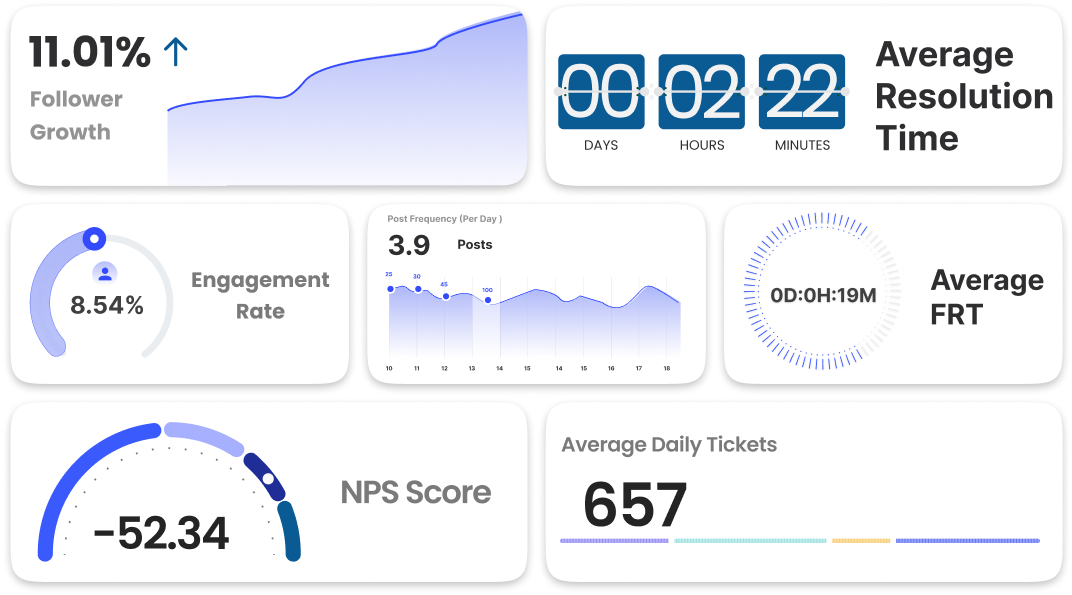
- Follower Growth: 11.01%
The OTT industry continues its steep digital ascent. With more users subscribing and following across social platforms, brands must be prepared to handle higher volumes of interaction—not just in content promotion but in real-time customer support. - Engagement Rate: 8.54%
Strong engagement underscores audience interest in show announcements, trailers, cast interactions, and meme-worthy moments. However, rising engagement also acts as a double-edged sword—exposing service issues, pricing dissatisfaction, and content criticisms in equal measure. - Post Frequency: 3.90 per day
A high publishing cadence keeps OTT brands top-of-mind. The opportunity here is to strike a balance between promotional posts and service-oriented communication that addresses user concerns (e.g., outage clarifications, subscription guides, and content navigation tips).
Customer Service Performance
- Average First Response Time (FRT): 19 minutes
Exceptionally fast. Most OTT platforms have mastered real-time triaging using automation, which sets a high industry benchmark for others. Maintaining this pace during peak traffic moments (e.g., premiere weekends or outages) will be crucial. - Average Resolution Time: 2 hours, 22 minutes
A stellar resolution time, especially considering the scale. However, resolving quickly is not always equivalent to resolving well. Negative sentiment suggests that many users still leave these interactions unsatisfied. - Net Promoter Score (NPS): -52.34
A deeply concerning figure. While users flock to OTT platforms for entertainment, loyalty suffers due to pricing confusion, poor content recommendations, login or playback issues, and generic support responses. The emotional connection is shallow, and frustration escalates quickly. - Average Daily Tickets: 657
A high volume reflective of the low barrier to customer outreach. Platforms must not only scale efficiently but ensure that responses are empathetic and personalized—not just fast.
Strategic Recommendations for May 2025
- Rebuild Trust Through Personalization
Negative NPS often stems from users feeling unheard or underserved. Start by refining content recommendation algorithms, offering more control over profiles and billing, and personalizing support interactions beyond templated replies. - Use Social Listening to Pre-Empt Escalations
Customer complaints rarely start as tickets. By proactively monitoring social buzz around playback glitches, price hikes, or unpopular UI changes, platforms can get ahead of discontent and win back goodwill. - Balance Automation With Human Touch
While response speed is a win, low NPS suggests a disconnect. Introduce hybrid resolution flows—use bots for basics but escalate billing, access, and account complaints to trained agents. - Invest in Clearer Communication
Many users are confused by pricing tiers, trial cut-offs, and regional availability of content. Clear in-app guides, billing breakdowns, and proactive notifications can resolve friction before it becomes anger.
Looking Ahead to May 2025
The OTT industry doesn’t lack attention—it commands it. But attention isn’t loyalty. CX leaders in this space must move beyond vanity metrics and focus on delivering consistent, transparent, and emotionally intelligent service. Because in a world where switching platforms takes seconds, experience is the only long-term differentiator.
Manufacturing Industry Monthly CXM Report: August 2025

Manufacturing brands—whether D2C innovators or legacy B2B players—often operate in the background of the customer experience conversation. But that’s changing. With more buyers expecting direct access, proactive updates, and responsive support, the pressure on manufacturing CX teams is growing. August’s performance shows steady progress, but also some friction that’s too familiar.
KPI Snapshot
KPI | Value |
Follower Growth | 1.79% |
Engagement Rate | 7.54% |
Post Frequency (per day) | 2.10 |
First Response Time (FRT) | 11 hours, 21 minutes |
Average Resolution Time | 23 hours, 54 minutes |
Net Promoter Score (NPS) | 18.35% |
Average Daily Tickets | 81 |
CXM Diagnosis: What the Data Tells Us
Responsiveness is sluggish—but recoverable.
Nearly 12 hours to respond and a full day to resolve may be acceptable for back-end technical queries, but it doesn’t meet the expectations of modern buyers—especially when product information, delivery timelines, or installation issues are involved. Faster coordination between teams is key.
Steady engagement from a niche audience.
With a 7.54% engagement rate and 1.79% follower growth, brands are holding attention—but only just. The challenge in manufacturing is always relevance. Generic content doesn’t cut it. Content has to be tailored to industry segments, use cases, or product evolution to generate impact.
Moderate satisfaction, but low advocacy.
An NPS of 18.35% shows customers are generally satisfied, but not enthusiastic. That lukewarm sentiment often comes from inconsistent communication, poor after-sales service, or unclear escalation paths. The goodwill is there—it’s just not being activated.
What’s Frustrating Customers
- Unclear installation instructions or delays
- Minimal updates on order status or production timelines
- Difficulty accessing post-sale service or warranty support
- Delays caused by coordination gaps between OEMs, suppliers, and delivery partners
- Confusing returns or service request processes
CX Priorities for September
- Tighten Post-Sale Service Coordination
Manufacturing brands must invest in smoother ticket routing between service teams, logistics partners, and regional support reps. A delay in parts shouldn’t translate to a delay in communication. - Make Product Support More Accessible
Interactive support centers, live chat with product experts, searchable troubleshooting libraries—these aren’t just for consumer tech. B2B buyers and industrial clients now expect the same ease of access. - Segment Content, Not Just Customers
Your buyer for a solar panel isn’t the same as your HVAC client. Develop vertical-specific messaging and support playbooks that speak directly to what each segment values. - Turn Passive Feedback Into Product Signals
With just 81 daily tickets, every conversation counts. Use sentiment mining and feedback tagging to identify recurring design or process flaws—and feed that insight back to R&D and product teams.
Final Word
Manufacturing CX is evolving—from reactive support to strategic differentiation. The brands that win won’t just respond faster; they’ll act smarter. By owning the full lifecycle—from inquiry to installation to issue resolution—manufacturers can move from functional to memorable, and from satisfactory to indispensable.
